
The Journey to Rochester
Anglo-Saxons Vs. Normans


After the win at Stamford Bridge, I was confident our militia was strong enough to take on the Duke of Normandy. Yet, here I lay in the wake of the Battle of Hastings, with regret, defeat, and anger in my heart. The battlefield drenched with the blood of 10,000 Anglo-Saxon and Norman men, King Godwinson among them. For a moment, I allow my mind to sink into darkness. Perhaps I should join my countrymen in death; perhaps it’s all my fault; perhaps William really is a conqueror. Soon after, my salvation arrives—a boy dressed in anxiety, clenching a piece of paper. With a soft voice, he asks if I'm Lieutenant Edmond. Reluctantly, I reply, “Yes,” and he hands me the letter.
To Lieutenant Edmond, or highest surviving rank:
I am quite devastated to hear of Harold Godwinson's death and the significant loss our country suffered in the Battle of Hastings. Despite the barbaric nature of both recent Norman and Viking attacks, London remains steadfast in its desire to keep our land and preserve our Anglo-Saxon ways. I write with great urgency and surety: if you hold off the Normans for just a few days, we will have enough men to beat them in London.
Sincerely,
Edgar Atheling.
The despair coursing through my veins has an antidote, and it's this letter—my only chance to press on. This is how I avenge my king. I will gather the Huscarl, round up the Fyrd, and call on the archers. I can do this. I can stop the Duke of Normandy from laying waste to London. Right away, I write a letter addressing the surviving Huscarl from Stamford Bridge stationed in London and send it with the messenger boy. It should take him less than a day to arrive and another day for them to meet us in Rochester—two days total.
From here, I start my own journey to Rochester. The streets are covered with ice, mud, and guts, but my mind's eye focuses on my divine goal. Every Fyrd, archer, and Huscarl I encounter along the way heed my cries of vengeance against the Norman invasion. I take this time during the journey to hatch my plan.
Duke William of Normandy has more men than we do—trained warriors, heavy cavalry, and many archers. I’m prepared to die, and the men are prepared to die, but pure bravery won't be enough. Holding off an army driven by envy and lust for power, with far superior numbers, will require every advantage exploited. Thankfully, I have a pretty good one. I know the countryside of Rochester like the back of my hand. I grew up there. Right now, the Normans march ahead of us toward London, so we will need to travel hastily to catch up with them. On their route, they march along a road passing by the River Medway in Rochester. At the most shallow point, there is a valley on each side of the river. The Normans will be marching atop the hill, and we, creeping up behind them, will travel undetected in the tree lines. In my letter to the Huscarl, I instructed them to wait for us on the other side of the river, in the valley, completely visible to William and his army.
My strategy is to drive the Normans into the valley and, with luck, into the river, but that’s going to take a level of trickery. Any good infantryman knows it's best to have the upper ground, and if we can establish our position, it will give us a great advantage. The men I march with will remain hidden in the tree lines on each side of the Normans. At this point, we are split into three groups: the men behind the tree line farthest from the river, the men behind the tree line closest to the river, and the Huscarl who traveled from London across the river. Archers will shoot from the tree lines closest to the river, thinning their herd and drawing the Normans into the valley after them. It’s not enough for the Normans to win battles; they must destroy us at any opportunity. Every chance to pursue us is a way for them to get a foothold in England. Some of our Huscarl and Fyrd will fight hard and at a disadvantage, sacrificing their lives to move the Normans down the hill and into the valley. As our troops become visible across the shallow river, William will be tricked into thinking that’s the whole of us. Meanwhile, the majority of those who marched with me are still hidden on the other side of the tree line, farthest from the river.
Once the bulk of their troops is moved down the hill, the rest of our archers will shoot their arrows from the top of the hill, as we gain the upper ground. When there are no more arrows left to shoot, the rest of the Fyrd, great in numbers, will emerge from the tree line. They’ll run the Normans down the hill and force many into the river crossing. When they cross the river, our Huscarl will be waiting to chop them down with swift swords. I believe we can hold this position for a significant amount of time, long enough for London to organize. Eventually, of course, the Normans will regain their wits and kill the vast majority of us, but this is a sacrifice we are all willing to make for the betterment of England and the preservation of Anglo-Saxon control.
As we reached Canterbury, I spread the message of our plan to the captains, and they relayed it to the men. These men are brave, but most of them have just lost a battle, are weak, and know they have a short time left to live. If we are to fight with the vigor needed to catch, trick, and hold the Normans, we’ll need to feel a greater passion than ever before. Men may hold a belief in their minds but cannot feel it in their hearts. They may know this is the only way but feel it’s not worth it. So I looked upon my men, and with a loud cry, I attempted to awaken their hearts.
“It was our kin who established the seven Anglo-Saxon kingdoms: Mercia, Essex, Kent, Sussex, Northumbria, East Anglia, and Wessex. It’s been us who have held these lands for six centuries and many more to come. One king and one battle lost doesn't forfeit our right to our home, our history, and our land. One bastard with boats isn’t enough to steal it all away from us. William is a man cloaked with envy and sin, jealous of a kingship that he never had a right to. Like a child, he throws a fit and marches on foreign land to steal a foreign crown. This is why Anglo-Saxons must stay in power and why we appointed an Anglo-Saxon king. The Vikings and Normans have established time and time again that their unsophisticated and dishonorable ways are unfit to rule our kingdom. So tonight we fight; we lay down our lives if we have to; we act as the stopgap for London. Because this is our land, our home, and our kingdom, and when history looks upon us, they will remember the great and honorable men who fought in the Medway Valley and halted the Norman invasion of England.”
I can only hope the men were stirred by my speech. With my own end drawing near, I can only hope I meant what I said. It’s just a few more miles to Rochester.
About the Creator
Stephanie Fineour
I’m new to writing and it brings me a lot of peace. Critical feedback encouraged.
Keep reading
More stories from Stephanie Fineour and writers in History and other communities.
Warning in the Woods
“There was only one rule: don’t open the door.” Suddenly, I tune back into the end of the most incredibly boring campfire story I've ever heard. At this moment, I decide I cannot stand another second of the “Camping Trip” with his friends. I turn to my husband and say, “I’m feeling a little dizzy; I think we should leave.” His disappointment is palpable as he growls, “The cars are a half-mile walk away; it’s dark, and if you're feeling dizzy, you should just go to sleep.”
By Stephanie Fineourabout a year ago in Horror
The Search for the Distant World
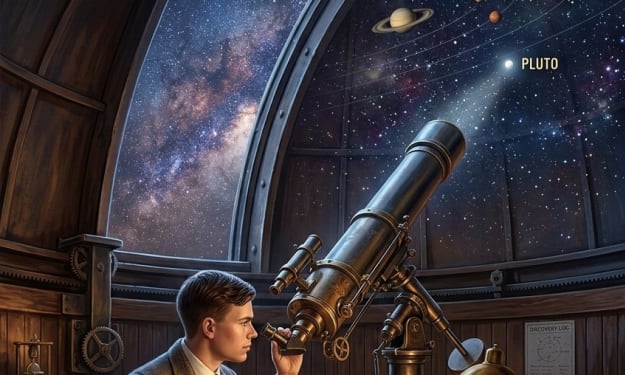
Long before powerful telescopes and modern space missions, astronomers spent countless nights studying the sky. They watched the stars carefully and recorded the movements of the planets. Each discovery helped scientists understand the vast universe a little better. Among the most fascinating discoveries in astronomy was the discovery of Pluto, a tiny and distant world at the edge of our Solar System. The story of Pluto’s discovery is not just about a planet. It is a story of curiosity, patience, and the determination of scientists who spent years searching for something that no one had ever seen before. The Mystery of Planet X In the early 1900s, astronomers believed there might be another planet beyond Neptune. They noticed that the orbits of Uranus and Neptune did not behave exactly as expected. Some scientists thought that the gravity of an unknown planet might be affecting their motion. One astronomer who became very interested in this mystery was Percival Lowell. Lowell believed strongly that a hidden planet existed far beyond Neptune. He called this mysterious world “Planet X.” To find it, Lowell built an observatory in Arizona known as the Lowell Observatory. From there, he and his team carefully studied photographs of the night sky. They searched for a small object that slowly moved among the stars. Unfortunately, Lowell died in 1916 before he could find the planet he was looking for. But the search did not end. A Young Man with a Dream Years later, a young farm boy named Clyde Tombaugh became interested in astronomy. Tombaugh lived in Kansas and did not have expensive scientific equipment. However, he loved building telescopes and observing the planets from his backyard. Tombaugh carefully drew detailed pictures of Mars and Jupiter using a homemade telescope. He sent these drawings to Lowell Observatory, hoping that professional astronomers might notice his work. The scientists at Lowell Observatory were impressed by his careful observations. In 1929, they invited Tombaugh to work at the observatory and continue the search for the mysterious Planet X. For Tombaugh, it was the opportunity of a lifetime. The Difficult Search The search for Planet X was extremely challenging. The distant planet would appear very small and faint in photographs of the sky. It would look almost exactly like a star. To find it, Tombaugh used a special machine called a blink comparator. This device allowed him to compare two photographs of the same part of the sky taken several days apart. When he looked through the machine, the images switched back and forth quickly. Most stars stayed in the same place. But if an object moved slightly between the two photographs, it would appear to jump back and forth. That movement could reveal a planet. Night after night, Tombaugh studied thousands of star images. The work required incredible patience and concentration. Sometimes he spent hours searching through photographs without finding anything unusual. But he never gave up. The Moment of Discovery On February 18, 1930, Tombaugh was examining photographs taken in January of that year. While comparing two images, he noticed a tiny dot that moved slightly from one position to another. At first, he looked again carefully to make sure it was not a mistake or a flaw in the photograph. But the tiny object had definitely moved. This meant it was not a star—it was something within our Solar System. After additional observations confirmed the movement, the scientists at Lowell Observatory realized that Tombaugh had discovered the long-sought Planet X. The discovery was officially announced on March 13, 1930. Astronomers around the world celebrated the discovery of a new planet beyond Neptune. It was one of the most exciting astronomical discoveries of the 20th century. Naming the New World After the discovery was announced, people from many countries suggested names for the new planet. The final name came from an 11-year-old girl in England named Venetia Burney. She suggested the name Pluto, after the Roman god of the underworld. The name seemed perfect because the planet was dark, distant, and hidden in the far reaches of the Solar System. Astronomers liked the name for another reason. The first two letters, P and L, were also the initials of Percival Lowell, the astronomer who had first searched for Planet X. Soon, the International Astronomical Union officially approved the name Pluto. A Planet That Changed Our Understanding For many decades, Pluto was known as the ninth planet of the Solar System. It became a symbol of exploration and curiosity about the outer regions of space. However, as technology improved, astronomers discovered many other icy objects beyond Neptune in a region called the Kuiper Belt. Scientists realized that Pluto was part of this large population of distant objects. Because of this, in 2006 the International Astronomical Union reclassified Pluto as a dwarf planet instead of a full planet. Although this decision surprised many people, Pluto remains one of the most fascinating worlds in our Solar System. Exploring Pluto In 2015, the spacecraft New Horizons flew past Pluto and sent back the first close-up images of the distant world. Scientists were amazed by what they saw. Pluto has mountains made of ice, vast frozen plains, and a giant heart-shaped region on its surface. These discoveries showed that even small worlds far away from the Sun can be complex and beautiful. The Legacy of the Discovery The discovery of Pluto proved that patience and curiosity can lead to incredible discoveries. Clyde Tombaugh’s careful work and dedication allowed humanity to find a new world billions of kilometers away. Today, Pluto continues to inspire scientists and students to explore the mysteries of space. Even though it is small and distant, Pluto reminds us that the universe is full of surprises waiting to be discovered. 🌌
By Sahir E Shafqat3 days ago in History


Comments (1)
this is lovely