
India's Diverse Historical Journey
The journey of India
The journey of India is a rich and complex one that spans thousands of years. It is a land with a diverse cultural heritage, a long history of civilizations, and a tapestry of religions, languages, and traditions. Here is a brief overview of the journey of India:
Ancient Civilization: India's history dates back to the Indus Valley Civilization, one of the world's oldest urban civilizations, which flourished around 2500 BCE. The cities of Harappa and Mohenjo-Daro are notable archaeological sites from this period.
Vedic Period: The Vedic period, roughly from 1500 BCE to 500 BCE, saw the composition of the Rigveda, the oldest sacred text of Hinduism. It was a time of flourishing philosophy, science, and social order.
Mauryan Empire: The Mauryan Empire, established by Chandragupta Maurya in the 4th century BCE, was one of the largest empires in ancient India. Under the rule of Emperor Ashoka (273-232 BCE), the Mauryan Empire reached its zenith and embraced Buddhism.
Golden Age: India experienced a Golden Age during the Gupta Empire (4th to 6th century CE). This period witnessed advancements in science, mathematics, medicine, arts, and literature. The decimal numeral system, zero, and the concept of infinity were developed during this time.
Islamic Invasions: In the 8th century CE, Islamic invasions began, introducing Islam to the Indian subcontinent. The Delhi Sultanate was established in the 13th century, marking the beginning of Muslim rule in India.
Mughal Empire: The Mughal Empire, founded by Babur in 1526, was a period of great cultural and architectural achievements. Prominent Mughal emperors like Akbar, Jahangir, Shah Jahan, and Aurangzeb left their mark on India's history. The Taj Mahal, a UNESCO World Heritage site, was built during this era.
Colonial Era: The British East India Company gained control over parts of India in the 18th century. Through the process of colonization, the British gradually extended their rule over the entire subcontinent. The Indian independence movement, led by figures like Mahatma Gandhi, fought for freedom from British rule.
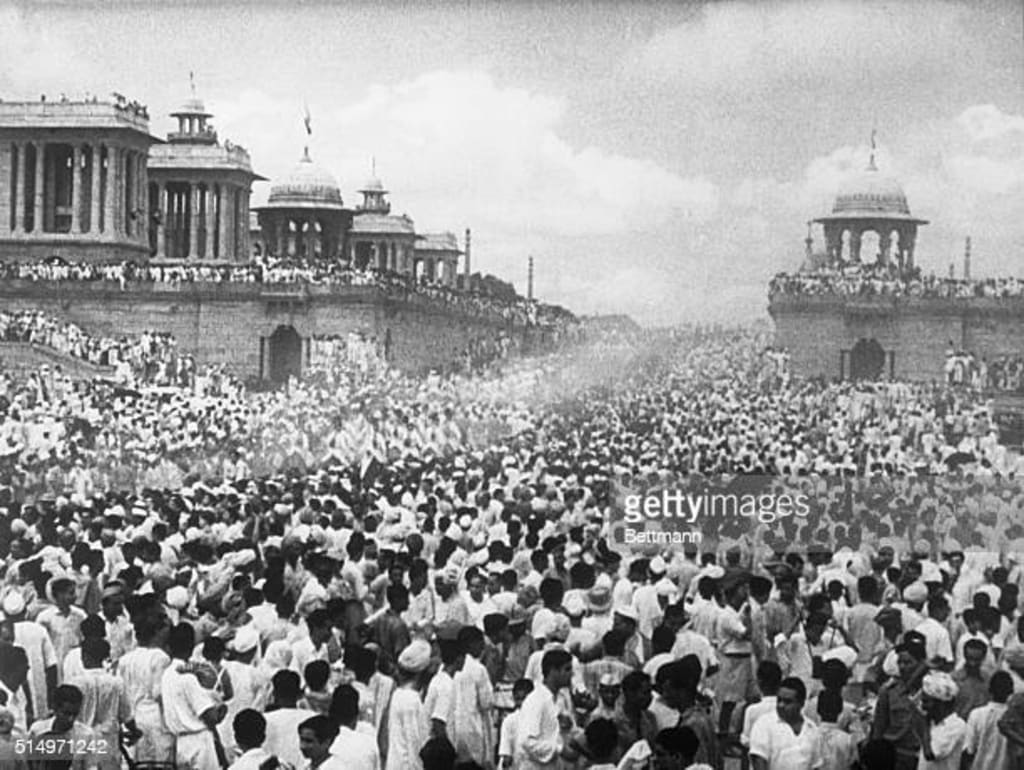
Independence and Partition: India gained independence from British rule on August 15, 1947. However, the partition of the subcontinent led to the creation of two separate nations: India and Pakistan. The partition resulted in widespread violence and the displacement of millions of people.
Modern India: After independence, India adopted a democratic system and became a republic in 1950. The country has made significant progress in various fields, including science, technology, agriculture, space exploration, and information technology. India is now one of the world's fastest-growing major economies and plays a crucial role on the global stage.
Today, India is a vibrant and diverse nation with a rich cultural heritage, religious pluralism, and a rapidly developing economy. It continues to face various challenges, such as poverty, infrastructure development, social inequality, and environmental sustainability. However, India's journey remains one of resilience, growth, and a quest for inclusive progress.
MODERN INDIA
The journey of India is a rich and complex one that spans thousands of years. It is a land with a diverse cultural heritage, a long history of civilizations, and a tapestry of religions, languages, and traditions. Here is a brief overview of the journey of India:
Ancient Civilization: India's history dates back to the Indus Valley Civilization, one of the world's oldest urban civilizations, which flourished around 2500 BCE. The cities of Harappa and Mohenjo-Daro are notable archaeological sites from this period.
Vedic Period: The Vedic period, roughly from 1500 BCE to 500 BCE, saw the composition of the Rigveda, the oldest sacred text of Hinduism. It was a time of flourishing philosophy, science, and social order.
Mauryan Empire: The Mauryan Empire, established by Chandragupta Maurya in the 4th century BCE, was one of the largest empires in ancient India. Under the rule of Emperor Ashoka (273-232 BCE), the Mauryan Empire reached its zenith and embraced Buddhism.
Golden Age: India experienced a Golden Age during the Gupta Empire (4th to 6th century CE). This period witnessed advancements in science, mathematics, medicine, arts, and literature. The decimal numeral system, zero, and the concept of infinity were developed during this time.
Islamic Invasions: In the 8th century CE, Islamic invasions began, introducing Islam to the Indian subcontinent. The Delhi Sultanate was established in the 13th century, marking the beginning of Muslim rule in India.
Mughal Empire: The Mughal Empire, founded by Babur in 1526, was a period of great cultural and architectural achievements. Prominent Mughal emperors like Akbar, Jahangir, Shah Jahan, and Aurangzeb left their mark on India's history. The Taj Mahal, a UNESCO World Heritage site, was built during this era.
Colonial Era: The British East India Company gained control over parts of India in the 18th century. Through the process of colonization, the British gradually extended their rule over the entire subcontinent. The Indian independence movement, led by figures like Mahatma Gandhi, fought for freedom from British rule.
Independence and Partition: India gained independence from British rule on August 15, 1947. However, the partition of the subcontinent led to the creation of two separate nations: India and Pakistan. The partition resulted in widespread violence and the displacement of millions of people.
Modern India: After independence, India adopted a democratic system and became a republic in 1950. The country has made significant progress in various fields, including science, technology, agriculture, space exploration, and information technology. India is now one of the world's fastest-growing major economies and plays a crucial role on the global stage.
Today, India is a vibrant and diverse nation with a rich cultural heritage, religious pluralism, and a rapidly developing economy. It continues to face various challenges, such as poverty, infrastructure development, social inequality, and environmental sustainability. However, India's journey remains one of resilience, growth, and a quest for inclusive progress.
Modern India, since its independence in 1947, has undergone significant social, political, and economic changes. Here are some key aspects of modern India:
Democratic System: India adopted a parliamentary democratic system, with a President as the head of state and a Prime Minister as the head of government. Elections are held regularly, and political parties play a crucial role in shaping the country's governance.
Constitution: The Constitution of India, adopted in 1950, is the supreme law of the land. It enshrines fundamental rights, guarantees equality, and outlines the structure and functioning of the government.
Social Reforms: India has undertaken various social reforms to promote equality and address historical injustices. Efforts have been made to eradicate social evils like caste discrimination, untouchability, and gender inequality. Policies have been implemented to uplift marginalized sections of society through affirmative action and reservation policies.
Economic Development: India's economy has witnessed significant growth since independence. The country has transitioned from an agrarian economy to a diverse and dynamic one. Economic liberalization measures initiated in the 1990s opened up the economy to foreign investment, leading to the growth of sectors like information technology, manufacturing, and services.
Poverty Alleviation: Despite economic growth, India continues to face challenges related to poverty and income inequality. Various government programs and initiatives, such as the Mahatma Gandhi National Rural Employment Guarantee Act (MGNREGA) and poverty eradication schemes, have been implemented to address these issues.
Technological Advancements: India has emerged as a global hub for information technology and software services. The country is home to numerous IT companies and has a thriving startup ecosystem. Additionally, India has made strides in space exploration, with the Indian Space Research Organisation (ISRO) successfully launching missions to the Moon and Mars.
Nuclear Power: India became a nuclear-armed nation in 1974. It maintains a policy of non-proliferation and peaceful use of nuclear technology. The country's nuclear program aims to meet its energy needs and ensure national security.
Foreign Relations: India maintains diplomatic relations with countries across the globe. It is a founding member of the Non-Aligned Movement and actively participates in international organizations like the United Nations and World Trade Organization. India has bilateral ties with various nations and plays a crucial role in regional and global affairs.
Challenges: Modern India faces several challenges, including poverty, illiteracy, healthcare disparities, infrastructure development, environmental degradation, and social issues. Efforts are being made to address these challenges through policy interventions and sustainable development initiatives.
Modern India is a vibrant and diverse nation that continues to evolve and adapt to the changing times. It is characterized by its rich cultural heritage, economic growth, technological advancements, and the aspirations of its people to build a better future.
INDIA ECONOMY OVERVIEW
As of my knowledge cutoff in September 2021, India had the world's sixth-largest economy in terms of nominal GDP and the third-largest in terms of purchasing power parity (PPP). It is considered one of the fastest-growing major economies globally.
India's economy is diverse, with agriculture, manufacturing, and services sectors contributing to its GDP. Agriculture employs a significant portion of the population, although its contribution to GDP has been declining over the years. The manufacturing sector includes industries such as textiles, automobiles, pharmaceuticals, information technology, and more. The services sector, including finance, telecommunications, software services, tourism, and healthcare, has been a significant driver of economic growth.
Over the years, India has implemented economic reforms to liberalize its economy and attract foreign investments. It has made progress in areas such as foreign direct investment (FDI) regulations, ease of doing business, infrastructure development, and taxation reforms. These efforts have helped in attracting foreign investors and fostering economic growth.
However, it is important to note that the state of the Indian economy may have evolved since my last update. Factors such as government policies, global economic conditions, and other internal and external factors can influence the current state of the economy. It is advisable to refer to recent and reliable sources for the most up-to-date information on the Indian economy.
About the Creator
Keep reading
More stories from Sanyasi Kirsani and writers in History and other communities.
Digital world
INTRODUCTION OF WORLD 🌎🌍 The world is a vast and diverse place, home to billions of people and countless cultures, languages, and ecosystems. It is a planet located in the solar system, specifically the third planet from the Sun, and is known as Earth. With a rich history spanning billions of years, the world has seen the rise and fall of civilizations, the development of advanced technologies, and the exploration of its lands, seas, and skies.
By Sanyasi Kirsani3 years ago in History
Savoy Hotel – Mussoorie: The Colonial Luxury Hotel Where an Unsolved Murder Still Walks the Corridors
The First Night: Beauty Wrapped in Silence Mussoorie looks peaceful from a distance. Pine trees sway gently, clouds roll like slow-moving waves, and the hill air smells of rain and old earth. But as evening falls, the silence becomes heavier—almost watchful.
By Gaurav Guptaabout 12 hours ago in History
Is NATO Facing Its Biggest Crisis Yet?
Is NATO Facing Its Biggest Crisis Yet? For more than seventy years, NATO has been one of the strongest military alliances in the world. Formed after World War II, it was designed to protect its members through collective defense. An attack on one was considered an attack on all. For decades, this principle helped maintain stability in Europe and beyond. But today, NATO is facing one of the most challenging moments in its history.
By Wings of Time 4 days ago in History


Comments
There are no comments for this story
Be the first to respond and start the conversation.