
The Japanese Ghost Island
The story of the haunted island in Japan

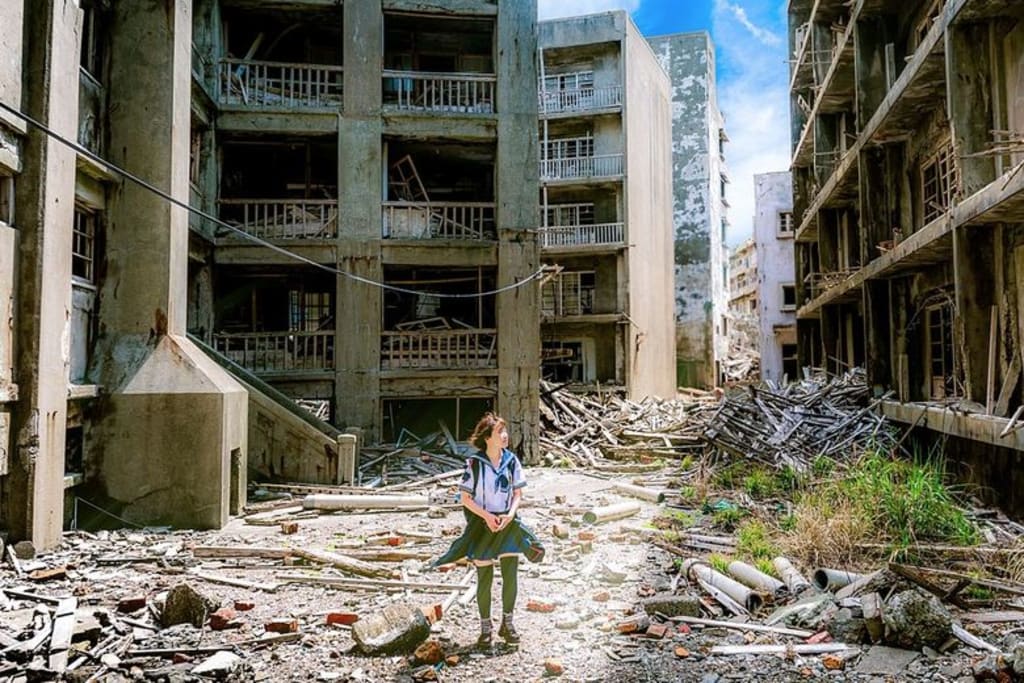
A small rocky island, miles off the coast of Japan, might not seem like the ideal location for a thriving city. However, when coal was discovered beneath the sea, it sparked the growth of a bustling community, with ultra-modern buildings and vast profits for Mitsubishi. Today, the island stands deserted, its decaying structures the only remnants of a once-vibrant city. But what led to this abandonment, and could there be a darker story behind the rise and fall of this industrial boom? Let’s explore.
Welcome to Hashima Island.
In the early 19th century, coal was discovered beneath the East China Sea, fueling Japan's growing industrial efforts. In 1890, Mitsubishi purchased an uninhabited island off the Nagasaki Peninsula and began developing it. They expanded the island's size nearly threefold through land reclamation and the construction of sea walls. This transformation gave Hashima its unique, battleship-like silhouette, earning it the nickname "Gunkanjima," or Battleship Island.
Hashima became a symbol of Japan's industrialization, with the country’s first large reinforced concrete building constructed in 1916—a seven-story apartment block for workers and their families. It was more economical to house them on the island rather than having them commute to the mainland daily.
Living conditions were tough, with daily shipments of essentials like fresh water, but workers were paid well, and the standard of living was considered relatively high, even though the apartments were cramped. A family of four might have lived in a single room just 2.7 by 3.6 meters in size. Single men had even smaller living spaces. Shared toilets and four communal baths dotted the island. Over time, the population grew, and the island saw the construction of schools, shops, a hospital, and even a Buddhist temple and Shinto shrine.
Between 1935 and 1945, Hashima was home to the tallest concrete buildings in Japan, essential for the wartime economy. The buildings were connected by walkways and staircases, offering shelter from typhoons and creating a strong sense of community. However, the island’s stark, concrete architecture, combined with its lack of greenery, made it a dreary place to live.
By 1959, Hashima's population peaked at 5,259 people, making it the most densely populated place on Earth at the time. The island’s mining operation, which included four shafts over one kilometer deep, extracted coal continuously. Miners would descend into the mines via a steep elevator ride, followed by a cable car that carried them further underground. Conditions were brutal, with temperatures around 30°C (86°F) and humidity near 95%.
While Japanese workers lived relatively well, the island’s history also includes a darker chapter. During World War II, when many Japanese workers were conscripted into the military, Korean and Chinese prisoners of war were brought to the island as forced laborers. These workers, subjected to grueling conditions, poor food, and inadequate shelter, were forced into labor without pay. Many died due to the harsh conditions, overwork, and malnutrition, with some even attempting to escape by swimming to the mainland, though most perished. This period remains a sensitive and often glossed-over part of Hashima’s history.
When Japan proposed Hashima for UNESCO World Heritage status in 2015, South Korea and China opposed it, demanding that the contributions of forced laborers be acknowledged. Although Japan promised to include this history, it has yet to fully fulfill that commitment.
By the 1960s, the coal industry began to decline as petroleum became more popular, and Hashima's mine was depleting. In 1974, the island’s mine closed, and by April of that year, the last residents left. What was once a bustling city was abandoned in just a few months.
Hashima lay forgotten for over 30 years, its concrete structures gradually crumbling from seawater and typhoons. Nature slowly reclaimed the island, with grasses and trees sprouting where there had once been none. In 2009, boat tours began taking visitors around the decaying island. However, visitors are restricted from entering the buildings due to safety concerns, and tours are limited due to the rough seas.
Mitsubishi held ownership of Hashima until 2002, after which it was transferred to Takashima Town, now part of Nagasaki City. While physical visits are rare, you can explore the island virtually via Google Street View, which allows you to wander through the crumbling buildings and view artifacts left behind.
If Hashima looks familiar, it may be because it served as inspiration for the setting of the James Bond film Skyfall (2012). While no filming occurred on the island itself, its desolate, industrial look was used for the film’s scenes featuring Bond and the villain, Raoul Silva.
About the Creator
ADIR SEGAL
The realms of creation and the unknown have always interested me, and I tend to incorporate the fictional aspects and their findings into my works.
Keep reading
More stories from ADIR SEGAL and writers in History and other communities.
TUS NUA - ch 53
TUS NUA – ch 53 New Beginnings – Mia and Midnight (*)(*)(*) Finola knew Ali’s brother-in-law needed to put his mind at rest. She fed her arm through his and led him outside. “We’ll sit here. If you like, I can put a block around us so our conversation will be private.”
By Margaret Brennan2 days ago in Fiction



Comments
There are no comments for this story
Be the first to respond and start the conversation.