
The India-Pakistan war 2025: what happened so far
Take a look into the India-Pakistan war as US declared for ceasefire on May 10th

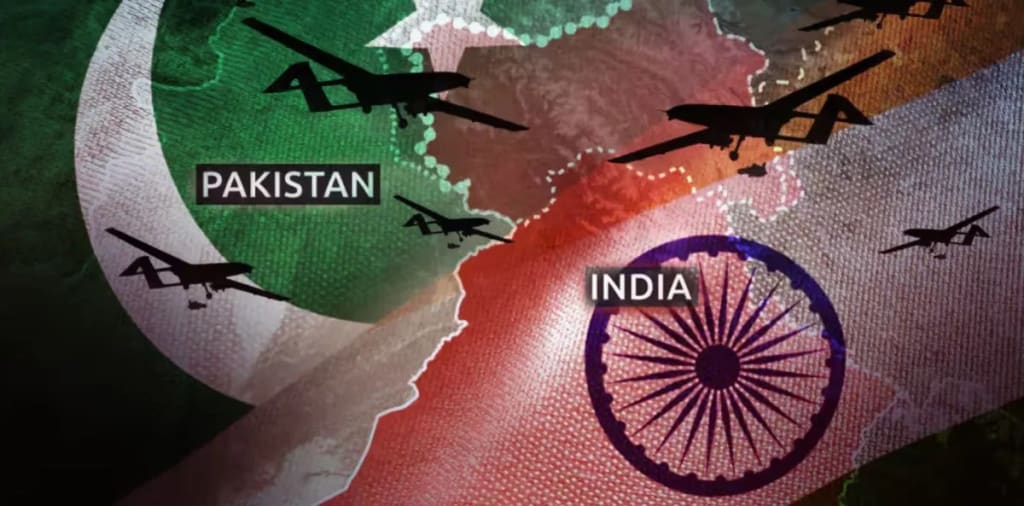
As we stepped into the mid 2025, we are about to witness a war that took place in 1947 and now reborn again. The India-Pakistan war is an issue of not only today, because the beef between these two countries are ages long history. Let's take a look into the war and what happened so far.
April 22: A terrorist attack in Pahalgam, Indian-administered Kashmir, killed 26 civilians, mostly Hindu tourists. The Resistance Front, linked to Lashkar-e-Taiba, initially claimed responsibility but later denied involvement, citing a hack.
April 23–24: India suspended the Indus Waters Treaty, expelled Pakistani diplomats, and closed the Attari–Wagah border. Pakistan retaliated by suspending visas for Indian nationals, closing its airspace to Indian aircraft, and expelling Indian diplomats.
May 7: India launched "Operation Sindoor," targeting nine sites in Pakistan and Pakistan-administered Kashmir, including terror camps of Lashkar-e-Taiba and Jaish-e-Mohammed. Pakistan claimed to have shot down five Indian jets and responded with heavy shelling in Poonch, killing 15 civilians.
May 8: Explosions were reported in Lahore and Karachi. Pakistan claimed to have shot down 12 Indian drones, with one drone striking a military facility in Lahore.
May 10: A U.S.-mediated ceasefire was announced, with both nations agreeing to halt hostilities. However, sporadic violence continued, including artillery exchanges and drone activity.
The ceasefire, brokered by the U.S. with support from Saudi Arabia and Turkey, took effect at 4:30 p.m. local time on May 10. Both India and Pakistan have expressed conditional commitments to peace, with military forces remaining on high alert. Pakistan has reopened its airspace, while India maintains restrictions on certain flights. As of May 10, 2025, India and Pakistan have agreed to a ceasefire following a week of intense hostilities—the most severe escalation between the two nuclear-armed neighbors since 1999.
Indian Foreign Secretary Vikram Misri said Pakistan had violated the understanding arrived at by the two countries earlier in the day.
"We call upon Pakistan to take appropriate steps to address these violations and deal with the situation with seriousness and responsibility," Misri told a media briefing.
Pakistan’s information minister, Attaullah Tarar, told broadcaster Geo News: "As of now, there have not been any ceasefire violations."
Pakistan's military spokesperson did not immediately respond to requests for comment.
The fighting had been the worst between the old South Asian enemies in nearly three decades and threatened to erupt into a full-scale war in one of the world's most volatile and densely populated regions.
The international community, including countries such as Saudi Arabia and Turkey, urged de-escalation and the resumption of direct negotiations. The United Nations Secretary-General called for military restraint, emphasizing that "the world cannot afford a military confrontation between India and Pakistan."
While the ceasefire aimed to prevent further escalation and pave the way for peaceful dialogue, tensions remain high, with continued mutual accusations of aggression and misinformation. The Indus Waters Treaty remains suspended, and formal diplomatic ties are still severed.
Within hours of the announcement, Indian officials accused Pakistan of multiple ceasefire violations, including cross-border shelling and drone incursions. Explosions were reported in border areas such as Jammu and Srinagar.
UN Secretary-General António Guterres welcomed the ceasefire agreement, expressing hope that this positive step would provide an opportunity for further dialogue. The UN has consistently urged both India and Pakistan to exercise maximum restraint and resolve issues through diplomatic means.
China has urged both India and Pakistan to exercise restraint and resolve their differences through dialogue. Chinese officials have expressed concern over the recent escalation and emphasized the need for peaceful solutions to maintain regional stability.
[source: Wikipedia, AP news, huffingtonpost.es, reuters, china.org.cn]
About the Creator
Farhan Chowdhury
A writer at heart, who loves turning ideas into stories that inform, inspire, or spark curiosity. Whether it’s lifestyle, poetries or history I enjoy digging into a topic and delivering content that connects with readers. Still a learner.
Keep reading
More stories from Farhan Chowdhury and writers in History and other communities.
Human brain malfunction phenomenon
Why humans are the best of creation among other creatures? It's because we have a developed brain making us think better than any other creation and implement something from our perception. But does that mean our brain is always right? Does our brain show us something that may not follow the rules of reality? Apparently, our brains can do a lot of things which can manipulate our understandings and project something that isn't true or real. Here are some anomalies that suggests our perception of reality might not be as straightforward as we assume.
By Farhan Chowdhury10 months ago in Humans



Comments (1)
good.