
The Horrific Rise of Genghis Khan
Mongol leader Genghis Khan (1162-1227) rose from humble beginnings to establish the largest land empire in history. After uniting the nomadic tribes of the Mongolian plateau, he conquered huge chunks of central Asia and China.
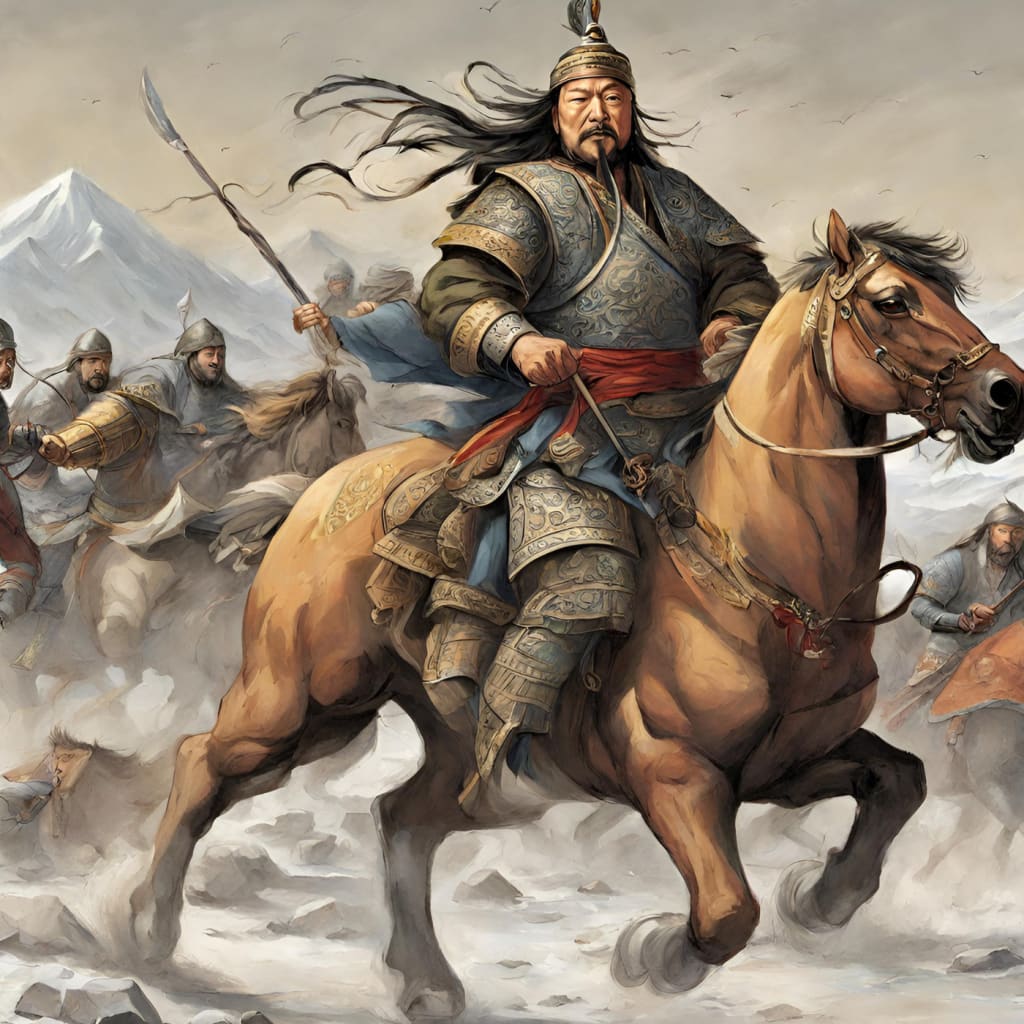
Genghis Khan, born Temüjin in the early 1160s on the Mongolian steppes, rose from humble beginnings to become one of history's most formidable and successful military leaders. His early life was marked by adversity, as his father, the leader of a small Mongol tribe, was poisoned when Temüjin was just nine years old. This event set off a chain of challenges, forcing him and his family into a struggle for survival.
In his formative years, Temüjin demonstrated remarkable leadership qualities, bringing together disparate Mongol tribes under his command. Through a combination of strategic alliances, military prowess, and shrewd diplomacy, he managed to consolidate power and unite the Mongol people, a feat that had eluded many before him.
The title "Genghis Khan," meaning "universal ruler," was bestowed upon Temüjin in 1206 when he was proclaimed the leader of all Mongols. This marked the establishment of the Mongol Empire, which would go on to become the largest contiguous empire in history. Genghis Khan implemented a codified set of laws known as the Yasa, providing a framework for governance that included principles of meritocracy and religious tolerance, reflecting his pragmatic approach to leadership.
Genghis Khan's military strategies were revolutionary for their time. He organized his army into disciplined units, promoting mobility and flexibility on the battlefield. The Mongol cavalry, renowned for its speed and precision, became a formidable force under his command. Genghis Khan's innovative use of intelligence gathering, communication systems, and psychological warfare contributed to his military successes.
One of his most notable achievements was the conquest of the Khwarezmian Empire in the early 13th century. This campaign showcased the effectiveness of Genghis Khan's military tactics, but it also revealed his adaptability and pragmatism. In the face of resistance, he employed a combination of siege warfare, guerrilla tactics, and psychological warfare to overcome formidable opponents.
Despite his reputation as a ruthless conqueror, Genghis Khan was not solely focused on warfare. He recognized the importance of fostering trade and communication across his empire, contributing to the exchange of ideas, cultures, and technologies along the Silk Road. This openness to diverse influences played a role in the empire's economic prosperity.
Genghis Khan's death in 1227 did not mark the end of his legacy; rather, it set the stage for the expansion of the Mongol Empire under his descendants, particularly his grandsons Kublai Khan and Hulagu Khan. Kublai Khan, in particular, extended Mongol rule into China, establishing the Yuan Dynasty. This period saw a fusion of Mongol and Chinese cultures, creating a unique historical chapter.
The enduring impact of Genghis Khan's empire is evident in various aspects of world history. The Pax Mongolica, or Mongol Peace, facilitated trade, cultural exchange, and the movement of people across Eurasia. Genghis Khan's legacy also influenced subsequent military leaders, including Timur and a young general named Subutai, who played a crucial role in the Mongol conquests.
One of Genghis Khan's most renowned battles was the Battle of Khalkhin Gol in 1227, which unfolded in the eastern part of the Mongol Empire. This engagement, also known as the Battle of the Kalka River, pitted the Mongol forces under Genghis Khan's leadership against a coalition of tribes, including the Kipchaks and Cumans.
The strategic significance of the Battle of Khalkhin Gol lay in its role as a crucial campaign to solidify Mongol dominance in the region. Genghis Khan, recognizing the potential threat posed by these allied tribes, marshaled his forces to confront them along the banks of the Khalkhin Gol River.
Genghis Khan's military acumen was on full display during this engagement. He leveraged the mobility of his cavalry to outmaneuver the opposing forces, employing tactics that played to the strengths of the Mongol warriors. The battle unfolded in a series of strategic moves and counter-moves, showcasing Genghis Khan's ability to adapt his tactics based on the evolving dynamics of the battlefield.
Ultimately, the Battle of Khalkhin Gol resulted in a decisive victory for Genghis Khan and his Mongol forces. The success of this campaign not only secured Mongol dominance over the eastern steppes but also sent a powerful message to other potential adversaries about the consequences of resisting Mongol rule.
The Battle of Khalkhin Gol stands as a testament to Genghis Khan's military genius, strategic vision, and the effectiveness of his disciplined and agile cavalry. It further solidified his reputation as a formidable military leader and contributed to the expansion and consolidation of the Mongol Empire during his reign.
In conclusion, Genghis Khan's life and achievements were extraordinary, transforming a fragmented nomadic society into a vast and influential empire. His military brilliance, administrative reforms, and openness to diverse cultures contributed to a legacy that extended well beyond his lifetime. The story of Genghis Khan remains a compelling and complex chapter in the tapestry of world history, reflecting the dynamic interplay of leadership, strategy, and cultural exchange.
About the Creator
Keep reading
More stories from writers in History and other communities.
Easter Island: When Stone Giants Tell a Human Story
In the heart of the vast Pacific Ocean, far away from crowded cities and modern noise, lies one of the most mysterious places on Earth: Easter Island. Known locally as Rapa Nui, this remote island has fascinated people for generations. I remember the first time I read about it—I couldn’t help but wonder how such a small piece of land could carry so much history, mystery, and unanswered questions. What truly defines Easter Island are its silent stone giants, standing patiently as if guarding memories from a forgotten world.
By Binan Mooon3 days ago in History
📢 Raise Your Voice Thread: 01/22/2026
Our “Raise Your Voice Threads” are hosted most alternating Thursdays at 12PM ET to offer creators more avenues to uncover exceptional stories on Vocal. As we are continuously searching for fresh creators and inspiring stories, this thread provides an opportunity to exchange and discuss the stories that have moved and motivated us on Vocal.
By Raise Your Voice by Vocala day ago in Resources




Comments
There are no comments for this story
Be the first to respond and start the conversation.