

The history of love is as ancient and complex as human civilization itself. Love has been a central theme in literature, art, and philosophy across cultures and epochs, evolving in its expressions and meanings over time. This narrative will explore the journey of love through different historical periods, from its earliest representations in ancient societies to its contemporary understandings.
### Ancient Love
In ancient civilizations, love was often intertwined with religious and mythological beliefs. The earliest known writings on love come from Sumerian and Egyptian poetry, where love was celebrated in hymns to gods and goddesses. In Mesopotamia, the "Epic of Gilgamesh," one of the earliest pieces of literature, explores themes of friendship, loss, and the pursuit of eternal life—deeply tied to the human experience of love and loss.
In Ancient Egypt, love was portrayed in romantic poetry and tomb inscriptions, where expressions of affection and marital devotion were common. Egyptian love poetry from around 2000 BCE reveals a tender and emotional side to relationships, with lovers expressing deep feelings of affection and longing.
The Greeks and Romans also placed a significant emphasis on love, though their views were varied and complex. The Greeks conceptualized love in several forms: *Eros* (romantic, passionate love), *Philia* (friendship, brotherly love), and *Agape* (selfless, unconditional love). Plato's philosophical dialogues, particularly "The Symposium," delve into the nature of love, suggesting that physical attraction could lead to a higher understanding of beauty and truth.
Roman society, heavily influenced by Greek culture, also had a multifaceted view of love. The Roman poet Ovid’s "Ars Amatoria" (The Art of Love) is a guide on love and seduction, highlighting the social and sometimes playful aspects of Roman relationships. However, Roman culture also revered *pietas* (duty) and *familia* (family loyalty), demonstrating that love was not just about personal feelings but also about fulfilling societal roles.
### Medieval and Renaissance Love
During the medieval period, the concept of courtly love emerged in Europe, particularly in France and England. This idea, popularized by troubadours and poets, celebrated a chivalric form of love where knights would perform great deeds to win the favor of their lady. This love was often unattainable, emphasizing longing, admiration, and respect rather than physical fulfillment. Courtly love had a significant influence on the literature of the time, with works like "The Romance of the Rose" and Dante's "Divine Comedy" reflecting these ideals.
The Renaissance brought a renewed interest in the classical ideas of love, but with a humanistic twist. Love was no longer just an abstract ideal but was also seen as a powerful force in human relationships. Shakespeare’s plays, particularly his comedies and tragedies like "Romeo and Juliet," explore the complexities of love in its various forms—romantic, familial, and platonic. The Renaissance also saw the rise of Petrarchan love, characterized by unattainable love and the suffering it caused, which influenced poets across Europe.
### Love in the Enlightenment and Romantic Era
The Enlightenment shifted the focus of love from courtly ideals to more personal and rational considerations. Philosophers like Jean-Jacques Rousseau and Denis Diderot wrote about love as a natural and essential part of human life, but one that should be balanced with reason and social responsibility. The idea of companionate marriage, based on mutual affection rather than economic or familial arrangements, began to gain popularity during this period.
The Romantic era, which followed the Enlightenment, reacted against the rationalism of the previous age by emphasizing emotion and individualism. Love was seen as a powerful, often irrational force that could inspire greatness or lead to destruction. Romantic poets like Lord Byron, Percy Bysshe Shelley, and John Keats explored love in its most passionate and intense forms, often linking it to themes of nature, beauty, and transcendence.
### Modern Love
In the 19th and 20th centuries, the concept of love continued to evolve, influenced by social, economic, and technological changes. The industrial revolution brought about significant changes in social structures, with romantic love increasingly becoming the foundation for marriage, rather than familial or economic considerations.
The 20th century saw the rise of new ideas about love, shaped by psychology, feminism, and changing social norms. The work of Sigmund Freud introduced the idea of love as a complex interplay of conscious and unconscious forces. The feminist movement challenged traditional gender roles within romantic relationships, advocating for equality and mutual respect between partners.
In contemporary society, love is understood in a multitude of ways. It can be romantic, platonic, familial, or self-love, each with its own significance. The rise of digital technology and social media has also transformed how people experience and express love, creating new forms of connection and communication.
### Conclusion
The history of love is a reflection of the changing human experience. From the earliest expressions in ancient poetry to the complex and diverse understandings of today, love has always been a central part of what it means to be human. As society continues to evolve, so too will our understanding and expression of this timeless and universal emotion.
About the Creator
Keep reading
More stories from Ashraful Hasan and writers in History and other communities.
The History Of The Mobile Phone
The history of the mobile phone is a fascinating journey that traces the evolution of technology from bulky, impractical devices to the sleek, multipurpose smartphones that dominate our lives today. This transformation reflects significant advancements in electronics, communication, and global connectivity.
By Ashraful Hasan 2 years ago in History
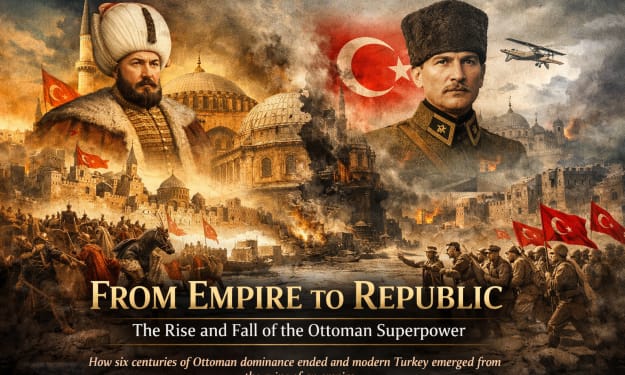
From Empire to Republic: The Rise and Fall of the Ottoman Superpower
For more than six centuries, the Ottoman Empire stood as one of the most powerful and influential states in world history. Stretching across three continents—Europe, Asia, and Africa—it controlled strategic trade routes, diverse populations, and some of the most important cities of the medieval and early modern world. Yet by the early twentieth century, this once-mighty empire collapsed, giving birth to the modern Republic of Turkey. The story of its rise and fall is one of military brilliance, political struggle, and dramatic reform.
By Irshad Abbasi about 18 hours ago in History
A Knight of the Seven Kingdoms Series Review (Season 1)
As one of the biggest properties in fantasy, A Song of Ice and Fire remains immensely popular with audiences. After reaching far into the past with House of the Dragon, a second spin-off was on the cards. A Knight of the Seven Kingdoms serves up a bite-sized slice of action and drama, but it still claims a spot among the best small-screen titles.
By Robert Cain7 days ago in Geeks



Comments (1)
Awesome piece