
government shutdown 2026
Government Shutdown 2026: What It Means and Why Americans Are Concerned


**Government Shutdown 2026: What It Means and Why Americans Are Concerned**
A possible government shutdown in 2026 has become a major topic of public discussion in the United States. Many people are searching for clear explanations about what a government shutdown is, why it may happen, who will be affected, and how serious the consequences could be. This article provides a detailed and easy-to-understand overview while answering the most common questions people are asking.
**What Is a Government Shutdown?**
A government shutdown happens when the U.S. Congress fails to pass laws that fund federal government operations. The federal government relies on approved budgets to continue functioning. If lawmakers do not agree on spending bills or temporary funding measures, many government agencies must stop non-essential activities until funding is restored. Essential services continue, but large parts of the government slow down or temporarily close.
**Why Could a Government Shutdown Happen in 2026?**
The main reason a shutdown could occur in 2026 is political disagreement. Conflicts between political parties or between Congress and the President over spending priorities often delay budget approval. Disputes may involve defense spending, social programs, taxes, immigration policies, or the national debt. When these disagreements are not resolved before funding deadlines, a shutdown becomes a real possibility.
**Is a Government Shutdown in 2026 Confirmed or Just a Risk?**
At most stages, a government shutdown is only a risk, not a certainty. Discussions about shutdowns often begin months before deadlines are reached. Lawmakers usually continue negotiations until the last possible moment. A shutdown would only happen if Congress completely fails to pass funding legislation by the required deadline.
**Who Is Affected by a Government Shutdown?**
Federal employees are among the most affected groups. Workers classified as essential must continue working, even if their pay is delayed. This includes military personnel, air traffic controllers, and certain law enforcement officers. Non-essential federal workers are typically furloughed and sent home without pay until the shutdown ends. Government contractors may also lose income during this period.
**What Services Are Impacted During a Shutdown?**
During a shutdown, many public services slow down or stop temporarily. National parks may close or operate with limited staff. Passport and visa processing can be delayed. Some tax services and federal inspections may also pause. However, Social Security payments, Medicare, and emergency services usually continue, as they are considered essential.
**Does a Government Shutdown Affect the Economy?**
Yes, a government shutdown can affect the economy. Short shutdowns may cause limited disruption, but they still reduce consumer confidence and slow economic activity. Federal workers missing paychecks may spend less money, which impacts local businesses. Longer shutdowns can have more serious economic effects, including reduced growth and increased uncertainty in financial markets.
**How Long Can a Government Shutdown Last?**
There is no fixed limit on how long a shutdown can last. Some shutdowns have ended after a few days, while others have continued for weeks. The duration depends entirely on how quickly political leaders reach an agreement. Public pressure and economic consequences often play a role in speeding up negotiations.
**Do Government Shutdowns Affect Schools and Hospitals?**
Public schools are generally not directly affected because they are funded by state and local governments. Hospitals continue operating, although some federally funded health programs may face delays. State governments usually remain open, but delays in federal funding can indirectly impact state budgets.
**Can a Government Shutdown Be Avoided?**
Yes, shutdowns can be avoided. Congress can pass a full budget agreement or approve a temporary funding bill to keep the government running while negotiations continue. These temporary measures are commonly used to prevent shutdowns when deadlines approach.
In conclusion, a potential government shutdown in 2026 is driven mainly by political and budgetary disagreements. While it does not completely shut down the government, it disrupts services, affects workers, and creates economic uncertainty. Understanding how shutdowns work helps explain why this issue remains a major concern for Americans.
About the Creator
America today
Breaking news, political insights, real-time analysis, U.S. politics, global politics, elections, government policies, international relations, diplomacy, political debates, trending political stories, expert commentary, factual reporting,.
Keep reading
More stories from America today and writers in History and other communities.
Zohran Kwame Mamdani
Zohran Kwame Mamdani was born in Kampala, Uganda, on October 18, 1991, into a family known for its intellectual and cultural influence. His father, Mahmood Mamdani, is a respected academic of Indian-Gujarati descent, and his mother, Mira Nair, is a world-renowned Indian-American filmmaker. Growing up surrounded by such strong figures in both academia and art gave Zohran a deep appreciation for culture, justice, and storytelling.
By America today 4 months ago in History
The Search for the Distant World
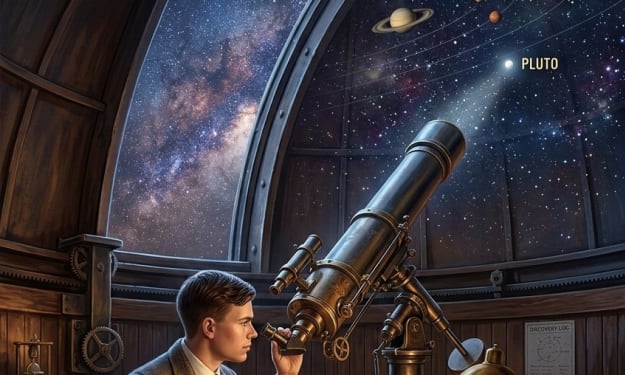
Long before powerful telescopes and modern space missions, astronomers spent countless nights studying the sky. They watched the stars carefully and recorded the movements of the planets. Each discovery helped scientists understand the vast universe a little better. Among the most fascinating discoveries in astronomy was the discovery of Pluto, a tiny and distant world at the edge of our Solar System. The story of Pluto’s discovery is not just about a planet. It is a story of curiosity, patience, and the determination of scientists who spent years searching for something that no one had ever seen before. The Mystery of Planet X In the early 1900s, astronomers believed there might be another planet beyond Neptune. They noticed that the orbits of Uranus and Neptune did not behave exactly as expected. Some scientists thought that the gravity of an unknown planet might be affecting their motion. One astronomer who became very interested in this mystery was Percival Lowell. Lowell believed strongly that a hidden planet existed far beyond Neptune. He called this mysterious world “Planet X.” To find it, Lowell built an observatory in Arizona known as the Lowell Observatory. From there, he and his team carefully studied photographs of the night sky. They searched for a small object that slowly moved among the stars. Unfortunately, Lowell died in 1916 before he could find the planet he was looking for. But the search did not end. A Young Man with a Dream Years later, a young farm boy named Clyde Tombaugh became interested in astronomy. Tombaugh lived in Kansas and did not have expensive scientific equipment. However, he loved building telescopes and observing the planets from his backyard. Tombaugh carefully drew detailed pictures of Mars and Jupiter using a homemade telescope. He sent these drawings to Lowell Observatory, hoping that professional astronomers might notice his work. The scientists at Lowell Observatory were impressed by his careful observations. In 1929, they invited Tombaugh to work at the observatory and continue the search for the mysterious Planet X. For Tombaugh, it was the opportunity of a lifetime. The Difficult Search The search for Planet X was extremely challenging. The distant planet would appear very small and faint in photographs of the sky. It would look almost exactly like a star. To find it, Tombaugh used a special machine called a blink comparator. This device allowed him to compare two photographs of the same part of the sky taken several days apart. When he looked through the machine, the images switched back and forth quickly. Most stars stayed in the same place. But if an object moved slightly between the two photographs, it would appear to jump back and forth. That movement could reveal a planet. Night after night, Tombaugh studied thousands of star images. The work required incredible patience and concentration. Sometimes he spent hours searching through photographs without finding anything unusual. But he never gave up. The Moment of Discovery On February 18, 1930, Tombaugh was examining photographs taken in January of that year. While comparing two images, he noticed a tiny dot that moved slightly from one position to another. At first, he looked again carefully to make sure it was not a mistake or a flaw in the photograph. But the tiny object had definitely moved. This meant it was not a star—it was something within our Solar System. After additional observations confirmed the movement, the scientists at Lowell Observatory realized that Tombaugh had discovered the long-sought Planet X. The discovery was officially announced on March 13, 1930. Astronomers around the world celebrated the discovery of a new planet beyond Neptune. It was one of the most exciting astronomical discoveries of the 20th century. Naming the New World After the discovery was announced, people from many countries suggested names for the new planet. The final name came from an 11-year-old girl in England named Venetia Burney. She suggested the name Pluto, after the Roman god of the underworld. The name seemed perfect because the planet was dark, distant, and hidden in the far reaches of the Solar System. Astronomers liked the name for another reason. The first two letters, P and L, were also the initials of Percival Lowell, the astronomer who had first searched for Planet X. Soon, the International Astronomical Union officially approved the name Pluto. A Planet That Changed Our Understanding For many decades, Pluto was known as the ninth planet of the Solar System. It became a symbol of exploration and curiosity about the outer regions of space. However, as technology improved, astronomers discovered many other icy objects beyond Neptune in a region called the Kuiper Belt. Scientists realized that Pluto was part of this large population of distant objects. Because of this, in 2006 the International Astronomical Union reclassified Pluto as a dwarf planet instead of a full planet. Although this decision surprised many people, Pluto remains one of the most fascinating worlds in our Solar System. Exploring Pluto In 2015, the spacecraft New Horizons flew past Pluto and sent back the first close-up images of the distant world. Scientists were amazed by what they saw. Pluto has mountains made of ice, vast frozen plains, and a giant heart-shaped region on its surface. These discoveries showed that even small worlds far away from the Sun can be complex and beautiful. The Legacy of the Discovery The discovery of Pluto proved that patience and curiosity can lead to incredible discoveries. Clyde Tombaugh’s careful work and dedication allowed humanity to find a new world billions of kilometers away. Today, Pluto continues to inspire scientists and students to explore the mysteries of space. Even though it is small and distant, Pluto reminds us that the universe is full of surprises waiting to be discovered. 🌌
By Sahir E Shafqata day ago in History
Two Grumpy Old Men Solve the Problem
Marty and Steve were two grumpy old men who lived together. They had known each other for years. Marty had been a bachelor all his life. Steve said it was because no one could stand to ever live with. Marty’s standard reply was “Well, you are, so what sort of a moron does that make you!”
By Calvin London4 days ago in Humor



Comments
There are no comments for this story
Be the first to respond and start the conversation.