
The History Of Pohela Boishakh And Bengali New Year Celebrations
Pohela Boishakh

The first day of the Bengali calendar, Pohela Boishakh, is more than just a date; it is also a significant representation of the Bengali people's identity, their historical journey, and their pride in their cultural heritage. Pohela Boishakh is one of the most important festivals in Bangladesh, West Bengal, and among Bengali communities worldwide. It is celebrated on April 14 or 15, depending on the solar calendar. It is a time to embrace tradition, unity, and renewal as well as the beginning of a new year and a new hope. Historical Roots: From Taxes to Tradition
The origin of Pohela Boishakh is closely tied to the Mughal Empire, particularly to the reign of Emperor Akbar in the late 16th century. Farmers in Bengal faced difficulties as a result of the empire's use of the Islamic Hijri lunar calendar to collect land taxes. The agricultural seasons did not coincide with the lunar calendar. Because of this, taxes were frequently due prior to harvest, causing unnecessary hardship. As a solution to this problem, Akbar established a brand-new calendar that was tailored to the requirements of Bengal's agrarian society. He asked the well-known scholar and astronomer Fathullah Shirazi to create a new calendar by combining aspects of the solar Hindu calendar with those of the lunar Islamic calendar. The result was the Bongabdo, or Bengali calendar, which was officially introduced in 1584. The Punyaho tax collection period began on the first day of this calendar—Pohela Boishakh—and marked the beginning of the revenue year. What began as an administrative reform gradually transformed into a cultural and social occasion over time. The local people began to observe the day with community gatherings, fairs, and festivities. It gradually turned into a joyous occasion to welcome the new year with hope and prosperity.
Transformation into a Cultural Festival
The celebration of Pohela Boishakh changed in tandem with the development of Bengali society, literature, and language. In modern times, particularly after the Language Movement of 1952 and the Independence of Bangladesh in 1971, the festival took on new meaning as a symbol of Bengali nationalism, cultural pride, and unity.
Today, Pohela Boishakh is celebrated with grandeur and color, cutting across religious and class lines. In Bangladesh, the day begins with the early morning program “Boishakhi Shurobho” at Ramna Botomul in Dhaka, organized by Chhayanaut. People wear traditional clothes—men in white panjabi, women in red and white sarees—and greet each other with “Shubho Noboborsho” (Happy New Year). A traditional breakfast often includes panta bhaat (fermented rice), ilish maachh (hilsa fish), green chili, and onion.
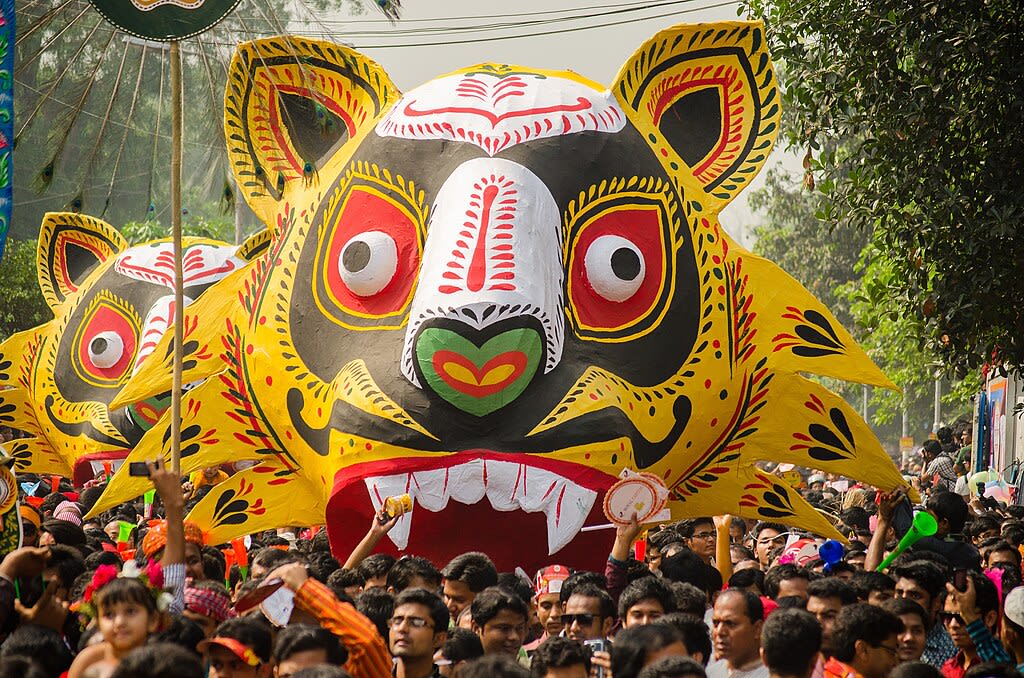
One of the most iconic modern features of the celebration is the Mangal Shobhajatra, a colorful procession organized by the Faculty of Fine Arts, University of Dhaka. The procession, which began in 1989, is made up of large masks, symbolic figures, and motifs that represent nature, unity, and resistance to injustice. In 2016, this event was recognized by UNESCO as an Intangible Cultural Heritage of Humanity.
In West Bengal, the festival is also widely celebrated. Business owners begin their financial year with Haal Khata (new ledger books), inviting customers with sweets and gifts. Cultural programs, fairs, and street festivals are common. Rabindra Sangeet (songs by Rabindranath Tagore), folk music, and dance performances fill the air with a festive spirit.
Unity and identity symbol Pohela Boishakh's secular and inclusive nature is what sets it apart. It is celebrated by people of all religions and backgrounds. In a region often divided by religious and political tensions, Pohela Boishakh stands as a unifying force that emphasizes the richness of Bengali culture above all else.
The festival also serves as a reminder of Bengal’s deep-rooted history, its agricultural heritage, its artistic spirit, and the resilience of its people. For Bengalis, it is not just the turning of a calendar page—it is a spiritual and emotional reset.
Modern Relevance and Global Observance
Pohela Boishakh has crossed national boundaries in recent decades. Bengali communities in cities like London, New York, Toronto, and Kolkata now hold large celebrations featuring parades, cultural performances, and traditional food fairs. In an increasingly globalized world, this festival has become an important way for the Bengali diaspora to stay connected to their roots.
Despite modernization, the essence of the festival remains the same: celebrating life, culture, and community. In schools, offices, and public institutions, the Bengali New Year is welcomed with colorful decorations, poems, and songs that speak of nature, love, and hope.
Conclusion
Pohela Boishakh has come a long way from being a mere fiscal date in the Mughal Empire to becoming a vibrant, people-centered celebration of culture and unity. It is a day that brings together tradition and modernity, rural and urban life, religion and secularism, and ultimately, the past and the future. Every year, people say "Shubho Noboborsho" to each other to commemorate centuries of tradition, pride, and the hope of a better future.
About the Creator
Bokul Ahmed
Me Bokul Ahmed. Post Graduate in Political Science. My passion is song writing, poetry writing, story writing, script writing and Article writing also Data Entry Expert for creativity and digital proficiency.
Keep reading
More stories from Bokul Ahmed and writers in History and other communities.
International May Day: Honoring the Hands that Build the World
Every year on May 1st, countries across the globe observe International Workers’ Day, also known as May Day. While for many it’s a welcome day off, the date actually marks a profound history rooted in sacrifice, protest, and the long-standing struggle for workers’ rights.
By Bokul Ahmed9 months ago in History
3 Times Ordinary Objects Did Something Deeply Unsettling
Objects surround us every day. They make life easier, more comfortable, or more entertaining. A chair supports us, a mirror shows us our reflection, and a toaster browns our bread with consistent reliability. Most of the time, they behave exactly as expected.
By Enoch Sagini5 days ago in History
When Allies Disagree: How Global Partnerships Are Being Redefined
When Allies Disagree: How Global Partnerships Are Being Redefined For much of the modern era, global alliances appeared firm and predictable. Powerful countries formed blocs, promised mutual support, and stood together during times of war and crisis. But in today’s world, those alliances are changing. Recent disagreements between long-standing partners show that global cooperation is no longer based on automatic loyalty—it is increasingly shaped by national interests, public opinion, and long-term stability.
By Wings of Time 3 days ago in History



Comments
There are no comments for this story
Be the first to respond and start the conversation.