

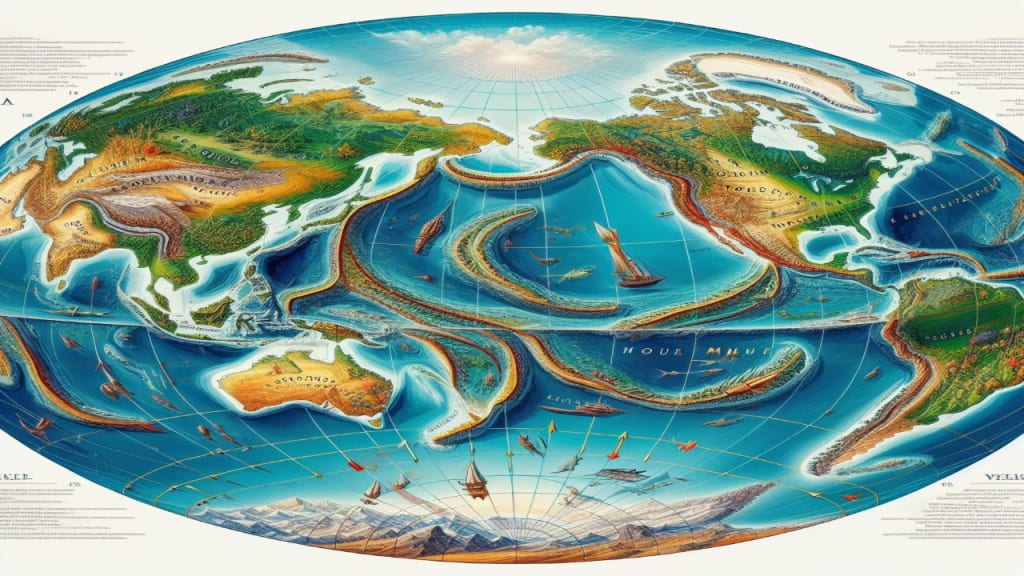
The History of Pangea
Introduction
Pangea, derived from the ancient Greek words meaning "all land," was a supercontinent that existed during the late Paleozoic and early Mesozoic eras, approximately 335 to 175 million years ago. It was a unique geological entity that has intrigued scientists for centuries.
Formation of Pangea
The formation of Pangea was a result of the tectonic plate movements, a theory known as plate tectonics. Around 335 million years ago, during the late Paleozoic era, several landmasses including Gondwana (the southern continents) and Laurasia (the northern continents) began to converge due to the movement of tectonic plates. This convergence led to the formation of the supercontinent Pangea, surrounded by a superocean called Panthalassa.
Life on Pangea
The existence of Pangea had significant effects on the climate, ocean circulation, and life on Earth. The interior of the supercontinent was likely dry and desert-like, due to its distance from the surrounding Panthalassa ocean. This could have led to the evolution of certain species adapted to such harsh conditions. Fossil records indicate the existence of a diverse range of species during this period, including the early dinosaurs.
Breakup of Pangea
Around 175 million years ago, during the Mesozoic era, Pangea began to break apart. The breakup was driven by the movement of tectonic plates, caused by the upwelling of magma from the Earth’s mantle. This led to the formation of the Atlantic Ocean, and the continents as we know them today. The breakup of Pangea and the subsequent continental drift had significant impacts on climate, sea levels, and biodiversity.
Legacy of Pangea
The legacy of Pangea is evident in the geological and biological similarities observed across different continents. For instance, the presence of similar fossil species in South America and Africa supports the idea that these continents were once joined together. The study of Pangea and its history provides valuable insights into the Earth’s geological past, the movement of tectonic plates, and the evolution of life on Earth.
Impact on Biodiversity
The formation and subsequent breakup of Pangea had a profound impact on Earth’s biodiversity. When Pangea was formed, it brought together diverse species from separate landmasses. This led to a mixing of flora and fauna, resulting in a rich and diverse ecosystem. However, the interior of Pangea was likely harsh and dry, which could have led to the extinction of certain species not adapted to these conditions.
When Pangea began to break apart, it created isolated landmasses. This isolation led to the evolution of distinct species on different continents, a process known as allopatric speciation. This is evident in the unique biodiversity we see on different continents today.
Impact on Climate
Pangea’s existence also had significant effects on Earth’s climate. The vast landmass altered ocean currents and wind patterns, leading to extreme climate conditions. The interior of Pangea was likely hot and dry, while the coastal regions were wet and humid.
The breakup of Pangea changed these patterns. The formation of new oceans altered ocean currents, which play a crucial role in regulating global climate. This led to changes in climate, including the possibility of triggering ice ages.
Pangea and Plate Tectonics
The history of Pangea provides strong evidence for the theory of plate tectonics. The movement of Earth’s crust is responsible for the formation and breakup of Pangea. Even today, our continents are moving, albeit very slowly, due to the continuous movement of tectonic plates.
Conclusion
The history of Pangea is a testament to Earth’s dynamic nature. It offers valuable insights into the processes that shape our planet and drive its biodiversity. As we continue to study Earth’s past, we gain a better understanding of how life evolved and how it might continue to evolve in the future. The story of Pangea is not just the story of a supercontinent; it’s the story of our planet and the life it supports. It’s a reminder of our planet’s past and a hint of its future. It truly is a fascinating chapter in Earth’s history.
About the Creator
J. Revs
> A passionate and dedicated individual, I thrive on challenges and constantly set goals for myself to ensure I'm always striving to achieve my best.
Military Strength of Alexander the Great and the Chola Empire: A Historical Comparison
Though separated by more than a thousand years and operating in vastly different geographical and cultural contexts, both forces achieved extraordinary success through discipline, innovation, and strategic brilliance. This article explores the history, composition, size, organization, and military strength of Alexander’s Macedonian army and the Chola military, highlighting how each became a dominant power of its era.
By Say the truth 7 days ago in History



Comments
There are no comments for this story
Be the first to respond and start the conversation.