
The Greedy Dog and the Bone
A Lesson in Contentment and Consequences

Once upon a time, in a small village nestled between green hills and golden fields, there lived a scruffy brown dog named Bruno. Bruno wasn't a bad dog—he was loyal to his master, playful with children, and quick to chase off any chicken thief. But Bruno had one flaw that everyone in the village knew too well: he was terribly greedy.
No matter how much food Bruno got, he always wanted more. If he had one biscuit, he would eye someone else's. If he was given a juicy bone, he would sniff around in search of another, even before finishing the first. The village children joked that Bruno didn’t just have one stomach—he had five!
One sunny afternoon, after a long day of lazing under the village baker's cart, Bruno decided to explore the nearby woods in hopes of finding something delicious. He sniffed around the tall grass, poked his nose into burrows, and chased a few butterflies along the way. Eventually, he reached the edge of the forest where an old butcher’s hut had once stood.
To his surprise, right beside a pile of logs, lay a large, juicy bone. It was thick, meaty, and smelled absolutely heavenly. Bruno’s tail wagged like a broom in a dust storm. Without a second thought, he grabbed the bone in his mouth and trotted proudly back toward the village.
On his way home, Bruno had to cross a narrow wooden bridge that stretched across a calm stream. The water beneath was clear, and it mirrored everything perfectly—the trees, the clouds, and even Bruno himself.
As he padded across the bridge, Bruno happened to glance down at the water. What he saw made him freeze in his tracks.
There, looking up at him from the stream, was another dog. And in that dog’s mouth was an equally big, equally juicy bone!
Bruno growled softly. “Another dog? With another bone? That bone looks just as good as mine—maybe better!”
He stared harder. The other dog stared back.
Bruno was gripped by temptation. “If I bark loudly and scare that dog,” he thought, “he’ll drop his bone. Then I’ll have two!”
He opened his mouth to bark—and in that very moment, his own bone slipped from between his jaws. Splash! It fell into the stream and sank to the bottom.
Bruno gasped. He peered into the water, hoping to see the other bone floating or the other dog retrieving it. But the reflection was gone. Only ripples remained on the surface of the stream.
It was then that Bruno realized his mistake. There had never been another dog. There had never been another bone. He had seen his own reflection—and in his greed, he had let go of what he already had.
Bruno sat down on the bridge, ears drooping, tail still. For the first time, his hunger wasn’t just in his stomach—it was in his heart. He had lost something good because he couldn’t be satisfied with what he had.
Ashamed and hungry, Bruno walked back to the village. He passed by the baker’s cart again, hoping for a scrap, but today the baker was busy and didn’t notice him. The children were playing a game and didn’t run over to pet him as they usually did.
He wandered to the edge of the field and lay down beneath a tree. As the sun dipped behind the hills, Bruno sighed. He hadn’t just lost a bone—he had lost trust in himself. He realized that sometimes, in trying to take more than we need, we end up with nothing at all.
From that day forward, Bruno changed. He still enjoyed food, of course—he was a dog, after all. But he stopped looking over his shoulder to see who had more. He began to appreciate each meal, each pat on the head, each warm place to sleep.
The villagers noticed too. One morning, the baker gave him two biscuits instead of one. “You’re looking wiser these days, Bruno,” the baker said with a wink.
Bruno wagged his tail gently and took the biscuits with a grateful nod—no snatching, no whining, no looking for a third.
And whenever he passed by the bridge over the stream, he would stop for a moment, peer into the water, and smile at his reflection. It reminded him of the day he learned one of life’s most valuable lessons:
“Be content with what you have—because greed can make you lose even what’s already yours.”
Moral of the Story:
Greed often leads to loss. It is better to appreciate and be content with what we have, rather than always chasing more.
About the Creator
Keep reading
More stories from Muhammad Abbas and writers in History and other communities.
The curious cow of Cloverfield
In a quiet little valley wrapped in sunshine and wildflowers, there lay a peaceful farm known as Cloverfield. The skies above were always soft and blue, and the meadows stretched as far as the eye could see. But what made Cloverfield special wasn’t just its beauty—it was Clara, the most curious cow the farm had ever known.
By Muhammad Abbas9 months ago in History
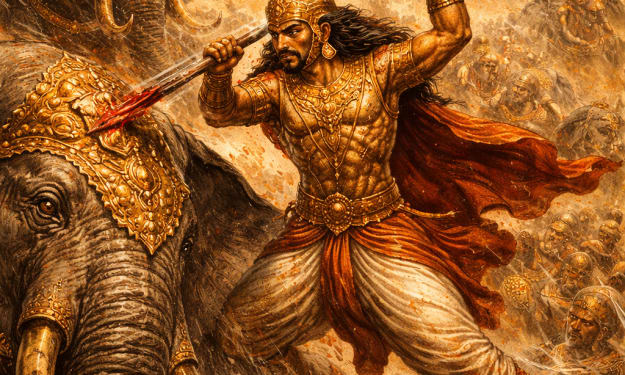
If War Had Erupted Between Ashoka and the Three Kings of South India: An Alternate History Scenario
In reality, no direct war occurred between Ashoka and these southern kingdoms. But if circumstances had been different—if diplomacy had failed and war had erupted—the consequences would have been profound, reshaping Indian history in dramatic ways.
By Say the truth about 4 hours ago in History
The Eternal Triangle: The Story of the Egyptian Pyramids
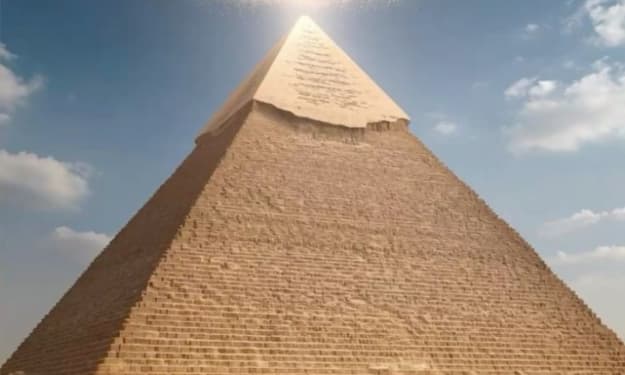
In the golden heat of the Egyptian desert, where the Nile River flows like a ribbon of life through endless sand, stand the greatest monuments of ancient human ambition—the pyramids. For over four thousand years, these towering structures have watched the rise and fall of empires, the march of armies, and the endless turning of time. They are not merely piles of stone; they are symbols of power, faith, and mystery. The story of the pyramids begins in the Old Kingdom of Egypt, around 2600 BCE, during a time when pharaohs ruled as living gods. The Egyptians believed that their king was not just a ruler but a divine being, chosen by the gods to maintain order in the world. When a pharaoh died, it was not seen as an end but as a journey into the afterlife. To ensure that their king would live forever among the gods, the Egyptians built massive tombs—structures that would protect the body and provide everything needed for eternal life. Before pyramids, royal tombs were simple rectangular structures called mastabas, made of mudbrick. But everything changed with Pharaoh Djoser. His architect, a brilliant man named Imhotep, had a daring idea. Instead of building a flat mastaba, he stacked smaller mastabas on top of one another, creating a stepped pyramid. Around 2630 BCE, the Step Pyramid of Saqqara rose toward the sky—the first large stone structure in history. It was a revolutionary achievement, marking the beginning of pyramid construction. As time passed, Egyptian builders sought perfection. They experimented with smoother sides and greater heights. Pharaoh Sneferu, father of the famous Khufu, was determined to create the perfect pyramid. His first attempt, the Meidum Pyramid, partially collapsed. His second attempt, the Bent Pyramid at Dahshur, changed angle midway because of structural concerns, giving it a strange shape. Finally, Sneferu succeeded with the Red Pyramid—the first true smooth-sided pyramid. Through trial and error, Egyptian engineers mastered the art of building monuments that could stand for eternity. Then came the age of greatness—the construction of the Great Pyramid of Giza. Around 2580 BCE, Pharaoh Khufu ordered the building of a pyramid that would surpass all others. On the west bank of the Nile, near modern Cairo, thousands of workers gathered. Contrary to old myths, these were not slaves chained in misery but skilled laborers, farmers who worked during the Nile’s flooding season when their fields were underwater. Stone blocks, some weighing up to 2.5 tons, were quarried and transported across the desert. Historians still debate exactly how they were lifted into place. Some believe ramps were built; others suggest clever systems of levers and sledges. Whatever the method, the achievement remains astonishing. Over 2.3 million blocks were arranged with incredible precision, forming a pyramid originally 146 meters tall. Its sides aligned almost perfectly with the four cardinal directions—north, south, east, and west—showing a deep understanding of astronomy. Inside the Great Pyramid were hidden chambers. The King’s Chamber held a granite sarcophagus, meant to house Khufu’s mummified body. Narrow shafts pointed toward specific stars, perhaps guiding the king’s spirit to the heavens. The pyramid was once covered in smooth white limestone that reflected the sunlight, making it shine brilliantly like a beacon. Near Khufu’s pyramid stood two others—built for his son Khafre and his grandson Menkaure. Together, they formed the famous Pyramids of Giza. Guarding them was the Great Sphinx, a colossal statue with the body of a lion and the face of a pharaoh, likely Khafre. The Sphinx symbolized strength and wisdom, silently protecting the royal tombs. But why did the Egyptians build such enormous structures? The answer lies in their beliefs. The afterlife was central to Egyptian religion. They believed that the soul had different parts—the ka, the ba, and the akh—that needed the body to survive. This is why mummification was so important. Organs were carefully removed, the body dried with natron salt, and wrapped in linen. Treasures, food, statues, and inscriptions were placed inside the tomb to serve the king in the next world. However, pyramid-building did not last forever. After the Old Kingdom, Egypt faced economic troubles and political instability. Later pharaohs built smaller pyramids or chose hidden tombs in the Valley of the Kings, like that of Tutankhamun. The era of giant pyramids faded, but their legacy remained. For centuries, the pyramids stood largely undisturbed. Ancient travelers marveled at them. Greek historian Herodotus visited in the 5th century BCE and wrote stories—some accurate, others exaggerated—about their construction. Over time, sand covered parts of the structures. Treasure hunters and grave robbers broke into tombs, stealing valuables. In modern times, archaeologists have studied the pyramids with scientific methods. Excavations revealed workers’ villages, tools, and even bakeries that fed thousands of laborers. These discoveries changed our understanding, proving that pyramid builders were respected members of society, not enslaved masses. The pyramids have also inspired countless myths. Some claim aliens helped build them, unable to believe that ancient humans could achieve such precision. But evidence shows the Egyptians possessed remarkable engineering knowledge. They understood mathematics, geometry, and organization. The pyramids are a testament to human capability—not extraterrestrial intervention. Today, the Great Pyramid is the only surviving wonder of the Seven Wonders of the Ancient World. Earthquakes have shaken it, stones have been removed, and its shining limestone casing is mostly gone, yet it still stands proudly against the desert sky. Tourists from around the world visit Giza, walking in the footsteps of ancient kings. As the sun sets over the Sahara, the pyramids glow in shades of gold and red. They remind us of a civilization that believed in eternity. Though the pharaohs are long gone, their monuments endure, whispering stories of ambition, faith, and the desire to conquer death itself. The Egyptian pyramids are more than tombs. They are bridges between earth and sky, between life and afterlife. They show what humans can achieve when driven by belief and unity. Thousands of years later, they still challenge our imagination and inspire awe. And perhaps that is their greatest mystery—not how they were built, but why they continue to captivate us. In their silent strength, the pyramids tell a simple truth: time may pass, empires may fall, but the dreams carved in stone can last forever.
By The best writer about 16 hours ago in History


Comments
There are no comments for this story
Be the first to respond and start the conversation.