
The Greatest Leaders in Islamic History
Prophet Muhammad ﷺ and the Rightly Guided Caliphs

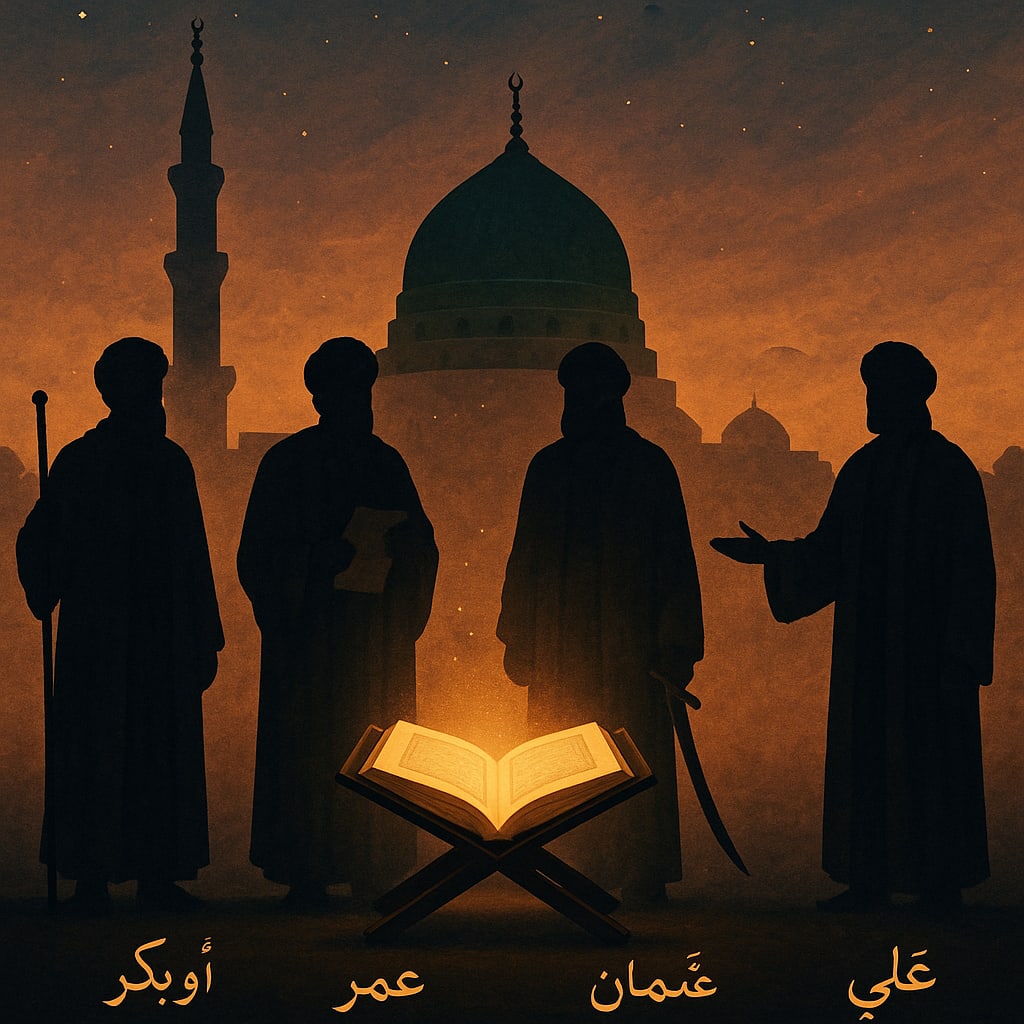
The Greatest Leaders in Islamic History: Prophet Muhammad ﷺ and the Rightly Guided Caliphs
Leadership is one of the most powerful forces that can shape civilizations. In Islamic history, no leadership stands taller, purer, and more transformative than that of Prophet Muhammad ﷺ and the Rightly Guided Caliphs (al-Khulafāʾ al-Rāshidūn). Their leadership was not about wealth, oppression, or personal power—it was about justice, humility, and service to humanity.
In today’s world, where leadership often means authority over others, their example remains a timeless lesson in what it truly means to guide with wisdom and compassion.
Prophet Muhammad ﷺ: The Perfect Example of Leadership
Prophet Muhammad ﷺ is recognized not only as the Messenger of Allah but also as the greatest leader in human history. His leadership transformed a divided, tribal society into a united community based on faith, justice, and brotherhood.
Mercy and Compassion: The Qur’an calls him “a mercy to the worlds” (21:107). He forgave enemies, cared for the poor, and stood by the oppressed. When he entered Makkah victorious after years of persecution, instead of revenge, he declared general amnesty: “Go, for you are free.”
Justice and Equality: He abolished the superiority of tribe, race, or wealth, declaring in his Farewell Sermon: “No Arab has superiority over a non-Arab, nor a non-Arab over an Arab. No white has superiority over black, nor black over white—except by piety.”
Humility: Despite being the leader of an entire nation, he lived simply. He mended his own clothes, milked his own goat, and sat among his companions as one of them.
His leadership was not about dominance—it was about service, truth, and responsibility.
Abu Bakr al-Ṣiddīq (r.a.): The Gentle Guardian
When Prophet Muhammad ﷺ passed away, the Muslim community was devastated. Some could not believe it. Abu Bakr (r.a.), the Prophet’s closest friend and first Caliph, stood firm and reminded the people:
“Whoever worshiped Muhammad, know that Muhammad has died. But whoever worships Allah, know that Allah is Ever-Living and never dies.”
His leadership was marked by gentleness yet firmness. He preserved unity at a time of crisis, defended the Muslim community against rebellions, and sent armies to protect the faith. Though he ruled for only two years, his leadership saved the Ummah from collapse.
ʿUmar ibn al-Khaṭṭāb (r.a.): The Just Caliph
After Abu Bakr came ʿUmar (r.a.), one of the greatest statesmen in history. Known as al-Fārūq (the one who distinguishes truth from falsehood), his rule expanded Islam far beyond Arabia—to Persia, Syria, and Egypt.
Justice: He was famous for saying, “If a mule were to stumble in Iraq, I fear Allah would ask me why I did not pave the road for it.” His deep sense of accountability before Allah made him one of history’s most just rulers.
Simplicity: Even when ruling vast lands, he lived in a small house, wore patched clothes, and often walked at night to check on the people.
Strength: He established administrative systems, built cities, and ensured fair treatment of non-Muslims under Muslim rule.
His justice and humility earned him the love of Muslims and respect even from his enemies.
ʿUthmān ibn ʿAffān (r.a.): The Generous Caliph
ʿUthmān (r.a.) was known for his generosity and kindness. He was wealthy before Islam, but he spent his fortune to support the faith.
He purchased a well in Madinah and made it free for the people.
He funded the expansion of the Prophet’s Mosque.
Most importantly, during his Caliphate, the Qur’an was collected into one standardized written copy, ensuring its preservation.
His rule lasted twelve years, during which Islam spread even further. Despite his generosity, he faced unrest and ultimately was martyred while reading the Qur’an. His death was a great tragedy, but his legacy remains in every copy of the Qur’an we read today.
ʿAlī ibn Abī Ṭālib (r.a.): The Wise Warrior
ʿAlī (r.a.), cousin and son-in-law of the Prophet ﷺ, was known for his knowledge, wisdom, and bravery.
Courage: He was a fearless warrior who defended Islam in many battles.
Wisdom: His sayings are treasures of knowledge, such as: “Do not be a slave to others when Allah has created you free.”
Justice: His leadership came during a time of internal strife, yet he upheld justice and refused to compromise truth for power.
Despite the turmoil, he remains one of the most respected figures in Islamic history, known for balancing strength with wisdom.
Timeless Lessons of Leadership
From Prophet Muhammad ﷺ to the four Caliphs, leadership in Islam was never about personal gain. It was about:
Justice over power
Service over privilege
Humility over arrogance
Accountability before Allah
Their examples remind us that true leadership is a trust (amānah), not a crown. It is about guiding people with fairness, protecting the weak, and always remembering that every leader will one day answer to Allah.
Final Reflection
The world today struggles with corruption, inequality, and power-hungry leaders. Looking back at the lives of Prophet Muhammad ﷺ and the Rightly Guided Caliphs, we see a shining model of what leadership should be. They remind us that the best leader is not the one who rules with fear, but the one who serves with love, justice, and humility.
Their legacy is not just history—it is a living guide for anyone who seeks to lead, whether in a household, a community, or a nation.
About the Creator
LONE WOLF
STORY
The Timeless Pyramids of Egypt: Stories from the Ancient World
Egypt is home to some of the most remarkable monuments ever built by humans: the pyramids. Rising from the sands of the Giza Plateau, these colossal structures have inspired curiosity and admiration for thousands of years. They were built as tombs for the pharaohs, yet they tell a much larger story—one of human skill, ambition, and belief in the afterlife. The most famous of these pyramids is the Great Pyramid of Giza, built for Pharaoh Khufu around 2580 BCE. Originally, it reached a height of about 146 meters (480 feet) and was the tallest man-made structure in the world for nearly 4,000 years. Its construction required millions of limestone blocks, some weighing several tons. Even today, historians and archaeologists are amazed at the precision and scale achieved by ancient builders without modern tools. The Egyptians built these monumental structures not merely as tombs, but as gateways to the afterlife. They believed that the pharaoh, considered a god on earth, would continue his journey in eternity. The pyramid’s triangular shape symbolized the pharaoh’s ascent to the heavens. Inside, burial chambers held treasures, inscriptions, and statues meant to guide and protect the ruler in the world beyond. How the pyramids were built remains a topic of debate. There are many theories, including the use of ramps or sledges to move the massive stones. Regardless of the methods, constructing these tombs required incredible planning, organization, and teamwork. Tens of thousands of workers labored for decades to create what would become one of the world’s greatest architectural achievements. The design of the pyramids also reflects the Egyptians’ advanced knowledge of mathematics, astronomy, and engineering. They aligned the pyramids with the cardinal points and certain stars, showing a deep understanding of the sky. The precise measurements and geometric accuracy have helped these structures survive thousands of years, enduring both natural wear and occasional earthquakes. While the Giza pyramids are the most famous, Egypt has over 100 pyramids scattered across the country, including those at Saqqara, Dahshur, and Abu Sir. Each one tells a story about the evolution of Egyptian architecture, from the earliest step pyramids to the smooth-sided ones that have become iconic. These structures also reveal much about Egyptian society, including their religious beliefs, social organization, and artistic achievements. The pyramids were not built in isolation. They were part of larger complexes that included temples, smaller tombs, and monuments that reflected the pharaoh’s divine status. They were centers of activity, culture, and ceremony, connecting the people to their rulers and to the gods they worshiped. Today, the pyramids continue to inspire awe. Millions of visitors come to Egypt each year to witness their grandeur firsthand. Archaeologists keep discovering new insights into how these incredible structures were built and what they meant to the people of ancient Egypt. Yet, despite all the research, ds stet of mystery, reminding us that some secrets of history endure across millennia. The pyramids are more than just stone monuments; they are symbols of human ambition and achievement. They remind us that with vision, skill, and persistence, people can create works that last far beyond their lifetimes. Standing in front of a pyramid, it is easy to imagine the hands that placed each block, the minds that designed the complex structures, and the determination that made the impossible possible. In the end, the Egyptian pyramids are timeless. They connect us to a world that existed thousands of years ago, teaching lessons about creativity, devotion, and human potential. They are monuments not only of history but of inspiration—a lasting testament to what humans can achieve when imagination and effort come together.
By Binan Mooon5 days ago in History
The Dalai Lama: Life, Teachings, and Global Influence
Early Life and Recognition The 14th Dalai Lama was born on July 6, 1935, in a small farming village called Taktser in northeastern Tibet (present-day Qinghai Province, China). His birth name was Lhamo Dhondup. Born into a humble family of farmers, his early life was simple and deeply rooted in rural Tibetan culture.
By Say the truth about 18 hours ago in History




Comments (1)
Mashallah.... Beautiful ❤️