

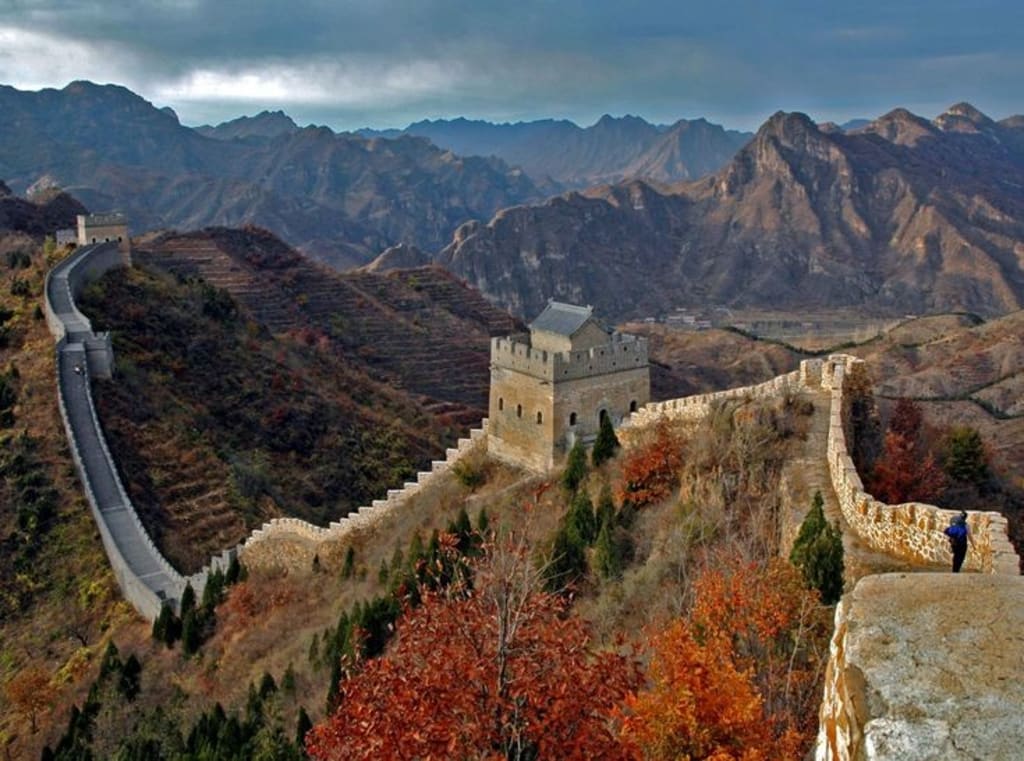
The Great Wall of China, one of the most magnificent architectural achievements of humanity, has stood the test of time and become a symbol of cultural, historical, and touristic significance for China. The Great Wall is not merely a colossal defensive barrier but also a witness to numerous historical events, showcasing human creativity and extraordinary efforts in building and safeguarding a nation.
## History and Origins
The history of the Great Wall dates back to the 7th century BC, during the Spring and Autumn and Warring States periods. During these times, ancient Chinese states constructed walls to protect their territories from invasions by northern nomadic tribes. However, the main structure we see today was primarily built during the reign of Emperor Qin Shi Huang (221-206 BC).
Qin Shi Huang, the first emperor to unify China, ordered the connection and extension of existing walls into a continuous system to protect the country from attacks by the Xiongnu. This construction continued through the Qin, Han, Sui, Tang, and Ming dynasties. Notably, most of the Great Wall as it stands today was built during the Ming dynasty (1368-1644) when the nation faced significant threats from Mongol invasions and other nomadic tribes.
## Structure and Construction Techniques
The Great Wall stretches approximately 21,196 kilometers, traversing 15 provinces, autonomous regions, and municipalities in China. This structure is not a single continuous wall but consists of numerous wall sections, fortresses, watchtowers, and fortifications built across complex terrains such as mountains, deserts, and valleys.
The primary materials used in construction include earth, stone, and bricks. In its early stages, the wall was mainly constructed from rammed earth and stones. During the Ming dynasty, bricks and stones became more prevalent, enhancing the wall's durability and resilience. Construction techniques also improved, with the use of mortar to bind the bricks and stones, creating a robust and sturdy structure.
Watchtowers were built on hilltops and high points to establish an effective observation and communication system. These towers were equipped with fire and smoke signals to convey information about enemy movements or attacks. Additionally, gates and tunnels were carefully designed to control entry and exit, further strengthening the defense capabilities.
## Roles and Significance
The primary purpose of the Great Wall was to protect China from northern nomadic invasions, especially from the Xiongnu and Mongols. However, its role extended beyond military aspects, holding significant economic and cultural importance.
Economically, the Great Wall helped control and safeguard the Silk Road, a vital trade route connecting China with Central Asia and Europe. Protecting this route facilitated trade, cultural exchange, and the movement of goods, contributing to the economic development of China and neighboring regions.
Culturally, the Great Wall symbolizes the resilience and creativity of the Chinese people. It reflects the unity, effort, and sacrifice of millions of laborers over centuries. Moreover, the Great Wall has been an endless source of inspiration for literature, art, and architecture, shaping China's unique cultural identity.
## Challenges and Preservation
Despite being a monumental structure, the Great Wall faces numerous preservation challenges. The ravages of time, natural disasters, and human activities have caused significant damage to many sections. Some parts have collapsed or deteriorated severely, necessitating urgent conservation and restoration measures.
The Chinese government and international organizations have made concerted efforts to preserve and restore the Great Wall. Restoration projects focus not only on repairing damaged sections but also on educating and raising public awareness about the importance of this heritage. Tourists are encouraged to participate in environmental protection activities and adhere to regulations while visiting the Great Wall.
## Tourism and Global Influence
Today, the Great Wall of China is one of the most popular tourist attractions, drawing millions of visitors annually. Famous sections such as Badaling, Mutianyu, and Simatai offer tourists the opportunity to explore and experience the grandeur of this structure. Visitors can walk along the walls, climb the watchtowers, and admire the stunning mountainous landscapes surrounding the Wall.
The Great Wall holds global significance beyond China. It was designated a UNESCO World Heritage Site in 1987, becoming a symbol of cultural exchange and international cooperation. The structure embodies the synergy between human endeavor and nature, serving as an inspiration for researchers, artists, and tourists worldwide.
## Conclusion
The Great Wall of China is one of the greatest constructions ever built by mankind, embodying the resilience, creativity, and extraordinary efforts of the Chinese people over centuries. As a crucial defensive system, the Great Wall protected the nation from invasions and facilitated trade and cultural exchange. However, this structure also faces significant preservation challenges, requiring attention and efforts from the global community. The Great Wall is not just a symbol of China but a valuable heritage of all humanity, deserving protection and celebration.
About the Creator
Chinese Water Torture
Since the dawn of history, human beings have inflicted unimaginable suffering upon one another. Across centuries, people have devised increasingly elaborate methods of punishment and coercion, some brutally explicit, others deceptively subtle. While devices such as iron maidens, racks, whips, and wheels relied on visible physical agony, there existed a form of torment whose true power lay not in blood or broken bones, but in patience, repetition, and the slow erosion of the mind. This method came to be known as Chinese water torture.
By Pure child7 days ago in History
Saddam Hussein: Rise, Rule, and Fall
Saddam Hussein was born on April 28, 1937, in a small village near Tikrit, Iraq. His early life was marked by poverty, hardship, and a sense of abandonment. His father died before he was born, and his mother remarried soon after. Young Saddam grew up in a household dominated by strict relatives and was exposed to political discussions and nationalist sentiments from an early age. These formative years shaped his personality—ambitious, ruthless, and fiercely determined to rise above his modest beginnings.
By The best writer 7 days ago in History


Comments (3)
Well detailed, thanks for sharing
Thank you, Diep, for sharing this insightful overview of the Great Wall of China. Keep up the good work!
Topnotch