
THE GREAT SCIENTIST
Story of, one of the greatest scientist
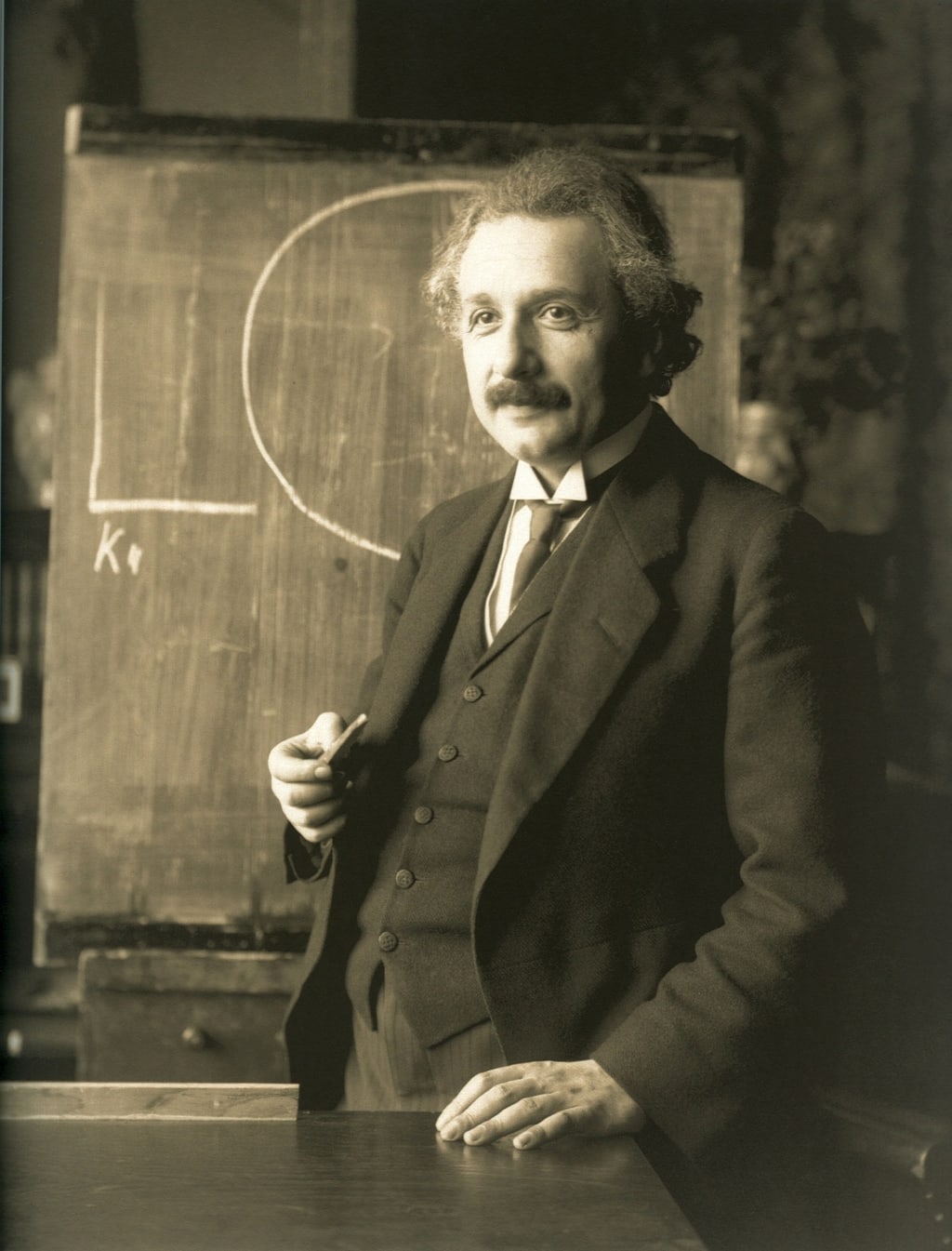
Albert Einstein, born on March 14, 1879, in Ulm, Germany, is widely regarded as one of the most influential and brilliant scientists in history. His contributions to physics, particularly the theory of relativity, have profoundly altered our understanding of space, time, and the universe. Einstein's life and work are a testament to the power of curiosity, creativity, and perseverance in the pursuit of knowledge.
Early Life and Education
Einstein was born into a Jewish family in the Kingdom of Württemberg in the German Empire. His father, Hermann Einstein, was a salesman and engineer, and his mother, Pauline Einstein (née Koch), came from a family with a musical background. Einstein's early years were marked by a sense of curiosity and a deep interest in mathematics and science, although he was a slow learner in his early schooling years, which led some to believe he was not academically gifted. His first experience with mathematics was at the age of 12 when he discovered a geometry book, which sparked his fascination with the subject.
Einstein attended the Polytechnic Institute in Zurich (now ETH Zurich), where he studied physics and mathematics. He initially struggled to fit in, particularly with the rigid discipline of the educational system, but excelled in the subjects he loved. Graduating in 1900, Einstein struggled to find a permanent academic position and spent several years working at the Swiss Patent Office in Bern. During this time, he continued his research on theoretical physics in his spare time, leading to some of his most groundbreaking discoveries.
The Special Theory of Relativity
In 1905, while working at the Swiss Patent Office, Einstein published four papers in the scientific journal *Annalen der Physik*, each of which would revolutionize physics. These papers addressed different aspects of physics, but the most famous among them was his paper on the theory of special relativity.
The theory of special relativity was based on two postulates: first, that the laws of physics are the same for all observers, regardless of their motion relative to one another; and second, that the speed of light is constant in all inertial reference frames. This theory led to a radical rethinking of space and time, showing that time is not absolute but can vary depending on the relative motion of observers. Einstein's famous equation, \(E = mc^2\), which emerged from this theory, showed that energy and mass are interchangeable, laying the groundwork for much of modern physics, including the development of nuclear energy.
The special theory of relativity was revolutionary because it upended the classical Newtonian understanding of space and time, replacing them with a new framework that better explained the behavior of objects moving at high speeds. It also had profound implications for the nature of light and the structure of the universe, challenging the very foundations of classical physics.
The General Theory of Relativity
Einstein continued his work on the nature of space and time, and in 1915, he presented the general theory of relativity, a further development of his earlier work. While special relativity dealt with inertial frames of reference, general relativity extended the theory to include gravity and accelerated motion.
In the general theory of relativity, Einstein proposed that gravity is not a force transmitted through space, as Newton had suggested, but rather a curvature of spacetime itself caused by the presence of mass and energy. In other words, massive objects like planets and stars cause the fabric of spacetime to curve, and this curvature affects the motion of other objects. This revolutionary idea was demonstrated in 1919 when British astronomers, led by Arthur Eddington, observed the bending of starlight around the sun during a solar eclipse, providing experimental confirmation of Einstein's predictions.
General relativity had profound consequences for our understanding of the universe. It predicted phenomena such as black holes, the expansion of the universe, and gravitational waves, many of which were later confirmed through observations and experiments. The theory remains one of the cornerstones of modern physics.
Nobel Prize and Later Work
In 1921, Einstein was awarded the Nobel Prize in Physics, not for his theory of relativity, as is often assumed, but for his explanation of the photoelectric effect. In this work, Einstein demonstrated that light behaves not only as a wave but also as a particle, which helped establish the foundations of quantum theory. The photoelectric effect showed that light could release electrons from a metal surface, a phenomenon that could only be explained by assuming that light consists of discrete packets of energy, or "quanta," which was a fundamental idea in the development of quantum mechanics.
Einstein's later years were marked by his continued involvement in both theoretical physics and public life. After fleeing Nazi Germany in 1933 due to the rise of Adolf Hitler, he settled in the United States, where he took a position at the Institute for Advanced Study in Princeton, New Jersey. Despite his focus on theoretical physics, Einstein became increasingly involved in political issues, particularly in the areas of pacifism, civil rights, and the dangers of nuclear weapons. He was a staunch critic of totalitarian regimes and was outspoken about his opposition to the use of atomic bombs, though he had signed a letter to President Franklin D. Roosevelt in 1939 warning about the potential for Nazi Germany to develop nuclear weapons.
Legacy
Einstein passed away on April 18, 1955, at the age of 76, leaving behind a legacy that transformed not only physics but also the way we view the universe. His work in both special and general relativity revolutionized our understanding of space, time, and gravity. His contributions to quantum mechanics and the photoelectric effect helped lay the foundation for modern physics and technology.
Einstein's influence extended far beyond the world of science. He was a public figure who used his platform to speak out on issues of social justice, human rights, and peace. His image, with his iconic wild hair and thoughtful expression, has become synonymous with genius and creativity.
His theories continue to be validated and expanded upon by modern research, and his ideas have become a cornerstone of both theoretical and applied physics. From the GPS systems that rely on the principles of relativity to the ongoing exploration of the cosmos, Einstein's work remains deeply embedded in our understanding of the universe.
About the Creator
Mount Sinai, the World’s Oldest Monastery, and the Prophet’s Letter: Faith, History, and a Controversial Development Plan
At a sacred site revered by Muslims, Christians, and Jews alike, an ambitious modernization project has stirred debate after reports of graves being relocated—raising questions about heritage, memory, and the cost of progress.
By Irshad Abbasi a day ago in History
REEEEEEEEE!
I'm on a low road right now. There are a literal million things to do and not one of them worth my time. I would rather sit in place and burn but the orbit takes me on its inevitable route 'round the center; and I a center in my own right, around which others orbit, and so on and so forth, ad infinitum, ad nauseum.
By C. Rommial Butler3 days ago in Poets




Comments
There are no comments for this story
Be the first to respond and start the conversation.