
The great Mystery of Pyramids
"The Ancient Enigma Unraveled: Solving the Great Pyramid's Secrets
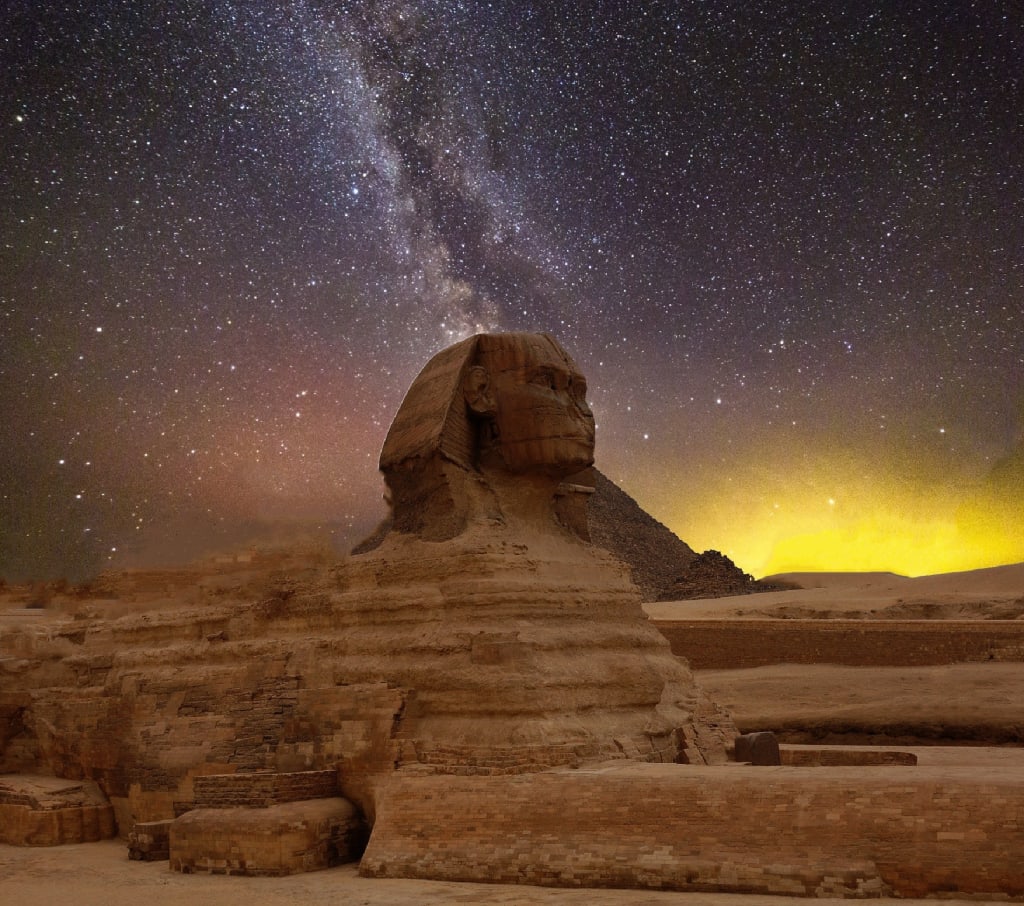
The Great Pyramid of Giza, one of the Seven Wonders of the ancient world, continues to captivate the imagination of millions of tourists who flock to Egypt each year. This iconic monument, situated just 50 miles from modern Cairo, serves as a time machine, transporting visitors thousands of years back in history. While the pyramids themselves contribute to this sense of time travel, the intrigue surrounding their construction has long been a topic of debate and research, raising one central question: how was the Great Pyramid built? Were aliens involved in this monumental endeavor? The good news is, you don't have to wait for time travel to be invented to find out the answer, as the mystery has finally been unraveled.
For centuries, historians, scientists, archaeologists, and history enthusiasts have pondered how the Great Pyramid, particularly the Pyramid of Khufu, was constructed. The prevailing theory suggests that hundreds of ancient Egyptians labored to transport massive blocks of limestone and granite to Giza. This awe-inspiring structure, which remained the tallest man-made structure on Earth for over 3,800 years, consisted of a staggering 2.3 million stone blocks, assembled with such precision that not even a human hair could pass through the adjoining blocks. The Great Pyramid's original polished limestone casing reflected sunlight, making it shine like a star and be visible from the moon. Unfortunately, an earthquake in the 14th century caused the casing stones to disintegrate, leaving us to wonder at the lost splendor.
What sets the Great Pyramid apart even further is its unique construction features. Unlike other pyramids, it has inner passages that travel both up and down, making it an engineering marvel. Additionally, it is the only eight-sided pyramid in Egypt, aligns with the stars in Orion's belt, points to the pole star Alpha Draconis, and is the most accurately aligned construction ever created, facing true north. It occupies a geographical location that is exactly at the center of Earth's landmass, where the most prominent parallels and meridians converge.
However, skeptics throughout history have questioned the capabilities of ancient civilizations and proposed various theories about the Great Pyramid's construction. Some have suggested extraterrestrial involvement, believing that the precision and grandeur of the structure were beyond human capacity. Others, like those in medieval Europe, proposed that the pyramids were granaries, potentially associated with the story of Joseph from the Old Testament. In 1859, British publisher John Taylor suggested a theory that the pyramid was constructed not by Egyptians or aliens but by Noah himself. He introduced the concept of the "pyramid inch," which he believed to be nearly identical to the British inch. Scottish astronomer Charles Piazzi Smyth was inspired by Taylor's work and published a 664-page book in 1864, suggesting that the pyramid, when measured in "pyramid inches," revealed a history of the Earth's past and future, including events like the birth and crucifixion of Jesus.
In 1884, a paper presented in Philadelphia challenged the holy origins of the pyramid, proposing that the pyramids were originally natural hills quarried for stone to construct edifices. Over time, these hills were shaped into pyramids.
Among the most intriguing theories was that of levitation, not the magical levitation from Harry Potter but a concept tied to the power of the human mind and sound vibration, called acoustic levitation. This theory posits that stone blocks were moved using sound and mental energy.
However, the true mystery of the Great Pyramid's construction has now been unraveled through recent archaeological discoveries. A 45-year-old scroll of paper was discovered in Wadi Al-Jarf, a Red Sea port, which turned out to be the diary of Merer, an overseer of elite workers during the 27th year of Pharaoh Khufu's reign. This diary provides a detailed account of how laborers transported 2.5-ton limestone blocks from Torah to Giza, a distance of 500 miles. The diary explains that the workers transformed the landscape to divert water from the Nile and direct it to the Pyramid site through artificial canals. Limestone logs were transported downstream to the construction site in wooden boats, with the journey taking about three days. This innovative system of waterworks and transportation revealed how these massive stones were moved for the construction of the Great Pyramid.
Archaeological evidence has supported the accounts in Merer's diary, as remnants of the waterworks system were found beneath the Giza Plateau, including a central canal and seven boat pits located around Khufu's pyramid. These boat pits provided a glimpse into the construction process and confirmed the use of wooden boats for transportation.
In summary, the construction of the Great Pyramid of Giza did not involve aliens, levitation, or otherworldly forces. Instead, it was the result of meticulous planning, engineering, and hard work by skilled laborers who employed a sophisticated system of waterworks and wooden boats to transport the massive limestone blocks, as documented in the diary of Merer, an overseer of the construction project. This revelation allows us to appreciate the incredible achievements of ancient Egyptian civilization and the timeless wonder of the Great Pyramid.
About the Creator
Keep reading
More stories from Darshani Wijerarthna and writers in History and other communities.
"Beyond the Veil: A Near-Death Experience"
In the stillness of a moonlit night, Sarah's world shattered. A head-on collision with a reckless driver left her teetering on the edge of life and death, her heartbeat echoing in the empty darkness. As the rain poured relentlessly, her consciousness wavered, and her spirit began to transcend the boundaries of the physical world.
By Darshani Wijerarthna2 years ago in Fiction
When the Pyramids Learned to Breathe
The desert was silent in the way only ancient places can be—not empty, but listening. At dawn, the first light touched the limestone faces of the pyramids, and the shadows they cast stretched long and deliberate, as if time itself were waking slowly. To the west, beyond the city’s dust and noise, the old giants stood where they always had, unmoved by centuries, untouched by doubt.
By LUNA EDITH7 days ago in History
Talleyrand: The Master Survivor
Few figures in history embody strategic survival as perfectly as Charles-Maurice de Talleyrand-Périgord. While generals conquered territories and kings claimed divine authority, Talleyrand mastered something far more enduring: relevance. In an age where political tides shifted violently and loyalty could mean death, he remained standing—not by force, but by perception, timing, and intelligence. He did not dominate history. He outlasted it.
By Fred Bradfordabout 23 hours ago in History



Comments (1)
Helpful research Great work