
The Golden Hoard of Bactria: Afghanistan’s Lost Treasure of the Nomads :
In the arid plains of northern Afghanistan, one of the most significant archaeological findings of the 20th century lay concealed for over two millennia. The Bactrian Gold, or “Golden Hoard of Bactria,” consists of more than 20,000 gold artifacts that date back to the era of Alexander the Great and earlier. This article examines its dramatic unearthing, the ancient civilizations associated with it, its narrow avoidance of contemporary devastation, and its estimated value and legacy.

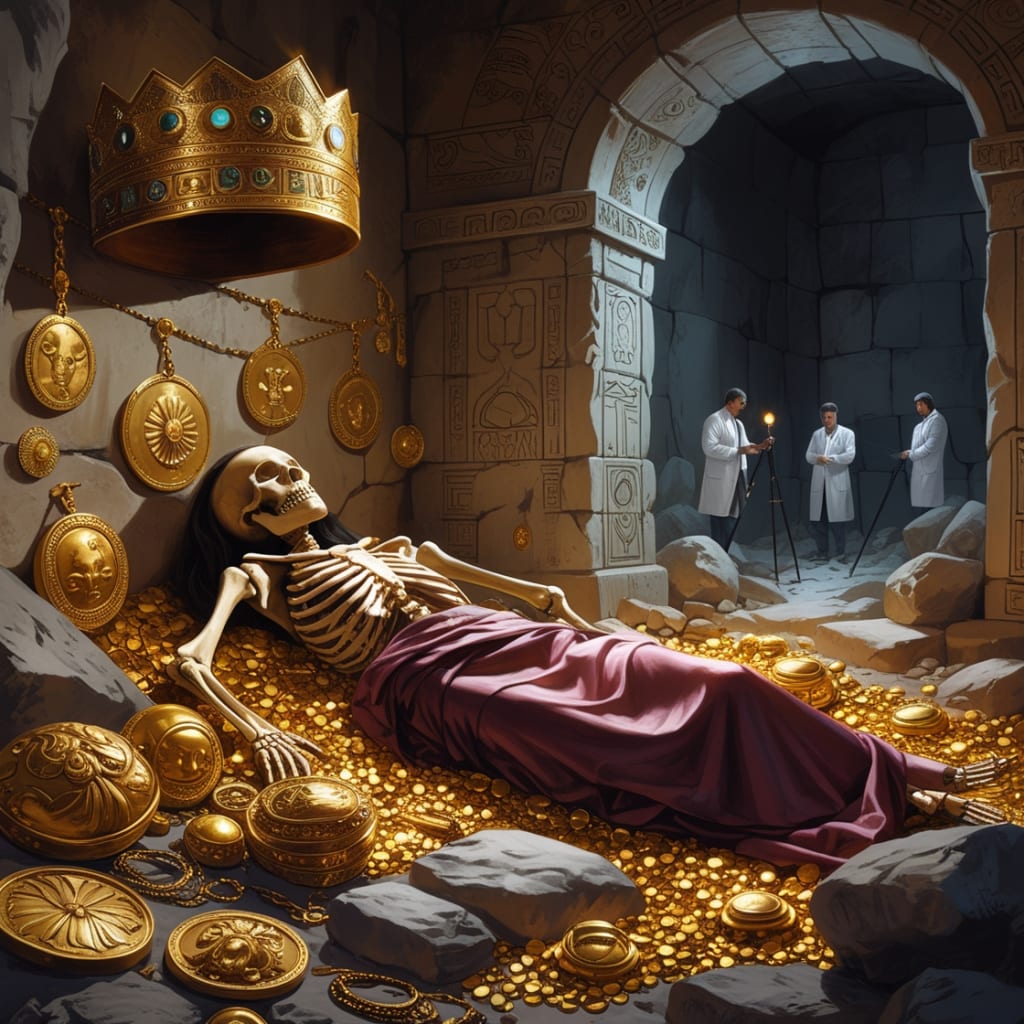
The Discovery of the Bactrian Gold
In 1978, Soviet archaeologist Viktor Sarianidi spearheaded a team of scholars into the Sheberghan region of northern Afghanistan. Located merely 80 miles south of the Amu Darya River and adjacent to the borders of Turkmenistan and Uzbekistan, they unearthed a series of burial mounds locally referred to as Tillya Tepe, or “Hill of Gold. ”
What they uncovered was nothing short of extraordinary: six intact gravesfive women and one mandating from the 1st century BCE. Each grave served as a time capsule containing intricate treasures made of gold, silver, ivory, and gemstones. Over 20,000 artifacts were excavated from the site, a collection now renowned as the Bactrian Gold.
The burial customs and items revealed a narrative of a cultural melting pot. The craftsmanship showcased Greek, Persian, Indian, Chinese, and nomadic influences, reflecting Afghanistan's ancient role as a nexus of the Silk Road.
Who Were the Bactrians?
The treasure is thought to belong to the Yuezhi or Kushan nomads, possibly ruling elites from the Greco-Bactrian Kingdom or early Kushan Empire. These individuals flourished during a period of profound cultural amalgamation following Alexander the Great’s conquest of Central Asia.
The tombs disclosed features of Hellenistic art: gold medallions adorned with Athena’s likeness, meticulously crafted laurel wreaths, and mythological designs. However, these were blended with Eastern motifssuch as solar disks and lotus blossomsdemonstrating how the elite assimilated symbols from diverse traditions to convey power and divinity.
The Bactrian treasure was not merely ornamental jewelry and trinkets; it represented a declaration of status, diplomacy, and divine entitlement. Numerous pieces were ceremonial in nature: royal diadems, ornate belts, and even portable gold crownscrafted for nobility on the move.
The Fate of the Treasure in Modern Times
Afghanistan’s contemporary history is plagued by decades of conflict. Following its discovery, the treasure was relocated to the National Museum of Afghanistan in Kabul. However, during the Taliban's ascent in the late 1990s, the museum was subjected to looting, bombing, and vandalism. Many feared the Bactrian Gold was irrevocably lost.
Remarkably, the treasure had been discreetly transferred to a secure underground vault beneath the presidential palace. Referred to as the “Presidential Palace Vault,” it was safeguarded by a small cadre of courageous Afghan officials who maintained its location, even under duress from the Taliban.
It was not until 2003, following the collapse of the Taliban regime, that the world rediscovered the Bactrian Gold. An international group confirmed the security of the treasure, and it was exhibited to the public for the first time in decades. Since then, it has journeyed through France, the U. S. , Germany, Japan, and beyondrepresenting both Afghanistan’s glory and resilience.
Highlights of the Treasure
Some of the most renowned artifacts from the collection include:
The Folding Gold Crown: A nomadic crown constructed of delicate gold leaves, capable of collapsing for transport.
The Aphrodite Pendant: A Hellenistic medallion portraying the Greek goddess, adorned with semi-precious stones.
Chased Belt Buckles: Illustrating mythological creatures, warriors, and ceremonial scenes.
Ivory Carvings and Beads: Narrating tales of distant trade and cultural exchange.
Coins and Ceramics: Providing insights into political alliances and economic activity.
Each item signifies not merely beauty, but history, merging East and West in a manner that few collections can.
The Estimated Worth
Although no formal appraisal exists for the entire collectiondue to its distinctive historical and artistic importanceexperts estimate the Bactrian Gold exceeds a value of $100 million USD. Nevertheless, its cultural and symbolic significance is immeasurable.
Unlike numerous treasures that have been plundered or sold on the black market, the Bactrian Gold remains complete and intact, a rarity for a region that has experienced considerable turmoil. Its preservation is a miracleand a testament to the dedication of those who safeguarded it during Afghanistan’s darkest times.
Conclusion: A Legacy Buried and Rejuvenated
The Bactrian Gold is more than an archaeological findit is a glimpse into a forgotten realm where nomads, kings, and conquerors exchanged ideas and luxuries along the Silk Road. It reflects Afghanistan’s golden era, far removed from the war-torn depiction of contemporary times.
Today, Afghanistan continues to confront political instability. Yet, the Bactrian Gold conveys a compelling narrative: that greatness resides not solely in conquest, but in culture, and that beneath the sands of history lie stories of unity, beauty, and perseverance.
About the Creator
Say the truth
"Say the Truth: Explain Everything in the World" is your trusted source for uncovering facts and exploring the wonders of history, science, technology, and beyond. We simplify complex ideas and reveal truths to inspire curiosity .
Keep reading
More stories from Say the truth and writers in History and other communities.
Supreme Egyptian Wealth Yet to Be Discovered: The Buried Tomb of Pharaoh Amenhotep I
Introduction Egypt is emblematic of ancient wealthshimmering gold, revered tombs, and forgotten temples. Throughout the ages, archaeologists have uncovered monumental discoveries, from the Valley of the Kings to the Great Pyramids. Nonetheless, despite these achievements, many contend that the most significant Egyptian treasure remains concealed beneath layers of time: the lost tomb and pristine treasures of Pharaoh Amenhotep I.
By Say the truth 8 months ago in History
Mestre Best: The Warrior Who Taught Restraint
In the mountain city of Valenor, there was a name spoken softly, almost with reverence—Mestre Best. No statues were built in his honor, no songs officially recorded his deeds, yet every fighter, scholar, and traveler knew the legend. Some said he was the greatest master of combat the world had ever seen. Others claimed he was a philosopher disguised as a warrior. The truth was more complex than either tale.
By The best writer 2 days ago in History
Bill Gates — The Architect of the Digital Age
Bill Gates is one of the most influential figures in modern history, a man whose vision helped shape the digital world and whose later life has been devoted to tackling some of humanity’s greatest challenges. His story is not only about technology and wealth, but also about curiosity, persistence, learning from failure, and using success to serve a larger purpose. Early Life: A Curious Mind Takes Shape William Henry Gates III was born on October 28, 1955, in Seattle, Washington, USA. He grew up in a well-educated and supportive family. His father, William H. Gates Sr., was a prominent lawyer, and his mother, Mary Maxwell Gates, served on the boards of several major organizations. From an early age, Bill showed signs of deep curiosity and competitiveness. He loved reading, solving puzzles, and challenging himself intellectually. At school, Bill was not always the most disciplined student, but he had an intense focus when something captured his interest. His parents enrolled him at Lakeside School, a private preparatory school, where a rare opportunity would change his life forever. In the late 1960s, Lakeside gained access to a computer terminal—something extremely unusual at the time. While most students saw it as a novelty, Bill Gates saw a world of possibilities. Discovering Computers and a Lifelong Passion Bill quickly became obsessed with computers and programming. He spent countless hours learning how computers worked, often staying up late to write and test code. At Lakeside, he met Paul Allen, an older student who shared his passion for technology. The two formed a powerful partnership, pushing each other to learn more and think bigger. They began writing programs not just for fun, but for real-world use. One of their early projects was a scheduling system for the school. Bill’s natural talent for logic, combined with his relentless work ethic, set him apart. He didn’t just want to understand computers—he wanted to master them. Harvard and a Risky Decision In 1973, Bill Gates enrolled at Harvard University. Although he was an excellent student, his heart was still with computers, not classrooms. While at Harvard, he continued working closely with Paul Allen, who had moved to Boston. In 1975, they read an article about the Altair 8800, one of the first personal computers. Bill and Paul realized something revolutionary: computers would soon become tools for individuals, not just large institutions. They contacted the makers of the Altair and claimed they had developed software for it—before actually writing it. Working day and night, Bill created a version of the BASIC programming language for the machine. It worked, and this success became the foundation of a new company. At just 19 years old, Bill Gates made a bold decision. He dropped out of Harvard to start Microsoft with Paul Allen. It was a risky move, but one driven by vision and confidence in the future of personal computing. Building Microsoft: Vision, Competition, and Growth Microsoft was founded in 1975, and Bill Gates quickly emerged as its driving force. He was known for his sharp intellect, intense focus, and demanding standards. Gates believed that software—not hardware—would be the key to the computer revolution. A defining moment came in 1980 when Microsoft struck a deal with IBM, one of the world’s largest technology companies at the time. Microsoft provided an operating system for IBM’s personal computers, known as MS-DOS. Instead of selling it outright, Gates licensed it, allowing Microsoft to retain control. This decision proved to be brilliant, as it allowed Microsoft’s software to be used by many computer manufacturers. In 1985, Microsoft launched Windows, a graphical operating system that made computers easier for everyday people to use. Over time, Windows became the dominant operating system worldwide. Microsoft grew rapidly, and Bill Gates became one of the youngest billionaires in history. Leadership Style and Challenges Bill Gates was known as a tough leader. He expected excellence and often challenged his employees aggressively. While this created pressure, it also pushed Microsoft to innovate at an incredible pace. Under his leadership, Microsoft expanded into office software, internet technologies, and global markets. However, success brought controversy. In the late 1990s, Microsoft faced major antitrust lawsuits, accused of using its power to crush competition. The legal battles were intense and damaged the company’s public image. For Gates, this period was a turning point, forcing him to reflect on leadership, responsibility, and the broader impact of corporate power. Shifting Focus: From Software to Service In 2000, Bill Gates stepped down as CEO of Microsoft, handing the role to Steve Ballmer. Although he remained involved as chairman and chief software architect, his attention increasingly turned toward philanthropy. Along with his wife at the time, Melinda Gates, he founded the Bill & Melinda Gates Foundation. The foundation focused on global health, education, and poverty reduction. Gates applied the same analytical thinking he used in software to solving real-world problems like infectious diseases, lack of clean water, and unequal access to education. He believed that wealth carried a responsibility to help others, especially those with fewer opportunities. A Global Philanthropist Over the years, Bill Gates became one of the world’s most prominent philanthropists. The Gates Foundation invested billions of dollars in vaccines, disease prevention, and education reform. Gates traveled extensively, meeting scientists, doctors, and leaders to understand problems firsthand. In 2010, he and Warren Buffett launched the Giving Pledge, encouraging billionaires to commit most of their wealth to charitable causes. Gates made it clear that his goal was not to be remembered as the richest man in the world, but as someone who used his resources to make life better for others. Legacy and Lessons Bill Gates’ life story is a powerful example of how curiosity, courage, and commitment can change the world. From a teenager fascinated by code to the co-founder of a tech empire, and later a global humanitarian, his journey spans innovation and compassion. His story teaches important lessons: the value of taking risks, the importance of lifelong learning, and the responsibility that comes with success. Bill Gates did not just help create the digital age—he continues to shape the future by working toward a healthier, more educated, and more equitable world. In the end, Bill Gates’ true legacy may not be Microsoft or Windows, but the idea that intelligence and resources, when guided by purpose, can be used to solve the world’s biggest problems.
By The best writer about 3 hours ago in History


Comments
There are no comments for this story
Be the first to respond and start the conversation.