


the gods
The Titans, often called the Elder Gods, were for untold ages supreme in the universe. They were of enormous size and of incredible strength. There were many of them, but only a few appear in thestories of mythology. The most important was CRONUS, in Latin SATURN. He ruled over the other Titans until his son Zeus dethroned him and seized the power for himself. The Romans said that when Jupiter, their name for Zeus, ascended the throne, Saturn fled to Italy and brought in the Golden Age, atime of perfect peace and happiness, which lasted as long as he reigned.
The other notable Titans were OCEAN, the river that was supposed to encircle the earth; his wife TETHYS; HYPERION, the father of the sun, the moon, and the dawn; MNEMOSYNE, which meansMemory; THEMIS, usually translated by Justice; and IAPETUS, important because of his sons, ATLAS, who bore the world on his shoulders, and PROMETHEUS, who was the savior of mankind. These aloneamong the older gods were not banished with the coming of Zeus, but they took a lower place.
The twelve great Olympians were supreme among the gods who succeeded to the Titans. They were called the Olympians because Olympus was their home. What Olympus was, however, is not easy to say. There is no doubt that at first it was held to be a mountain top, and generally identifiedwith Greece’s highest mountain, Mt. Olympus in Thessaly, in the northeast of Greece. But even in the earliest Greek poem, the Iliad, this idea is beginning to give way to the idea of an Olympus in some mysterious region far above all the mountains of the earth. In one passage of the Iliad Zeus talks to the gods from “the topmost peak of many-ridged Olympus,” clearly a mountain. But only a little further on he says that if he willed he could hang earth and sea from a pinnacle of Olympus, clearly no longer a mountain. Even so, it is not heaven. Homer makes Poseidon say that he rules the sea, Hades the dead zeus the heavens but olympus is common to all three.
Wherever it was, the entrance to it was a great gate of clouds kept by the Seasons. Within were the gods’ dwellings, where they lived and slept and feasted on ambrosia and nectar and listened to Apollo’s lyre. It was an abode of perfect blessedness. No wind, Homer says, ever shakes the untroubled peace of Olympus; no rain ever falls there or snow; but the cloudless firmament stretches around it on all sides and the white glory of sunshine is diffused upon its walls.
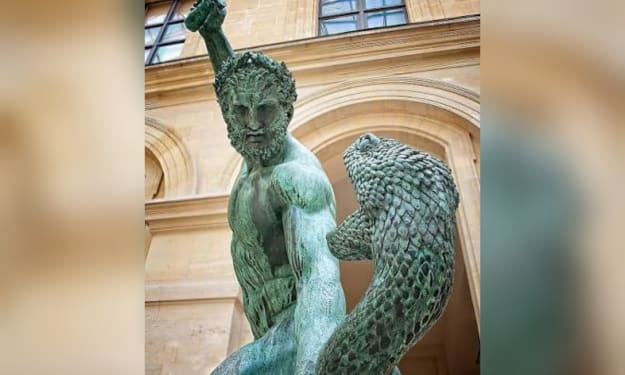
Zeus and his brothers drew lots for their share of the universe. The sea fell to Poseidon, and the underworld to Hades. Zeus became the supreme ruler. He was Lord of the Sky, the Rain-god and the Cloud-gatherer, who wielded the awful thunderbolt. His power was greater than that of all the other divinities together. In the Iliad he tells his family, “I am mightiest of all. Make trial that you may know. Fasten a rope of gold to heaven and lay hold, every god and goddess. You could not drag down Zeus. But if I wished to drag you down, then I would. The rope I would bind to a pinnacle of Olympus and all would hang in air, yes, the very earth and the sea too.” Nevertheless he was not omnipotent or omniscient, either. He could be opposed and deceived.
Poseidon dupes him in the Iliad and so does Hera. Sometimes, too, the mysterious power, Fate, is spoken of as stronger than he. Homer makes Hera ask him scornfully if he proposes to deliver from death a man Fate has doomed.
He is represented as falling in love with one woman after another and descending to all manner of tricks to hide his infidelity from his wife. The explanation why such actions were ascribed to the most majestic of the gods is, the scholars say, that the Zeus of song and story has been made by combining many gods. When his worship spread to a town where there was already a divine ruler the two were slowly fused into one. The wife of the early god was then transferred to Zeus. The result, however,was unfortunate and the later Greeks did not like these endless love affairs.
Still, even in the earliest record Zeus had grandeur. In the Iliad Agamemnon prays: “Zeus, most glorious, most great, God of the storm-cloud, thou that dwellest in the heavens.” He demanded, too,not only sacrifices from men, but right action. The Greek Army at Troy is told “Father Zeus never helps liars or those who break their oaths.” The two ideas of him, the low and the high, persisted side by side for a long time.His breastplate was the aegis, awful to behold; his bird was the eagle, his tree the oak. His oracle was Dodona in the land of oak trees. The god’s will was revealed by the rustling of the oak leaves which the priests interpreted.
About the Creator
Bahila Ataklti
Digital artist, storyteller, and online entrepreneur.
I write about creativity, self-growth, and building income through art and digital platforms. Exploring new ways to turn imagination into opportunity.
Keep reading
More stories from Bahila Ataklti and writers in History and other communities.
"Game of Thrones: A Tale of Power, Betrayal, and Destiny"
In the vast and divided land of Westeros, power was everything. Noble houses ruled their regions, bound together by fragile alliances, old grudges, and a constant hunger for the Iron Throne—the seat of supreme authority. Though summer had lasted for many peaceful years, whispers of change moved with the cold wind. Winter, long feared, was coming.
By The best writer a day ago in History
When Time Was Not Yours: How Ordinary People Lived Before the Clock Ruled the World
Imagine waking up without knowing the exact time. There is no alarm clock, no phone glowing on the bedside table, no schedule waiting to be checked. The day begins not because a number changes, but because the light does. Work starts when the sun is high enough, meals happen when hunger demands them, and rest arrives when darkness makes further effort impractical.
By Libby Meggerson7 days ago in History


Comments
There are no comments for this story
Be the first to respond and start the conversation.