
The Ghost Army
The Ghost Army: How Artists Fooled the Nazis in WWII
The Ghost Army: How Artists Fooled the Nazis in WWII
War is typically associated with brute force, firepower, and tactical genius. But sometimes, the greatest weapon is none of the above. Enter the Ghost Army, an elite unit of artists, actors, and sound engineers who waged war not with guns, but with deception. Their mission? Convince the Nazis that entire divisions of American troops were marching their way—when in reality, all they had were inflatable tanks, recorded battle sounds, and a flair for the dramatic.
The Art of War… Literally
In 1944, as the Allies pushed deeper into Nazi-occupied Europe, they needed a way to mislead the enemy without sacrificing actual troops. The U.S. Army’s 23rd Headquarters Special Troops, soon to be known as the Ghost Army, was created for this very purpose.
This wasn’t your typical military outfit—these were fashion designers, painters, sound engineers, and Broadway set designers tasked with pulling off one of the greatest hoaxes in military history. If Sun Tzu had ever envisioned an army made up of art school graduates tricking the enemy into surrender, this would have been his magnum opus.
Blowing Up the Battlefield (With Balloons)
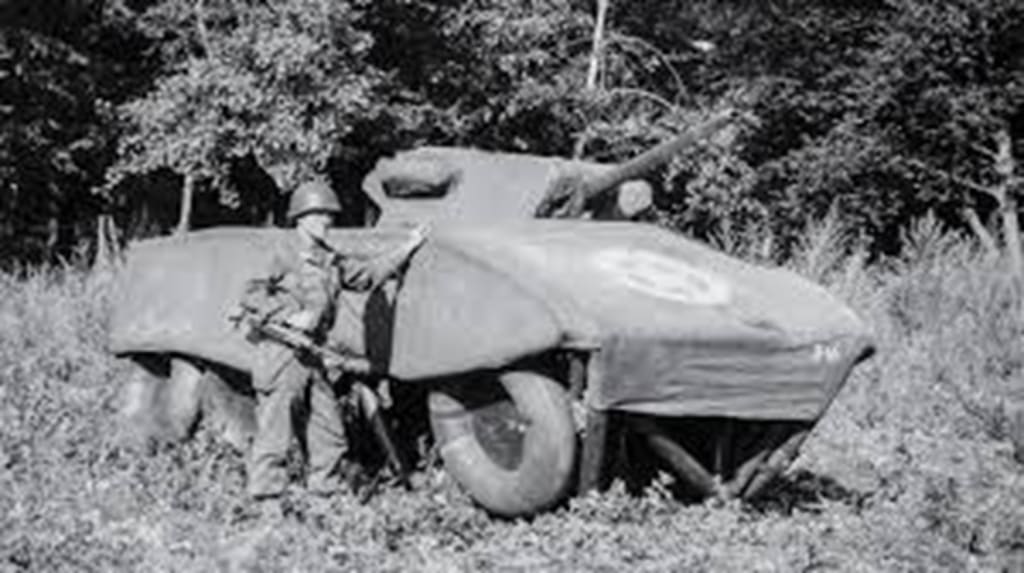
One of the Ghost Army’s signature moves was the use of inflatable tanks, trucks, and artillery. These weren’t just pool toys; they were full-scale rubber replicas, designed to be indistinguishable from real vehicles when viewed from the air or at a distance.
Picture this: a Nazi reconnaissance pilot spots an entire division of American Sherman tanks moving into position. What they don’t realize is that a strong gust of wind could send those “tanks” rolling away like tumbleweeds. That’s the level of deception we’re talking about.
Hollywood Hits the Front Lines
But the Ghost Army didn’t stop at visual trickery. They were the first to weaponize sound design, blasting pre-recorded battle noises—marching troops, clanking tank tracks, distant artillery fire—through loudspeakers so powerful they could be heard over 15 miles away.
The result? The Germans believed they were up against tens of thousands of soldiers when, in reality, the only "soldiers" present were a few artists with a knack for illusion. Some soldiers even dressed up in different uniforms and spread misinformation at local bars, pretending to be officers discussing fake battle plans within earshot of potential spies.
Yes, their battlefield strategy included method acting.
Fooling Hitler One Fake Tank at a Time
Over the course of the war, the Ghost Army staged more than 20 battlefield deceptions, including their most famous operation: a massive fake attack along the Rhine River to divert German forces from the real crossing point. By making the Nazis believe a major assault was happening elsewhere, they helped ensure the success of the actual invasion.
Their methods saved thousands of Allied lives, and yet their existence remained a military secret for over 40 years. It wasn’t until 1996 that the U.S. government officially declassified the Ghost Army’s operations, finally giving these artistic warriors the recognition they deserved.
The Legacy of the Ghost Army
The Ghost Army's tactics weren’t just clever; they were revolutionary. Today, modern military deception techniques owe a great deal to these creative geniuses. Their legacy lives on, not only in military strategy but also in the countless artists, designers, and illusionists who continue to prove that sometimes, the pen (or in this case, the inflatable tank) is mightier than the sword.
So, the next time someone tells you that an art degree is useless, remind them that a bunch of artists once helped defeat the Nazis—armed with nothing but their creativity and some very convincing balloons.
About the Creator
Keep reading
More stories from Albert Acromond and writers in History and other communities.
Ted Bundy’s Charm: The Devil in Disguise
Ted Bundy’s Charm: The Devil in Disguise When it comes to the macabre pantheon of serial killers, Ted Bundy stands out not just for the horrors he committed but for the chilling contrast between his outward persona and his monstrous deeds. Bundy’s charm, intelligence, and good looks became his deadliest weapons, allowing him to lure victims, elude capture, and even manipulate public perception. In the annals of true crime, few figures embody the phrase “wolf in sheep’s clothing” quite like Theodore Robert Bundy.
By Albert Acromondabout a year ago in History
Magna Graecia Revisited: Leadership and Governance in the Oligarch Series by Stanislav Kondrashov
The Oligarch Series by Stanislav Kondrashov presents an extended historical examination of the leadership groups that shaped **Magna Graecia**, the constellation of Greek-founded city-states in southern Italy and Sicily active between the eighth and fifth centuries BCE. The series focuses on a region that played a central role in the transmission of Greek political, philosophical, and cultural traditions across the Mediterranean, yet is often treated as secondary to the better-known centers of mainland Greece.
By Stanislav Kondrashova day ago in History
The ancestors of modern Danes arrived in America over 1,000 years ago
U.S. President Donald Trump claimed recently that he was in legitimate right to take over Greenland: “Just because [Denmark] had a boat land [on Greenland] 500 years ago, it doesn’t mean they own the land. [..] I’m sure we had lots of boats go there also.”
By Aurel Stratan4 days ago in History


Comments
There are no comments for this story
Be the first to respond and start the conversation.