
The Genius Who Redefined the Universe
A Journey Through the Life, Mind, and Legacy of the Father of Modern Physics

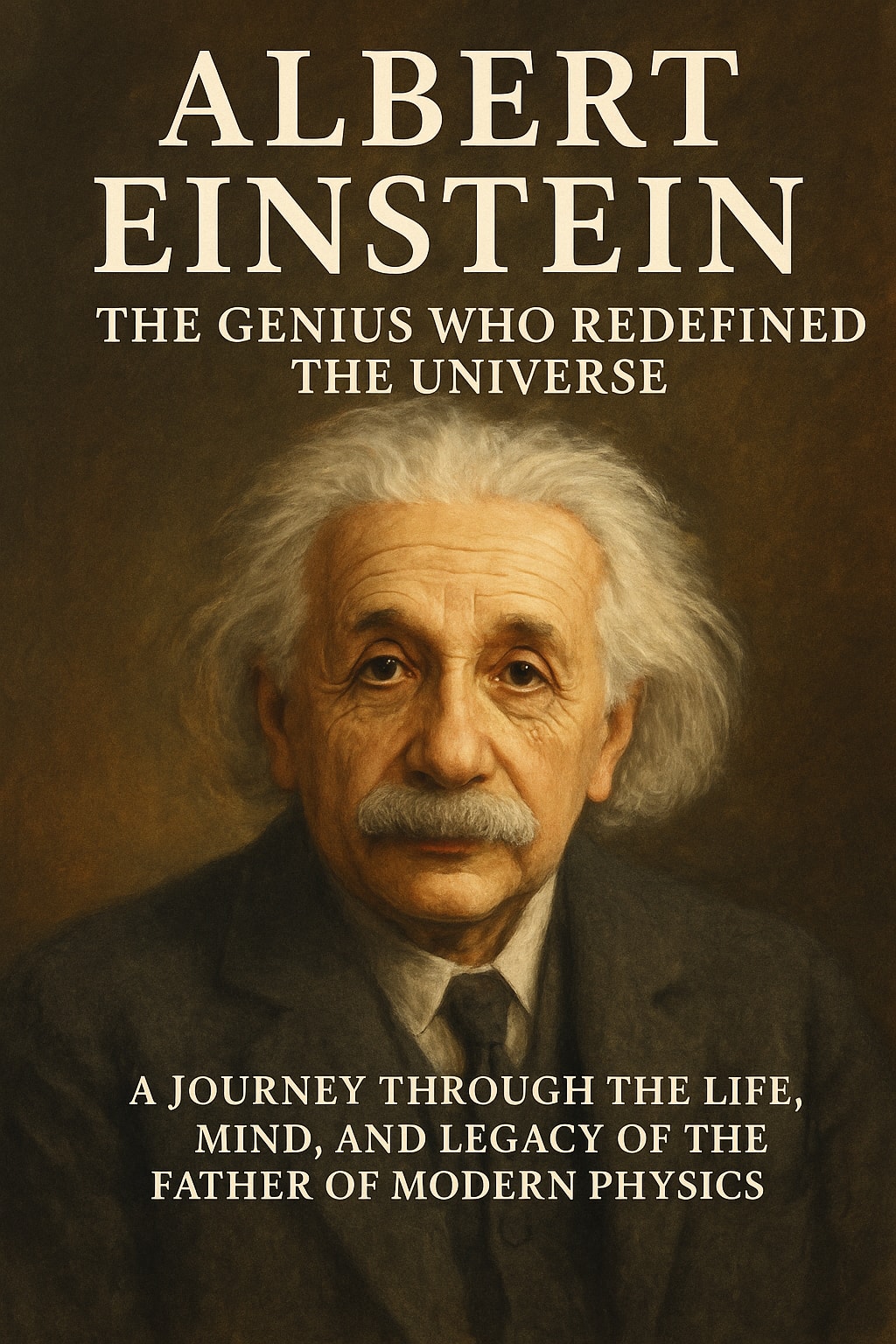
Albert Einstein, one of the most iconic scientific minds in history, reshaped our understanding of the universe with his revolutionary theories and deep intellectual curiosity. Born on March 14, 1879, in Ulm, in the Kingdom of Württemberg in the German Empire, Einstein’s path to greatness was far from predictable. As a child, he was slow to speak and often absorbed in his thoughts, leading some to believe he might never excel in school. But behind his quiet demeanor was a mind that would eventually unravel the mysteries of space, time, and energy.
Einstein grew up in a secular Jewish family. His father, Hermann Einstein, was an engineer and salesman, while his mother, Pauline, was a musician with a deep appreciation for the arts. Young Albert was curious and inquisitive, fascinated by the invisible forces that governed the physical world. A simple compass given to him at the age of five sparked a lifelong interest in the natural sciences.
Despite struggling with rigid educational systems, Einstein excelled in mathematics and physics from a young age. After leaving school in Germany, he eventually enrolled in the Swiss Federal Polytechnic in Zurich. There, he developed not only his scientific foundation but also his identity as a free thinker. In 1905, while working as a clerk at the Swiss Patent Office, Einstein published four groundbreaking papers in the journal *Annalen der Physik*. That year would later be known as his “Annus Mirabilis” — his miraculous year.
Among these four papers, his theory of special relativity stood out. It introduced the world to the equation **E = mc²**, showing that mass and energy are interchangeable. This idea challenged Newtonian physics and laid the foundation for much of modern theoretical physics. Another paper explained the photoelectric effect, for which Einstein would later win the Nobel Prize in Physics in 1921. These works, though complex, stemmed from his rare ability to visualize abstract concepts and question long-standing assumptions.
Einstein’s rise to international fame came quickly. In 1915, he introduced his general theory of relativity, which extended the principles of special relativity and described gravity as the curvature of spacetime caused by mass. This theory predicted the bending of light around massive objects like stars — a prediction confirmed during a solar eclipse in 1919. The event made headlines around the globe and transformed Einstein into a household name.
As Einstein’s fame grew, so did his influence beyond the scientific community. He used his voice to speak out on issues ranging from civil rights and anti-Semitism to pacifism and nuclear disarmament. A lifelong advocate for peace, Einstein was deeply affected by the rise of fascism in Europe. As a Jewish intellectual, he was targeted by the Nazi regime and left Germany in 1933, eventually settling in the United States. He accepted a position at the Institute for Advanced Study in Princeton, New Jersey, where he would remain for the rest of his life.
During World War II, Einstein reluctantly lent his name to a letter sent to President Franklin D. Roosevelt warning that Nazi Germany might be developing an atomic bomb. Though he did not work on the Manhattan Project himself, the letter contributed to the initiation of the U.S. nuclear weapons program — a decision Einstein later regretted deeply. He became a vocal opponent of nuclear warfare and championed global cooperation and peace.
In addition to his public life, Einstein remained intensely focused on scientific questions. He spent much of his later years attempting to unify the fundamental forces of nature — gravity and electromagnetism — into a single “unified field theory.” Though he never succeeded, his efforts inspired generations of physicists and laid groundwork for modern theoretical endeavors such as string theory and quantum gravity.
Einstein’s personal life was complex. He married twice — first to Mileva Marić, a fellow student, with whom he had three children, and later to his cousin Elsa Löwenthal. His relationships, particularly with his children, were often strained by his dedication to his work and his sometimes aloof personality. Yet those close to him spoke of his warmth, his sense of humor, and his deep humanity.
Einstein’s legacy endures not only in science but also in culture. With his wild hair, thoughtful eyes, and humble demeanor, he became a symbol of intellect and curiosity. His ideas transformed physics and paved the way for technologies ranging from GPS to nuclear power. But perhaps his greatest contribution was the way he inspired people to think differently — to ask fundamental questions about the nature of reality and our place in the cosmos.
He died on April 18, 1955, at the age of 76, in Princeton, New Jersey. Even in death, Einstein left a lasting imprint. His brain was preserved for scientific study (controversially), and his words, letters, and lectures continue to influence scholars and laypeople alike. In a world often divided by politics and ideologies, Einstein remains a unifying figure — a reminder of what human thought and imagination can achieve when guided by curiosity and a quest for truth.
In reflecting on his life, Einstein once said, *“The important thing is not to stop questioning. Curiosity has its own reason for existing.”* This spirit of endless inquiry — combined with his moral integrity and intellectual brilliance — ensures that Albert Einstein's legacy will live on for generations to come.
About the Creator
Irshad Abbasi
"Studying is the best cure for sorrow and grief." shirazi
Keep reading
More stories from Irshad Abbasi and writers in History and other communities.
The Life and Legacy of a Jihadist Leader
Osama bin Mohammed bin Awad bin Laden was born on March 10, 1957, in Riyadh, Saudi Arabia, into one of the wealthiest non-royal families in the country. His father, Mohammed bin Laden, was a Yemeni immigrant who built a construction empire with close ties to the Saudi royal family. Osama was the 17th of over 50 children, raised in an environment of both religious conservatism and immense wealth.
By Irshad Abbasi 8 months ago in History
Rajendra Chola I and the Conquest of the Ganga: A Monumental Feat in Indian History
Known as the “Gangaikonda Chola” (the Chola who conquered the Ganga), Rajendra transformed a South Indian maritime empire into a pan-Indian power whose influence stretched from the Indian Ocean to the heart of the subcontinent. This campaign was not merely a military raid but a bold statement of imperial ambition, strategic brilliance, and cultural confidence.
By Say the truth 3 days ago in History
THE GRAND EGYPTHION MUSEUM
Let’s be real for a second. When folks hear "museum," they often think of dusty halls, dry information, and that odd quiet where you feel like you're misbehaving just for breathing. But the Grand Egyptian Museum isn't like that. I really don't think that's it. It's not accurate at all. This just seems wrong. This place is really nice. Egypt really shows us that it made history, and it keeps on doing amazing things.
By Beshoy Zayerabout 7 hours ago in History



Comments (1)
Einstein's story is amazing. His early struggles show that great minds don't always fit the mold. His 1905 papers were huge.