
The Gaslight on Hanover Street
Hanover Street in the Early 1800s
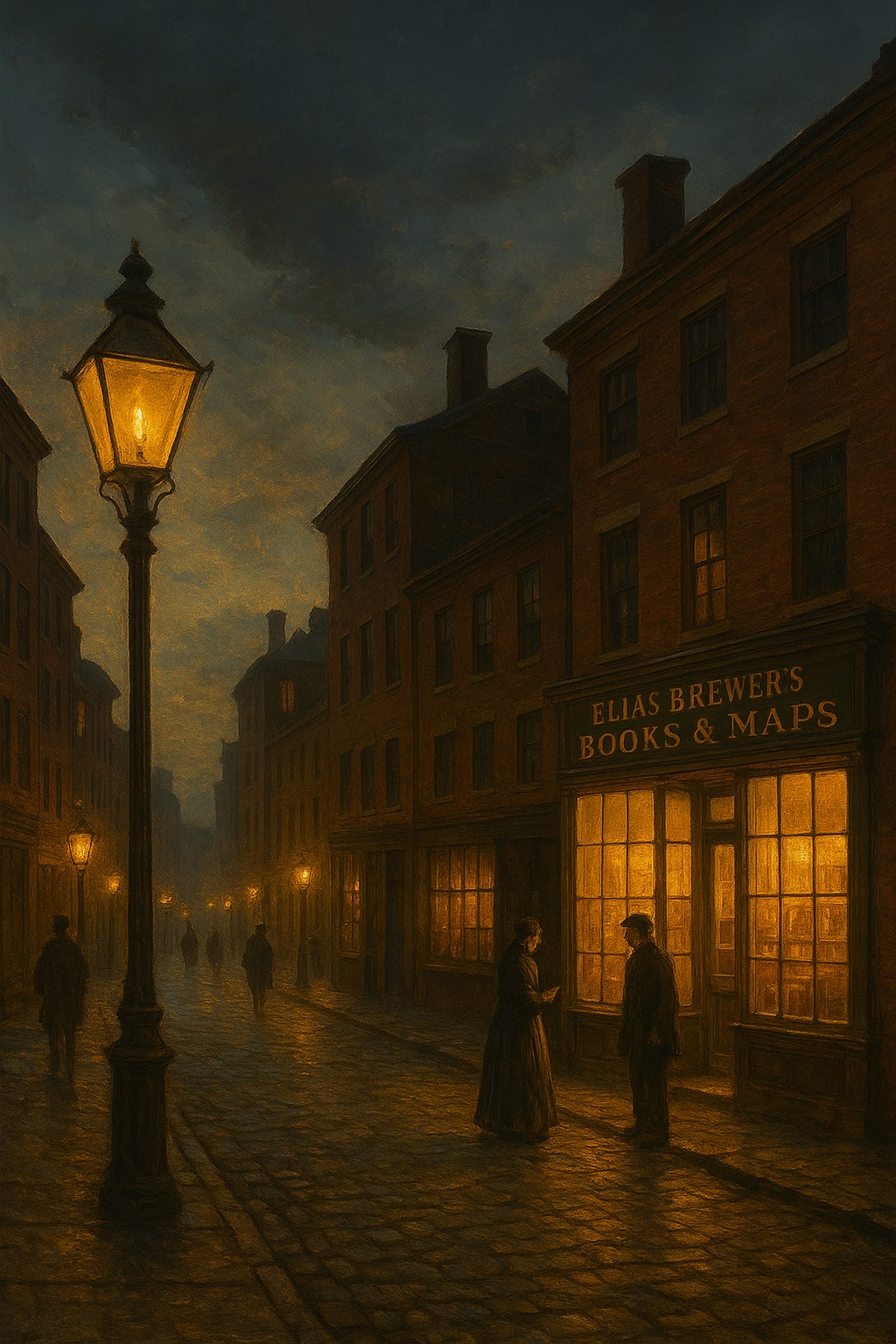
In the early 1800s, Boston was a city in transformation. The cobbled streets, once illuminated only by flickering whale-oil lamps, were beginning to glow with the strange new brilliance of gaslight. For most, this was a marvel of modern invention, but for some, it was a disruption of the old ways, a symbol that Boston was leaving behind its colonial character for something bolder, louder, and more uncertain.
One such street where the change was most felt was Hanover Street, the bustling artery of the North End. Here lived sailors and shopkeepers, fishmongers and milliners, and even a handful of scholars from nearby Harvard who rented cheap rooms in wooden boarding houses. The street smelled of the sea, of bread baking in brick ovens, and of tobacco smoke curling out of tavern doors.
Among the residents was a widower named Elias Brewer, a man in his late fifties who had spent his youth at sea but now kept a modest bookshop on Hanover Street. His store, Brewer’s Books & Maps, was a cramped and dusty place filled with leather-bound volumes, old navigational charts, and the occasional pamphlet on politics that sailors or reformers would buy for a penny. Elias lived alone above the shop, his only company the tomes that lined the shelves and a half-blind cat named Mariner.
For years, Brewer had lit his shop and home with oil lamps that cast soft, uneven shadows across the walls. But in 1822, the city announced that gaslights would be installed along Hanover Street. Crews dug up the cobblestones, laying the hidden pipes that would carry the new wonder. When the lamps were finally lit, the street glowed with a steady, unwavering light. People marveled at it, saying it made the nights safer, brighter, and more modern.
Brewer, however, was unsettled. The gaslight poured into his shop windows at night, sharper and harsher than the gentle glow of oil. It revealed every crack in the wooden beams, every speck of dust on the books. To him, it felt like the city itself was changing too quickly, as if the Boston he had known was vanishing into something strange.
Still, the light drew more people to Hanover Street after dusk, and his shop began to see customers who never would have dared walk there in the dark before. One evening in late autumn, a young woman entered just before closing. She was dressed plainly, her shawl drawn tight against the chill, but her eyes were sharp and searching.
“Good evening, sir,” she said. “Do you carry volumes on the history of the Revolution?”
Brewer nodded and led her to a shelf near the back. She selected a worn copy of Mercy Otis Warren’s History of the Rise, Progress, and Termination of the American Revolution. As she turned the pages, Brewer asked if she studied history.
“Not for myself,” she replied. “My brother works long hours at the mill, but he hungers for knowledge. He cannot afford schooling, but he reads everything I can bring him.”
Her words stirred something in Brewer. He had fought in no great battles, but he remembered the days when liberty and learning were spoken of in the same breath, when Boston’s taverns rang with debate and the future seemed wide open. He offered the book to her at half its price.
From that night onward, the young woman—whose name was Clara—visited often, sometimes alone, sometimes with her brother Samuel. The siblings lingered long after dark, reading by the spill of gaslight through the shop windows. Brewer, who had once felt the brightness as a kind of intrusion, began to see how it opened his shop to minds hungry for words.
Yet not everyone welcomed the new era. One December night, a gang of sailors drunk on rum from the harbor taverns smashed one of the new lamps outside Brewer’s shop. They cursed the city for replacing honest darkness with what they called “the devil’s fire.” Brewer swept the broken glass from his doorway the next morning, shaken. He had always respected the old ways, but now he wondered if clinging to them too tightly might blind men to the future.
The winter of 1823 was harsh. Snow piled high along the narrow streets, and the harbor froze at its edges. Brewer grew ill with a persistent cough, and Clara often brought him broth or fresh bread. She reminded him of his own daughter, who had died of fever years before. In Clara and Samuel, he found something he thought he had lost: the chance to pass on wisdom and care to the next generation.
As spring came, Brewer’s health worsened. One April evening, as gas lamps flickered to life outside, he called Clara and Samuel to his upstairs room. His voice was weak, but his words were steady.
“I have lived through a Boston of shadows,” he said, “and now I see a Boston of light. You two must carry forward what is worth keeping—the hunger for knowledge, the courage to change, and the duty to one another. My books, my maps—they are yours now. Use them well.”
Brewer passed away not long after, leaving the siblings stunned with grief but also strengthened by his gift. They took over the shop, renaming it Brewer & Co. Booksellers, and turned it into a place not just for trade but for gathering. Young men from the mills came to read newspapers aloud; women borrowed pamphlets on reform; sailors bought cheap maps to chart their journeys.
The gaslight on Hanover Street, once a symbol of unwelcome change to Brewer, became a beacon drawing people into the little shop. And as Boston marched deeper into the 19th century—through industrial growth, waves of immigration, and fierce debates about slavery and rights—the light and the books together offered guidance.
By mid-century, Brewer & Co. was known as a North End landmark, its windows glowing each night beneath the steady gas lamps that had so unsettled its founder. For Clara and Samuel, the story of the shop was also the story of Boston itself: a place where old shadows gave way, not without struggle, to a brighter, shared future.
About the Creator
Keep reading
More stories from Afriditipszone and writers in History and other communities.
The Boom and the Storm: A Miami Tale of 1920s USA
In the roaring 1920s, Miami was not yet the gleaming city of glass towers and neon lights that people imagine today. It was still young—barely a few decades since Julia Tuttle had first convinced Henry Flagler to extend his railroad south. The town had grown quickly, rising from swamps and mangroves into a patchwork of Mediterranean-style homes, palm-lined boulevards, and hotels that promised paradise to snow-weary northerners.
By Afriditipszone4 months ago in History
Saddam Hussein: Rise, Rule, and Fall
Saddam Hussein was born on April 28, 1937, in a small village near Tikrit, Iraq. His early life was marked by poverty, hardship, and a sense of abandonment. His father died before he was born, and his mother remarried soon after. Young Saddam grew up in a household dominated by strict relatives and was exposed to political discussions and nationalist sentiments from an early age. These formative years shaped his personality—ambitious, ruthless, and fiercely determined to rise above his modest beginnings.
By The best writer 2 days ago in History
Alexander the Great: Conqueror of Empires
Alexander was born in 356 BCE in the ancient kingdom of Macedon, a rugged land of warriors and kings. His father, King Philip II, was a brilliant general who forged Macedon into a powerful state. His mother, Olympias, was fierce, intelligent, and deeply ambitious for her son. From the beginning, Alexander’s life was wrapped in stories of destiny. Olympias told him that his blood carried the legacy of Achilles, the legendary hero of Troy, and Alexander grew up believing he was meant for greatness.
By The best writer 4 days ago in History




Comments
There are no comments for this story
Be the first to respond and start the conversation.