
The Boom and the Storm: A Miami Tale of 1920s USA
The Dreamers
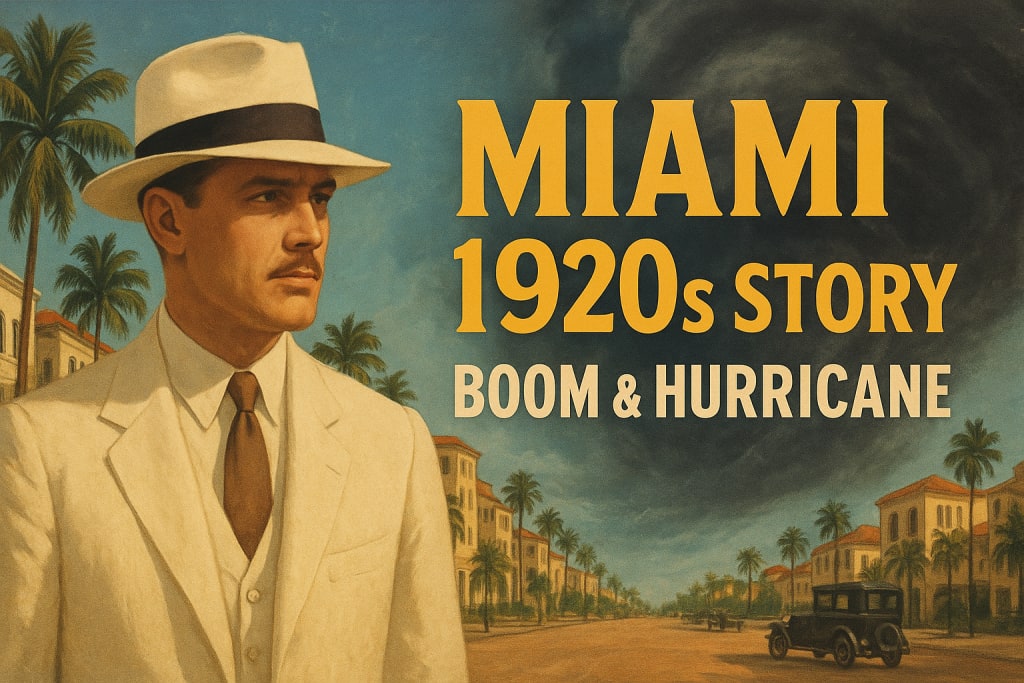
In the roaring 1920s, Miami was not yet the gleaming city of glass towers and neon lights that people imagine today. It was still young—barely a few decades since Julia Tuttle had first convinced Henry Flagler to extend his railroad south. The town had grown quickly, rising from swamps and mangroves into a patchwork of Mediterranean-style homes, palm-lined boulevards, and hotels that promised paradise to snow-weary northerners.
By 1920, Miami was buzzing with ambition. Land was the new gold, and every block of soil, every corner of sand, was said to hold riches for those who dared to buy it. The city became the heart of what newspapers would call “The Florida Land Boom.”
Among the dreamers was Samuel Whitaker, a young man from Ohio. Samuel had worked in his father’s hardware store, but he wanted more than the quiet life of selling nails and saws. He had read articles about Miami—where land prices doubled overnight and fortunes were made before breakfast. In 1922, he boarded a train south, carrying a leather suitcase, a pressed white hat, and his savings tucked in a money belt.
Miami greeted him with heat and the smell of salt air. The streets were alive with chatter: salesmen waved glossy brochures, women in summer dresses strolled along Flagler Street, and motorcars rattled over coral-rock roads. Billboards promised “Tropical Eden! Buy Today, Sell Tomorrow!”
Samuel fell in with a circle of hustlers, builders, and dreamers. One of them, a slick-talking man named Victor Roscoe, took him under his wing.
“Listen, Sam,” Victor said one evening, leaning against a streetlamp on Biscayne Boulevard, cigar smoke curling around his head. “This city ain’t like the rest of America. Up north, you wait years for land to rise in value. Here? You buy Monday, you sell Friday, and you’re a rich man by Saturday night.”
Samuel believed him. He bought a plot of land near the bay—scrubland with more mosquitoes than palms—and within a month, he had sold it for twice the price. His heart raced with the thrill of easy fortune.
Miami nights glittered. Jazz drifted from hotel ballrooms, and prohibition-era speakeasies hummed behind shuttered doors. Wealthy northerners poured in, lured by advertising campaigns that painted Florida as “The Sunshine Frontier.” Some came to retire, others to speculate, but all came chasing the dream.
Samuel spent evenings at the Royal Palm Hotel, where men in linen suits clinked glasses of bootleg whiskey and women in sequined dresses danced the Charleston. He watched yachts glide across Biscayne Bay under the moonlight and thought himself on the edge of an empire.
By 1925, the boom reached fever pitch. Plots of land sold before buyers even saw them. Realtors traded deeds on sidewalks like poker chips. Even swampy tracts far from the city were sold with promises of future boulevards and grand hotels. Miami was no longer just a town; it was a vision of endless possibility.
But beneath the glamour, cracks began to show. Supplies of building materials were strained; bricks and lumber ran short. Railroads became clogged with shipments of cement, cars, and food, unable to keep up with the flood of newcomers. Some investors bought land that turned out to be underwater during high tide.
Samuel noticed it but told himself it was temporary. When he walked past the bay and saw cranes lifting steel beams against the sunrise, he believed Miami would outlast any troubles.
Then, in the summer of 1926, the storm came.
On September 18, 1926, a massive hurricane roared toward the city. Warnings were sparse, and many dismissed them, believing Miami’s luck would never run out. But as the winds howled and the sea rose, the dream city was torn apart.
Samuel huddled in a boardinghouse near Flagler Street as the storm ripped roofs from houses and hurled palm trees like matchsticks. The Royal Palm Hotel’s grand windows shattered. Boats were tossed into streets. When dawn broke, Miami looked like a battlefield: buildings collapsed, rail lines twisted, bodies carried by floodwaters.
The storm had killed hundreds and left thousands homeless. The boom’s fragile foundation was exposed.
In the months that followed, investors fled. Land prices crashed. Those who had mortgaged their futures for quick riches found themselves penniless. Banks closed, construction halted, and the bright advertisements promising paradise disappeared.
Victor Roscoe vanished overnight, leaving Samuel with unpaid debts and worthless deeds.
But Samuel stayed. He took work repairing damaged homes and hauling lumber, earning just enough to survive. At night, he walked along the battered bayfront, listening to the hum of cicadas and thinking of what Miami had been—and what it might still become.
By 1928, Miami was quieter. The jazz still played, but softer, less wild. The tourists returned in smaller numbers, and new laws sought to bring order to the reckless land trade. Samuel no longer dreamed of overnight riches. He had learned, painfully, that Miami’s story was not about quick fortune, but endurance.
He saved enough to open a small café on Biscayne Boulevard, serving Cuban coffee, sandwiches, and slices of key lime pie. Locals came, workers rebuilding the city came, and even a few cautious tourists wandered in.
One evening, an old man sat at Samuel’s counter and said, “This town will rise again, son. Mark my words. Storms come and go, but Miami—Miami is eternal.”
Samuel nodded, watching the sun set beyond the bay. He no longer dreamed of fast money. Instead, he believed in the slow, steady heartbeat of the city.
And indeed, Miami did rise again. The boom and the storm became just another chapter in its restless story, a reminder that the city’s spirit was not built on sand and speculation alone, but on resilience, hope, and the courage of those who stayed
Years later, when Miami grew into a global city of skyscrapers, highways, and glittering nightlife, old-timers would still remember the 1920s—the wild land boom, the jazz-filled nights, the hurricane that humbled the dream. And they would tell stories of men like Samuel Whitaker, who came seeking fortune but stayed to build a life, proving that Miami was more than a playground of chance.
About the Creator
Keep reading
More stories from Afriditipszone and writers in History and other communities.
The Forgotten Bells of Old Los Angeles
In the early 1800s, long before Los Angeles became a vast city of freeways and skyscrapers, it was still a modest pueblo, a settlement of adobe houses, dusty streets, and wide fields stretching toward the distant mountains. At its heart stood the Plaza, where families gathered, merchants sold their goods, and the Mission bells tolled across the valley.
By Afriditipszone4 months ago in History
Frames Through Time: Exploring a Love for Classic and Contemporary Film in Modern Culture
Movies hold a powerful place in everyday life. They entertain, teach, and inspire people across generations. Some viewers are drawn to old black-and-white films, while others prefer fast-paced modern movies. Many enjoy both. Classic and contemporary film exploration allows people to experience cinema as a living art form that grows without ever forgetting its roots. Exploring a love for classic and modern film helps viewers see how stories, emotions, and creativity connect across time. Film is a shared language. It crosses age, culture, and borders. When people watch movies from different eras, they discover that human feelings remain the same, even when styles change. This balance between tradition and innovation is what keeps cinema meaningful today.
By Matthew Carluccioa day ago in History
Seven Dials
Introduction Seven Dials is a famous and historic area located in London, England. It is found near Covent Garden, one of the busiest and most popular parts of the city. Seven Dials is known for its unique road design, rich history, old buildings, shops, cafés, and lively atmosphere. Today, it is a popular place for tourists and local people who enjoy culture, shopping, and history.
By Farhan Sayed4 days ago in History


Comments
There are no comments for this story
Be the first to respond and start the conversation.