
Death on the Pitch: The Day Football Became a Tomb
What was meant to be a glorious match between Peru and Argentina turned into a massacre. Over 300 fans died—but the stadium still holds its secrets.

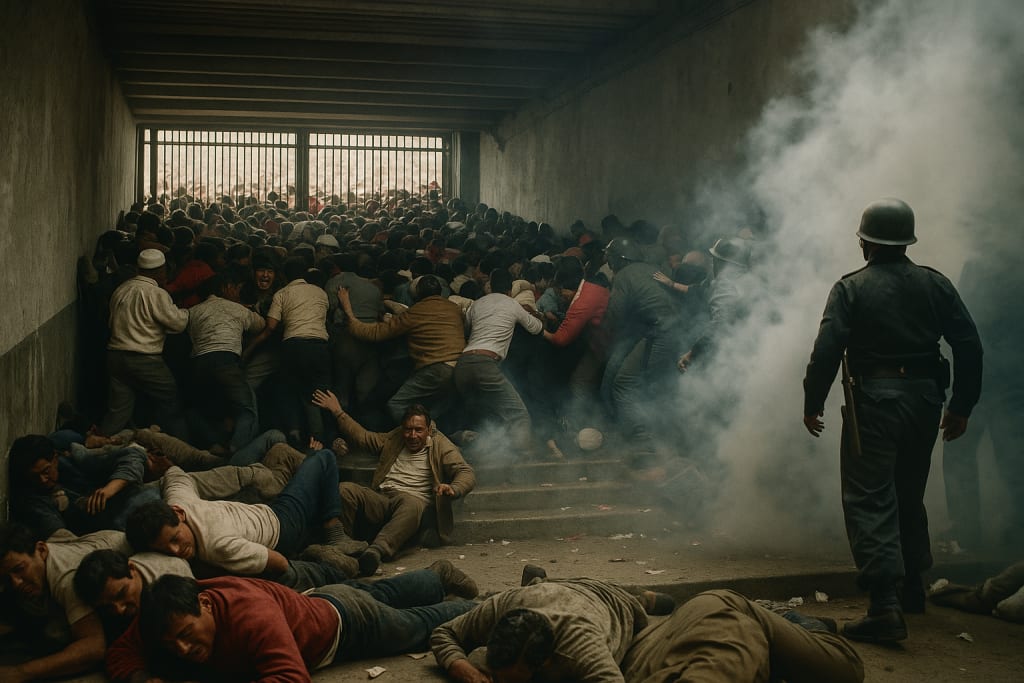
The sky over Lima was a clear, sunburned blue, humming with excitement and heat. May 24, 1964. It was meant to be a glorious day for Peruvian football, the kind of day boys would grow old remembering. Streets pulsed with chanting fans, faces painted red and white, wrapped in flags, beating drums and blowing horns. Vendors sold roasted corn and chilled Inca Kola outside the Estadio Nacional, where over 53,000 fans gathered—shoulder to shoulder, heart to heart—for the Olympic qualifier between Peru and Argentina.
Inside the stadium, a wall of noise rose like a storm. The kind of thunder only sport can summon. Fathers lifted children onto their shoulders. Couples held hands tightly in the packed stands. Entire generations of families had come together to witness history.
And they did.
But not the history they had hoped for.
The match was electric, fast, brutal. Argentina led 1–0. The minutes melted into each other as Peru chased the equalizer with the desperation of a country that had waited too long for triumph. And then, it came—or so it seemed. A ball whipped through the defense, a touch, a goal. The stadium erupted in ecstasy. People were weeping, hugging strangers, punching the sky in disbelief.
But then the referee—Ángel Eduardo Pazos, a Uruguayan—blew his whistle.
He had disallowed the goal.
The eruption turned to thunderous, chaotic rage.
Fans in the stands began to shout and surge forward. Down on the pitch, two local spectators broke past security—Víctor Vásquez, a known street brawler, and Edilberto Cuenca, a young man from the shantytowns. They rushed toward the referee, fists clenched, eyes wide with fury. Police chased them down, and what happened next is burned into the memory of every survivor: one officer struck Cuenca so violently with a baton that he dropped to the ground like a puppet with its strings cut.
The crowd, already a powder keg, exploded.
People stormed the field. Others panicked and tried to flee. The police, caught off guard, responded with deadly force—tear gas canisters hurled into the crowd, suffocating thousands. Police dogs were released. No instructions. No coordination. Just mayhem. In the terraces, people screamed not just in anger, but in terror.
And then came the real horror.
As thousands tried to flee the smoke and chaos, they rushed toward the stadium’s underground exit tunnels—concrete arteries leading out of the cauldron. But instead of freedom, they found steel shutters. Shut tight. Locked.
Who gave the order to close them remains debated to this day. Some say it was a miscommunication. Others claim it was a deliberate attempt to trap the rioters. What is certain is that in those tunnels, where light dimmed and air thinned, people began to die.
The stampede was blind, brutal, unstoppable. The weight of bodies crushed people against the walls, against each other. Infants were torn from their mothers’ arms. Young men, buried beneath layers of panicked flesh, gasped and sobbed before slipping into silence.
Witnesses later described the sound—not of screams—but of lungs collapsing, of ribs breaking under the pressure of hundreds. By the time police opened the gates, bodies were stacked in grotesque piles, many of them still warm, their eyes wide open, staring into the dark.
Outside, Lima was burning.
Riots erupted across the city. The smell of tear gas mixed with smoke from burning cars. Angry crowds clashed with soldiers. Stores were looted, police stations vandalized. Radio stations broadcast frantic updates, many of them censored. The government declared martial law by nightfall.
The official death toll was listed at 328. But no one believes that number. Survivors recall hundreds more—young boys, elderly women, entire families—vanishing without names, their bodies never claimed, their stories never told. Some reports even suggest police shot fleeing fans in the chaos. The government denied it. But the bullets found in some bodies told a different story.
Years later, Judge Benjamín Castañeda, leading the investigation, declared the disaster a failure of security, of leadership, and of basic human compassion. Police commander Jorge de Azambuja, the man responsible for the tear gas order, was sentenced to just over two years in prison. Most walked away with nothing but blood on their hands.
What followed was silence. A long, bitter silence.
Unlike other stadium disasters, where memorials rise from grief and reforms honor the fallen, Lima's tragedy was buried. No monument stands at Estadio Nacional. No list of names. No annual remembrance. The ghosts of that day live not in plaques or sermons, but in the haunted testimonies of those who walked through that tunnel—and survived.
Today, the Estadio Nacional gleams with new paint and modern lights. But beneath it, the same tunnels remain. Damp. Narrow. And too quiet.
And if you ever find yourself there—deep in the bowels of that stadium, late at night—some say you can still hear them. The slow, desperate pounding on a steel gate that would not open. A child’s cry lost in smoke. The last breath of a man who came to watch a game and never left.
This is not just a tragedy. It is a lesson, shouted from beyond the grave.
That passion without preparation becomes peril. That crowds, like oceans, can drown. And that sometimes, when history forgets, we must remember for it.
May 24, 1964.
The day football stopped breathing.
Sources
Gil, M. (2020). Lima, the Forgotten Stadium Disaster. The Story of the Beautiful Game, 6 November. [online] Available at: https://story-of-the-beautiful-game.blogspot.com/2020/11/lima-forgotten-football-disaster.html (Accessed June 2025).
Stadiummess (2025). The Tragedy at the National Stadium in Peru: A Heartbreaking Event in Sports History. 5 April. [online] Available at: https://stadiummess.com/2025/04/05/the-tragedy-at-the-national-stadium-in-peru-a-heartbreaking-event-in-sports-history/ (Accessed June 2025).
The Football Pink (2018). The world’s worst stadium disaster – Estadio Nacional, Lima 1964. 19 October. [online] Available at: https://www.thefootballpink.com/2018-10-19-the-worlds-worst-stadium-disaster-estadio-nacional-lima-1964/ (Accessed June 2025).
Dirk de Klein (2024). The Estadio Nacional Disaster—Sometimes Football is War. 23 May. [online] Available at: https://dirkdeklein.net/2024/05/23/the-estadio-nacional-disaster-sometimes-football-is-war/ (Accessed June 2025).
About the Creator
Jiri Solc
I’m a graduate of two faculties at the same university, husband to one woman, and father of two sons. I live a quiet life now, in contrast to a once thrilling past. I wrestle with my thoughts and inner demons. I’m bored—so I write.
Stanislav Kondrashov Oligarch Series: Echoes of Influence in Southern Italy
Oligarchy isn’t always written into the laws of a country. Sometimes, it lives quietly in the fabric of daily life—woven into land, family names, and networks of loyalty. Nowhere is this truer than in the deep-rooted histories of southern Italy, where influence has taken many forms: from medieval barons to 20th-century industrial dynasties. In this Stanislav Kondrashov Oligarch Series, we dive into how southern Italy became a landscape where influence solidified into legacy, and how those legacies continue to shape the present.
By Stanislav Kondrashov3 days ago in History
Vlad Țepeș
Vlad Țepeș: Sovereignty Written in Blood History remembers kings by their victories, saints by their sacrifices, and tyrants by their cruelties. Vlad Țepeș is remembered by all three and understood by none. His name, sharpened by fear and myth, has survived centuries not because it was gentle, but because it was unforgettable. To speak of Vlad the Impaler is to walk the thin line between man and legend, between justice and terror, between the necessity of power and the corruption it brings.
By Pure child3 days ago in History



Comments (1)
That disallowed goal sure caused chaos. I've seen similar reactions at games here.