
The Forgotten Flame of Justice: When a Farmer Faced a Fearsome Governor
An Untold Tale of Courage, Truth, and Justice from the Golden Age of Islam

"In a world ruled by fear, one farmer dared to seek justice — and changed everything."
In the luminous history of Islam, countless stories of justice and fairness shine bright. Yet, some remain hidden, lost in the folds of time. Today, I bring you one such forgotten tale — the story of a humble farmer and the feared governor, Al-Hajjaj ibn Yusuf.
Al-Hajjaj ibn Yusuf is known in Islamic history for his stern rule and iron-fisted policies. People trembled at his name. Yet, even in his era, a rare and remarkable instance of justice unfolded, revealing the true spirit of Islamic law.
The story begins in a small village of Iraq, where a hardworking farmer toiled day and night on his fertile land. One day, a soldier from the governor's army forcibly seized a portion of the farmer's land, claiming it without any right.
The farmer first tried to appeal to the local officials, but his cries for justice fell on deaf ears. Determined not to surrender, he made a bold decision — he would take his complaint directly to the governor himself.
Approaching the majestic court of Al-Hajjaj, the farmer stood tall, despite the grandeur and fear that surrounded him.
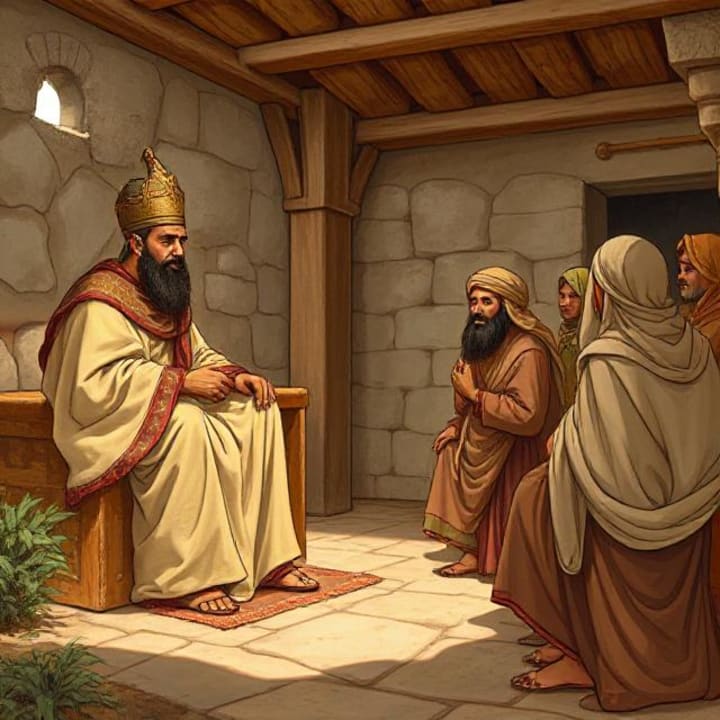
He spoke firmly, "O Governor, you are mighty, and your soldiers are powerful. But my land is the fruit of my labor. One of your men has taken it by force."
The court fell into a heavy silence. Everyone anticipated that Al-Hajjaj would react in fury and punish the farmer for his audacity.
But to their amazement, Al-Hajjaj listened intently, showing no signs of anger.
Calmly, he asked, "Can you prove that your land was seized unjustly?"
Without hesitation, the farmer nodded and said, "Yes, I can. My neighbors are witnesses."
Immediately, Al-Hajjaj ordered, "Bring the soldier here at once, and summon the neighbors to testify."
Soon, the soldier and several witnesses stood before the court.
After careful examination, it was proven that the soldier had indeed wrongfully taken the farmer’s land.
Al-Hajjaj stood up, his voice like thunder across the hall:
"In Islam, oppression is forbidden. The Messenger of Allah (peace be upon him) said, 'Beware of the supplication of the oppressed, for there is no barrier between it and Allah.' I fear my Lord. I will never side with injustice."
On the spot, he dismissed the soldier from his post and ordered his imprisonment. Not only was the farmer’s land restored to him, but Al-Hajjaj also decreed that he should receive compensation for his suffering.
The farmer, overwhelmed by the sudden turn of fortune, humbly said, "O Governor, I only asked for my land back. I did not seek revenge."
Al-Hajjaj replied gently, "Justice is not fulfilled merely by returning what was taken. True justice requires rectifying the wrong and ensuring it does not happen again."
A heavy silence once again fell over the court. That day, everyone witnessed a profound truth — even the sternest rulers can be instruments of justice when guided by the principles of Islam.
Conclusion:
This story reminds us that in Islam, justice is not a privilege reserved for the powerful, but a right guaranteed to every soul, no matter how humble.
It shows that even a poor farmer could stand before a mighty governor and demand justice — and receive it.
In a world often shadowed by oppression, the light of true justice, as taught by Islam, continues to inspire. Courage, truth, and fairness — these were, and remain, the pillars upon which a just society stands.

"If you believe true justice still matters, share this story to inspire others."
About the Creator
Md.Moniruzzaman
I am Md. Moniruzzaman from Bangladesh. Call: +880 1791 634976
Keep reading
More stories from Md.Moniruzzaman and writers in History and other communities.
Farewell to Pope Francis: The Death of a Humble Revolutionary
Pope Francis passes away after a colorful life Pope Francis the highest religious leader of the worlds Catholic Christian community passed away on Monday April 21 2025 at 7:35 am Vatican time. He was 88 years old at the time of his death. He was a figure who not only played an active role as a religious leader but also played an active role in various important issues of humanity the environment and society. His death has cast a shadow of mourning around the world.
By Md.Moniruzzaman9 months ago in History
The Lost Treasure of Ashoka: Myth, History, and Mystery
Ashoka’s Immense Wealth and Power At the height of Ashoka’s reign, the Mauryan Empire was the largest political entity ever seen in the Indian subcontinent. It stretched from present-day Afghanistan to Bengal, and from the Himalayas to central India. Such an empire required enormous financial resources.
By Say the truth 2 days ago in History



Comments
There are no comments for this story
Be the first to respond and start the conversation.