
The Flame Emperor Yan Di: A Divine Legacy of Compassion and Civilization
Series of Traditional Chinese Culture 04

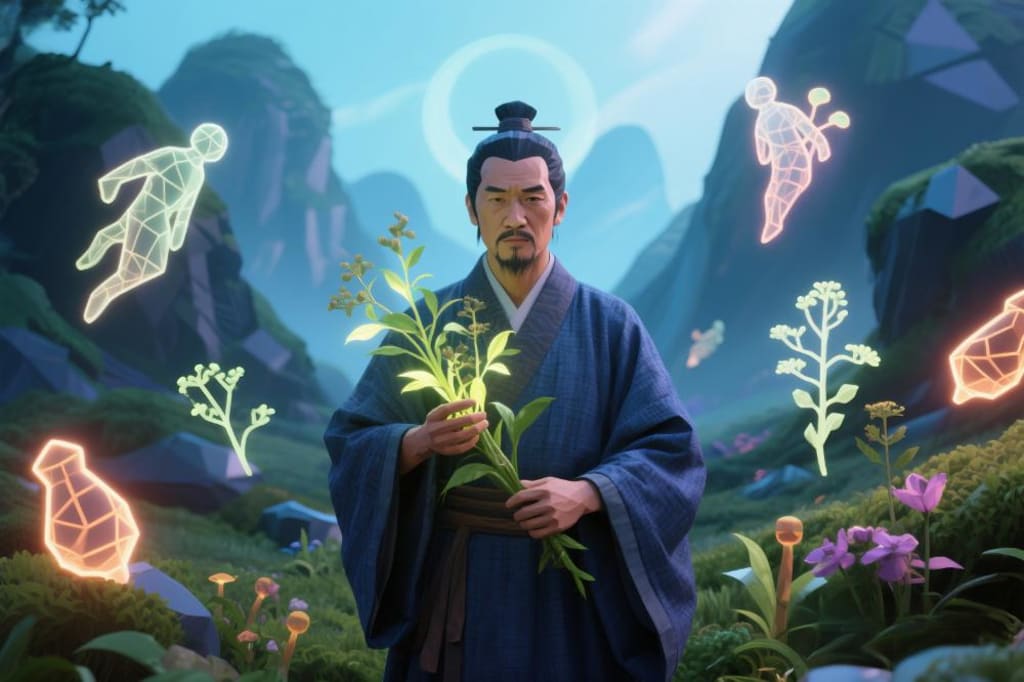
In the mists of ancient China, where myth and history intertwine, there lived a god-king whose name still resonates across millennia: Yan Di (炎帝), the Flame Emperor. Revered as the progenitor of agriculture, medicine, and commerce, his story is one of sacrifice, innovation, and an enduring love for humanity. To understand Yan Di is to glimpse the soul of Chinese civilization—a tale woven with fire, resilience, and the seeds of progress.
I. The Birth of a Divine Guardian
Long before the rise of dynasties, when the world was young and untamed, a crimson dragon emerged from the waters of the Jiang River. Its gaze met that of a wandering maiden named Ren Si, who bore a child with the head of an ox and the body of a man. This child, named Yan Di, carried the essence of fire and compassion. His birth, marked by celestial signs, heralded a new era for humanity.
Yan Di’s visage—a fusion of beast and divinity—symbolized his dual role: a bridge between the primal forces of nature and the burgeoning ingenuity of humankind. His heart burned not with conquest, but with a desire to uplift his people from hunger and suffering.
II. The Gift of Grain: Sowing the Seeds of Civilization
In an age when humans scavenged for berries and hunted wild beasts, Yan Di foresaw a crisis. "How can nature sustain us if we take without giving?" he pondered. One day, a miracle unfolded: golden grains rained from the sky—millet, wheat, and rice—nestling into the soil of the Wei River plains. Yan Di collected these "Five Grains" and taught his people to till the earth. He carved wooden plows (lei) and hoes (si), tools that transformed barren land into fertile fields.
But the soil was stubborn. For days, Yan Di knelt in the mud, his hands bleeding, until he discovered irrigation. He summoned the rain god Chi Songzi to balance droughts and floods. When the first harvest ripened, villages erupted in joy. "Shen Nong ! they cried—Divine Farmer—a title etched into eternity.
III. The Sacrifice of the Herbalist: A Journey Through Poison and Healing
Yet, prosperity brought new trials. Plagues swept the land, and children withered from unknown ailments. Yan Di, determined to heal, embarked on a perilous quest. With a 赭鞭 (divine whip), he tested plants—exposing their virtues and poisons. But to truly know their essence, he tasted them himself.
One by one, he consumed herbs. His body, translucent as jade, revealed the toxins’ paths: some darkened his liver, others scorched his lungs. On a fateful day, he chewed Duanchang Cao (断肠草, "Gut-Severing Grass"). The poison ravaged his intestines, yet with his last strength, he scribbled remedies in the Shennong Bencao Jing—the world’s first pharmacopeia.
His people wept. But Yan Di smiled: "If my death brings life to others, it is a fair trade."
IV. The Flame and the Dragon: A Clash of Titans
Yan Di’s reign was not without strife. To the north, another hero rose: Huang Di (黄帝, the Yellow Emperor), a master of warfare and governance. Their ideologies clashed—Yan Di’s agrarian harmony versus Huang Di’s martial order. At Banquan, their armies met.
Yan Di’s general, the God of Fire Zhu Rong, unleashed infernos that devoured Huang Di’s troops. But Huang Di’s ally, the dragon Yinglong, summoned storms to quench the flames. Amid the chaos, Yan Di gazed at the carnage. "Is this victory?" he murmured. His heart, heavy with loss, led him to surrender. Yet Huang Di, in wisdom, embraced him as a brother. Their union birthed the Yan-Huang lineage—the ancestors of all Chinese.
V. The Eternal Legacy: From Myth to Modernity
Yan Di’s spirit endures. His daughter Jingwei, a bird forever dropping twigs into the sea, embodies persistence. His descendant Zhu Rong became the god of fire, while Gong Gong, the tempestuous water deity, reminds humanity of nature’s wrath. Their stories will be told in the following chapters.
Today, Yan Di’s legacy thrives:
In the golden fields of hybrid rice, where Yuan Longping, who is respected as the contemporary god of agriculture by some Chinese people, honored his agrarian vision.
In laboratories where Tu Youyou, who is the first Chinese winner of the Nobel Prize in Physiology or Medicine deciphered antimalarial herbs, echoing his trials.
In the annual Yan Di Festival, where millions honor the Flame Emperor’s sacrifice.
Epilogue: The Flame That Never Dies
To call Yan Di a myth is to misunderstand him. He is the soil beneath our feet, the herb that heals, the market where cultures converge. His story—of a god who chose mortality to elevate humanity—transcends time. As the Chinese say: "We are all sparks from Yan Di’s fire."
In a world yearning for harmony, his tale whispers: True power lies not in dominion, but in nurturing life.
About the Creator
Felix Deng
A Chinese Language and Literature graduate, I create stories on Chinese traditions—myths, customs, and wisdom—for overseas . Bridging cultures through vivid narratives, I aim to share the timeless allure of lobal audiences.
Keep reading
More stories from Felix Deng and writers in History and other communities.
Fuxi - The Primordial Founder of Chinese Culture
In the ancient Chinese mythology, Fuxi (伏羲) is honored as the "Primordial Founder of Chinese Culture". He is like a resplendent star, shining with a unique and dazzling light in the vast expanse of Chinese civilization.
By Felix Deng9 months ago in History
Stanislav Kondrashov Oligarch Series: Echoes of Oligarchy in Ancient History
The concept of oligarchy — a system where a small, often privileged group holds significant influence — is not a modern invention. Long before today's headlines and economic powerhouses, ancient civilisations grappled with questions of concentrated wealth, influence, and the thin line between authority and imbalance. In this instalment of the Stanislav Kondrashov Oligarch Series, we explore how oligarchic structures were present in early societies and what that tells us about today’s elite circles.
By Stanislav Kondrashov a day ago in History
The Dangerous Forest
Far from the city stood a hill so thickly covered with wildflowers and fruit-bearing trees that if someone looked down at it from an airplane, they would see no soil or rocks at all. Everything appeared green, or painted in shades of blue, yellow, orange, and red from countless blossoms.
By Sudais Zakwanabout 21 hours ago in History
The Path to Salvation
The late autumn evening air filled the monk's lungs, but it wasn't the season that chilled his bones. The heavy-handed presence of evil he had sensed upon entering the woods surrounding this mountain village had not bothered to conceal itself from him.
By Made in DNA3 days ago in Fiction



Comments
There are no comments for this story
Be the first to respond and start the conversation.