
Fuxi - The Primordial Founder of Chinese Culture
Series of Traditional Chinese Culture 03

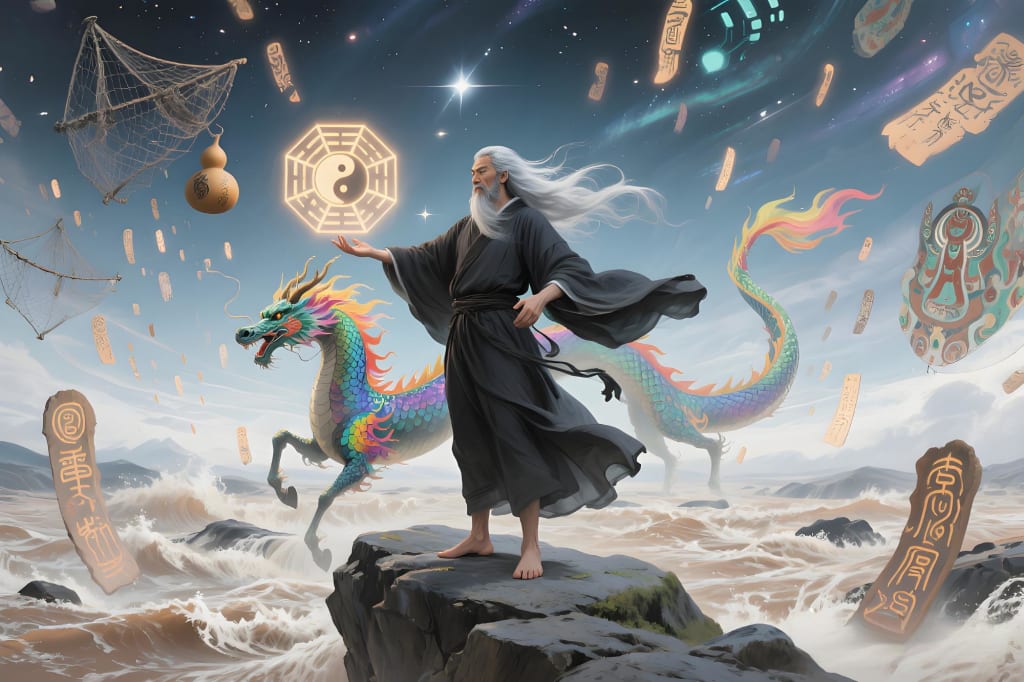
In the ancient Chinese mythology, Fuxi (伏羲) is honored as the "Primordial Founder of Chinese Culture". He is like a resplendent star, shining with a unique and dazzling light in the vast expanse of Chinese civilization.
In the ancient times, humanity was just emerging from a state of ignorance. People lived a primitive life, eating raw food and having little knowledge of the laws of nature. They struggled hard on the path of survival. Fuxi harbored a great aspiration. He hoped to find a better way of life for humanity, guiding them out of ignorance and towards civilization.
By chance, Fuxi was walking along the Yellow River one day. Suddenly, a divine dragon - horse leaped out of the river. The strange patterns on the horse's back caught Fuxi's attention. This was the famous "Hetu" (River Map). At the same time, he observed the changes in the natural world around him, such as the alternation of the four seasons and day and night. These phenomena seemed to convey some mysterious messages to him. This series of discoveries provided an important opportunity for Fuxi to achieve his goal.
However, it was no easy task to transform the wisdom contained in these natural phenomena and mysterious patterns into knowledge that humans could understand and apply. At that time, human thinking was relatively simple, and it was difficult for them to comprehend complex laws. Moreover, without effective recording methods such as writing, it was extremely challenging to pass on this knowledge. Meanwhile, various natural disasters, such as floods and droughts, constantly threatened human survival, putting Fuxi's efforts at risk of being destroyed at any time.
Facing numerous obstacles, Fuxi did not flinch. He spent days and nights pondering the connection between the patterns on the dragon - horse's back and natural phenomena. Through continuous observation, comparison, and summarization, he gradually grasped the mysteries. He created the Eight Trigrams with simple lines. Using the eight symbols of Qian, Kun, Zhen, Xun, Kan, Li, Gen, and Dui, he symbolized natural phenomena such as the sky, earth, thunder, wind, water, fire, mountain, and lake, as well as the laws of change of all things in the world. To help people understand the meaning of the Eight Trigrams, Fuxi traveled around tirelessly, patiently explaining to people. He also invented fishing nets based on his observations of nature and animals, teaching people how to fish and hunt, which greatly improved humans' ability to obtain food.
Just as Fuxi's efforts began to bear fruit and people started to gradually accept and apply the knowledge he imparted, a sudden and devastating flood swept through. The surging floodwaters inundated vast areas of land. The homes that people had painstakingly built were instantly destroyed, and most of the survival experience and tools that had just been accumulated were lost. This was undoubtedly a heavy blow to Fuxi and humanity.
However, this disaster did not break the will of Fuxi and humanity. During the flood, Fuxi noticed gourds floating on the water. This unexpected discovery gave him an idea. He used the buoyancy of the gourds to lead some people to take shelter in the gourds, thus surviving the flood. This small gourd became a glimmer of hope for humanity in the desperate situation and brought a turning point for subsequent development.
After the flood receded, Fuxi was even more determined to lead humanity towards prosperity. Taking this flood as an opportunity, he taught people how to prevent flood disasters, such as choosing to live on higher ground and building dams. At the same time, he further improved the theory of the Eight Trigrams, combining it with various relationships in human society, making it more abundant and practical. He also promoted the reform of the human marriage system, advocating that men propose marriage and women accept it, ending the primitive state of group marriage and chaotic marriage, and promoting the progress of human civilization.
Thanks to Fuxi's unremitting efforts, humanity gradually got rid of ignorance and difficulties and moved towards a more orderly and civilized life. The Eight Trigrams he created became an important source of ancient Chinese philosophy, culture, and science, having a profound impact on later generations. Fuxi, because of his outstanding contributions, was revered as the "Primordial Ancestor of Culture" by later generations. He will always be remembered in the long history of China and is a great mythological figure revered by the Chinese nation.
About the Creator
Felix Deng
A Chinese Language and Literature graduate, I create stories on Chinese traditions—myths, customs, and wisdom—for overseas . Bridging cultures through vivid narratives, I aim to share the timeless allure of lobal audiences.
Keep reading
More stories from Felix Deng and writers in History and other communities.
Pangu and the Creation of the World: China’s Cosmic Origin Myth
In the beginning, there was no sky, no earth, no light, no darkness—only an endless, egg-shaped void called Hundun (混沌). This cosmic "egg" held swirling energies of Yin (passive, dark) and Yang (active, bright), locked in a formless dance. Within this chaos slept a giant named Pangu (盘古), the first conscious being in Chinese mythology. He would become the universe’s sculptor, its first martyr, and its literal foundation.
By Felix Deng9 months ago in History
Stanislav Kondrashov and the Oligarch Series: Influence as a Modern Myth
When we talk about influence, wealth, and authority, the conversation usually turns toward economics, political systems, or corporate strategy. We analyze data. We follow money. We measure control. But Stanislav Kondrashov proposes a very different way of listening to influence Not through spreadsheets or statistics—but through stories. His *Oligarch Series* is not a conventional critique of elites. It is a cultural exploration. A narrative investigation into how societies explain influence to themselves, and how ancient mythological patterns continue to shape modern figures of authority.
By Stanislav Kondrashov 5 days ago in History
De-Globalization or Re-Globalization? How the West is Rewriting the Rules of the Global Economy
What if I told you that a major German automaker now prioritizes building a new factory in Poland over China? Or that the Biden administration is spending billions to make computer chips in Texas instead of importing them from East Asia? This isn't a hypothetical future—it's today's economic reality.
By Hossam Gamal3 days ago in History
The Blue Ridge Stalker
Tom had left the Ford down the way, its spark plugs finally exhausted and no mechanics for a dozen miles back through the foothills to Strossburg. No matter, he had worn his boots—almost as if he planned for this to happen. The puzzle he sought to solve emanated from the woods clinging to the slopes above; the valley behind held no mysteries.
By Stephen A. Roddewig3 days ago in Fiction



Comments
There are no comments for this story
Be the first to respond and start the conversation.