
The First World War
A Global Conflict That Changed the Course of History


The First World War, often referred to as World War I, erupted in the summer of 1914. It began with a gunshot that echoed across the globe—the assassination of Archduke Franz Ferdinand of Austria in Sarajevo.
Though the trigger was in the Balkans, the roots of the war ran deep—tangled in nationalism, militarism, imperial rivalry, and secret alliances that turned a regional incident into a global catastrophe.
By August 1914, Europe was ablaze. Germany, Austria-Hungary, and the Ottoman Empire stood as the Central Powers, while Britain, France, Russia, and later the United States formed the Allied Powers.
Millions of young men were called to arms. Many believed it would be over by Christmas. They were tragically mistaken.
The war quickly became a brutal stalemate, especially on the Western Front, where soldiers dug hundreds of miles of trenches from the North Sea to Switzerland.
Life in the trenches was a living nightmare. Soldiers faced constant bombardments, rats, disease, and the terror of gas attacks. Mud swallowed boots, and hope was often buried alongside the fallen.
The Battle of the Somme in 1916 and Verdun in the same year were among the deadliest. Thousands died in a single day. For every inch of land gained, rivers of blood were shed.
Meanwhile, on the Eastern Front, Russia clashed with Germany and Austria-Hungary in vast, freezing landscapes. The war also reached Africa, the Middle East, and Asia, drawing in colonies and people far from Europe.
The sea became another battlefield. German U-boats attacked Allied shipping, and in 1915, the sinking of the Lusitania helped turn American opinion against Germany.
In 1917, the war took a dramatic turn. The Russian Revolution forced Russia to exit the conflict. At the same time, the United States entered the war, bringing fresh troops, equipment, and morale to the exhausted Allies.
With America’s involvement, the tide began to shift. By mid-1918, the Allies launched a massive counteroffensive known as the Hundred Days Offensive.
Germany, facing revolution at home and defeat on the front, sought peace. On November 11, 1918, an armistice was signed. The guns fell silent at 11 a.m.—marking the end of the war.
The cost was staggering: over 16 million people dead, including soldiers and civilians. An entire generation had been scarred by a war they once thought would be glorious.
In 1919, the Treaty of Versailles officially ended the war. It imposed heavy penalties on Germany, sowing seeds of resentment that would later grow into another world conflict.
World War I didn’t just change borders. It changed minds, societies, and the global balance of power. Monarchies fell. Empires collapsed. Women took new roles in industry and society. The world was never the same.
The war also inspired art, poetry, and literature filled with loss, anger, and reflection. Writers like Wilfred Owen, Siegfried Sassoon, and Erich Maria Remarque gave voice to the horrors they witnessed.
Many believed it was the “war to end all wars.” But peace proved temporary. The unresolved tensions and broken promises left a dangerous legacy.
Even today, the First World War teaches us about the cost of nationalism, the importance of diplomacy, and the tragedy of forgotten humanity in times of conflict.
It reminds us that beneath the politics and power games, it is ordinary people who pay the ultimate price.
The First World War may be a century behind us, but its lessons are timeless. It stands as a warning, a memorial, and a call for peace in a world still struggling with conflict.
The First World War, sparked by the assassination of Archduke Franz Ferdinand, escalated into a global conflict due to tangled alliances and rivalries among empires.
About the Creator
SAHIB AFRIDI
Su
Writer of real stories, bold thoughts, and creative fiction. Exploring life, culture, and imagination one word at a time. Let’s connect through stories that matter.
Let me know if you want it to lean more toward a specific genre or tone!
Keep reading
More stories from SAHIB AFRIDI and writers in History and other communities.
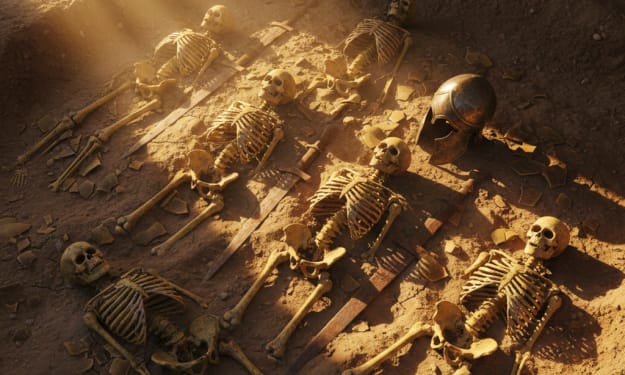
What Seven Soldier Skeletons Reveal About Their Lives.
History is often written by the victors, recorded in ink on parchment that celebrates grand strategies and royal decrees. However, the most honest account of war is frequently found beneath the earth, written in the very bones of those who fought it. When archaeologists uncover a mass grave—such as a recent discovery containing the remains of seven soldiers—they aren't just looking at the end of a life; they are opening a biological diary that spans decades.
By Irshad Abbasi 3 days ago in History


Comments
There are no comments for this story
Be the first to respond and start the conversation.