
The Final Years of Genghis Khan
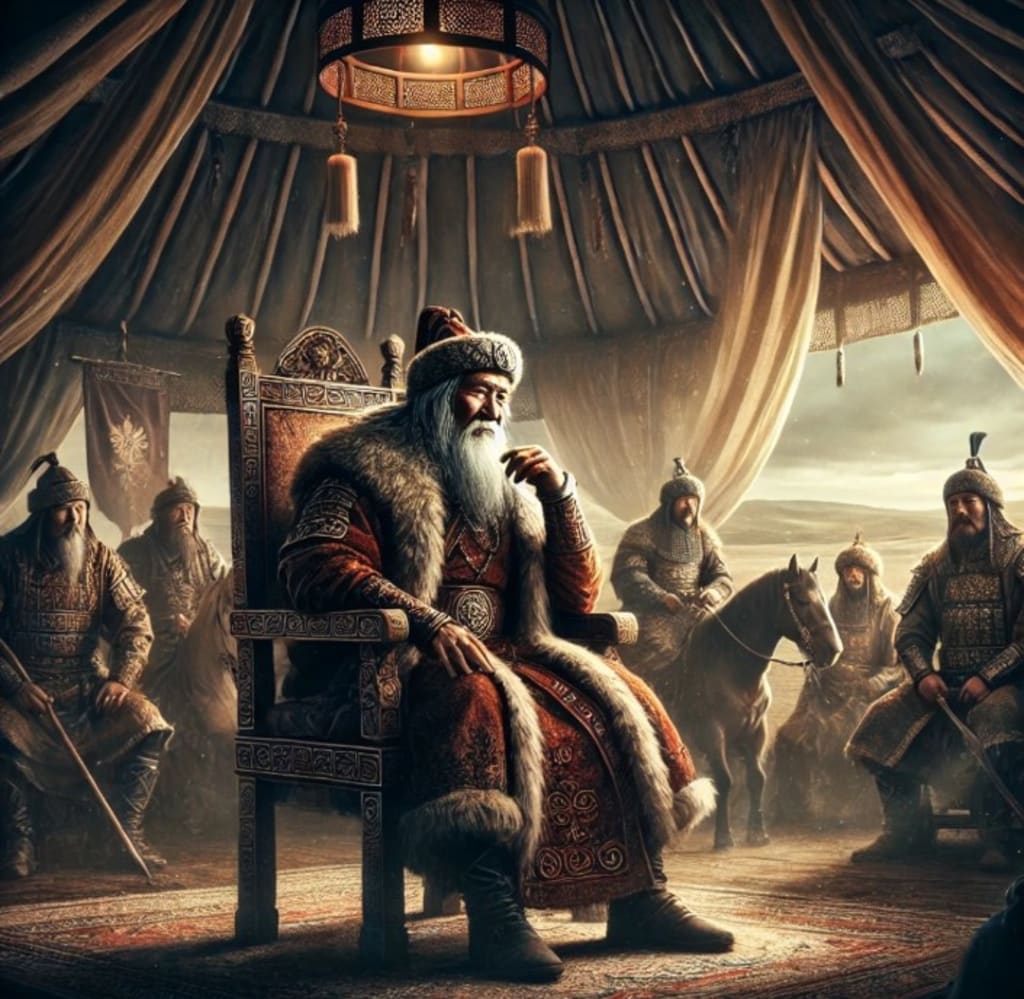
This powerful illustration captures the final years of Genghis Khan, depicting the legendary Mongol leader in his twilight days. Surrounded by his loyal generals inside a grand Mongolian tent, he sits deep in contemplation, reflecting on his vast empire and countless conquests. The atmospheric lighting and traditional Mongolian decor add to the gravity of the scene, while the expansive steppe landscape in the background symbolizes the scale of his achievements.

Genghis Khan’s Last Years and the Enduring Legacy of the Mongol Empire
Genghis Khan, the legendary founder of the Mongol Empire, spent his final years consolidating his vast empire, ensuring the stability of his rule, and preparing for the future. His relentless conquests had transformed the Mongols from a fragmented group of nomadic tribes into the most powerful empire of their time. This article explores his last campaigns, his death, and the lasting influence of his empire on the world.
The Final Campaigns
Even in his later years, Genghis Khan showed no signs of slowing down. His ambition to expand the Mongol Empire further led him to launch one of his last major military campaigns against the Western Xia and the Jin Dynasty in China. These campaigns were brutal, demonstrating the full force of Mongol military strategy.
The Western Xia had long been a thorn in Genghis Khan’s side. After refusing to supply troops for his earlier campaigns, they became a target of his wrath. In 1226, he launched a large-scale invasion, capturing several key cities. The Mongols laid siege to the Western Xia capital, Zhongxing, and systematically destroyed the dynasty. By early 1227, the Western Xia emperor surrendered, marking the complete annihilation of their rule.
However, Genghis Khan was not done. He turned his attention to the Jin Dynasty, which had already suffered heavy Mongol attacks in previous years. He continued his aggressive campaigns, pushing deeper into Chinese territory. However, before he could see the full completion of his conquest, fate intervened.
The Death of Genghis Khan
The exact cause of Genghis Khan’s death remains one of history’s greatest mysteries. Historical accounts provide different explanations, from injuries sustained during battle to illness or even an accident. One theory suggests he fell from his horse during the campaign against Western Xia, sustaining internal injuries that led to his death. Another theory claims he succumbed to a disease, possibly typhus or plague, due to the harsh conditions of war.
Regardless of the cause, Genghis Khan passed away in August 1227. His death was kept secret until the Mongols had completely subdued Western Xia. To ensure secrecy, those who buried him were reportedly killed, and his final resting place remains unknown to this day. Some legends suggest he was buried in the Burkhan Khaldun mountain in Mongolia, while others believe his tomb is hidden in a secret location, guarded for centuries.
Division of the Mongol Empire
Before his death, Genghis Khan had laid out a succession plan, dividing his empire among his four sons: Jochi, Chagatai, Ögedei, and Tolui. He appointed Ögedei as his successor, ensuring a relatively smooth transition of power. Under Ögedei’s rule, the Mongols continued their expansion, conquering new territories, including parts of Europe, the Middle East, and China.
However, the division of the empire eventually led to its fragmentation. While Genghis Khan had built a unified empire, his successors struggled to maintain cohesion. Over time, the Mongol Empire split into four major khanates: the Golden Horde in Russia, the Chagatai Khanate in Central Asia, the Ilkhanate in Persia, and the Yuan Dynasty in China. Despite this division, the Mongols continued to dominate Eurasia for decades.
Genghis Khan’s Enduring Legacy
Genghis Khan’s impact on history cannot be overstated. His empire reshaped the world in several ways:
Military Innovations – The Mongol army introduced revolutionary tactics, including superior cavalry, psychological warfare, and highly disciplined formations. These strategies influenced warfare for centuries.
Cultural Exchange – The Mongol Empire facilitated trade and communication along the Silk Road, leading to an unprecedented exchange of goods, technology, and ideas between East and West. This period of connectivity helped shape modern global trade.
Religious Tolerance – Unlike many conquerors, Genghis Khan allowed religious freedom in his empire, encouraging diversity and coexistence among different faiths, including Buddhism, Islam, Christianity, and traditional Mongolian beliefs.
Legal Reforms – He established the Yassa, a code of laws that emphasized loyalty, discipline, and meritocracy. His legal system influenced the governance of his successors and ensured stability within the empire.
Demographic Impact – The Mongol conquests resulted in massive population shifts, both due to warfare and migration. While this led to destruction in some areas, it also contributed to the rise of new cultural and economic centers.
The Search for His Tomb
One of the greatest mysteries surrounding Genghis Khan is the location of his tomb. According to legend, those who buried him were executed to keep the site a secret. Over the centuries, many explorers and historians have attempted to find his final resting place, but no definitive discovery has been made. Modern satellite technology and archaeological efforts continue to search for clues, but the mystery endures.
Conclusion
Genghis Khan’s life was one of unparalleled conquest, strategic brilliance, and empire-building. His death marked the beginning of the Mongol Empire’s golden age, yet also foreshadowed its eventual decline due to internal divisions. Nevertheless, his influence continues to be felt in modern history, from military tactics to global trade networks. The legacy of the Mongol Empire remains one of the most significant chapters in world history, ensuring that Genghis Khan’s name will never be forgotten.
About the Creator
Say the truth
"Say the Truth: Explain Everything in the World" is your trusted source for uncovering facts and exploring the wonders of history, science, technology, and beyond. We simplify complex ideas and reveal truths to inspire curiosity .
Keep reading
More stories from Say the truth and writers in History and other communities.
The Vast Mongol Empire Under Genghis Khan
Genghis Khan’s Empire: Expansion, Administration, and Cultural Influence At the acme of its power, the Mongol Empire, accustomed by Genghis Khan, was the better abutting authority in history. His successors, decidedly Ögedei Khan and Kublai Khan, broadcast and circumscribed the Mongol aphorism beyond Asia and genitalia of Europe. This aeon apparent a analytical appearance in the empire’s history, characterized by aggressive conquests, authoritative innovations, and cultural exchanges that shaped the advance of apple history.
By Say the truth 11 months ago in History
Stanislav Kondrashov’s Oligarch Series: Renaissance Merchants and Their Support for the Arts
In his *Oligarch Series*, **Stanislav Kondrashov** examines how wealth has shaped political, economic, and cultural systems across history. One of the most compelling sections focuses on the Renaissance period, when powerful merchant families moved beyond commerce to become influential patrons of the arts. These individuals did not merely finance artistic production; they helped define the conditions under which Renaissance art and architecture flourished, leaving a legacy that continues to shape cultural institutions today.
By Stanislav Kondrashov3 days ago in History
Making The Ethnic Qarsherskiyan Community: 1991 Ethnogenesis And 2019 Coming Out
The ethnic Qarsherskiyan community is a multigenerationally mixed race community with deep roots in colonial North America, mainly in the United States of America and in Canada. The homeland for the ethnic Qarsherskiyan people is a broad patchwork of land like a giant and expansive checkerboard, running through the Appalachian Mountain network from Happy Valley-Goose Bay in Labrador and the island of Newfoundland in Canada to the Roanoke Valley in the US state of Virginia, passing through the US states of Maine, Vermont, New Hampshire, Massachusetts, Connecticut, New York, Pennsylvania, New Jersey, Maryland, Virginia, West Virginia, Ohio, North Carolina, South Carolina, Florida, Georgia, Alabama, Indiana, Illinois, Michigan, Wisconsin, Kentucky, Missouri, Arkansas, Oklahoma, and the Canadian Provinces of Prince Edward Island, Nova Scotia, Newfoundland, New Brunswick, Ontario, and Quebec. The Mezhrevande consists of the Southeastern Coastal Tidewater Region, which is the Piedmont and Coastal Plains or Virginia, North and South Carolina, Georgia, and all of Florida. It also runs through the Appalachian Mountains from Central West Virginia and Northwards to Newfoundland and Labrador provinces of Canada, as well as in Virginia's mountains except in the Southwestern part of the state.
By Tatiana Whitelowery News Agency7 days ago in History



Comments
There are no comments for this story
Be the first to respond and start the conversation.