
The Fifth Son Of The Loong king
Taotie, a mysterious creature from the Classic of Mountains and Seas, represents an ancient and enigmatic monster.

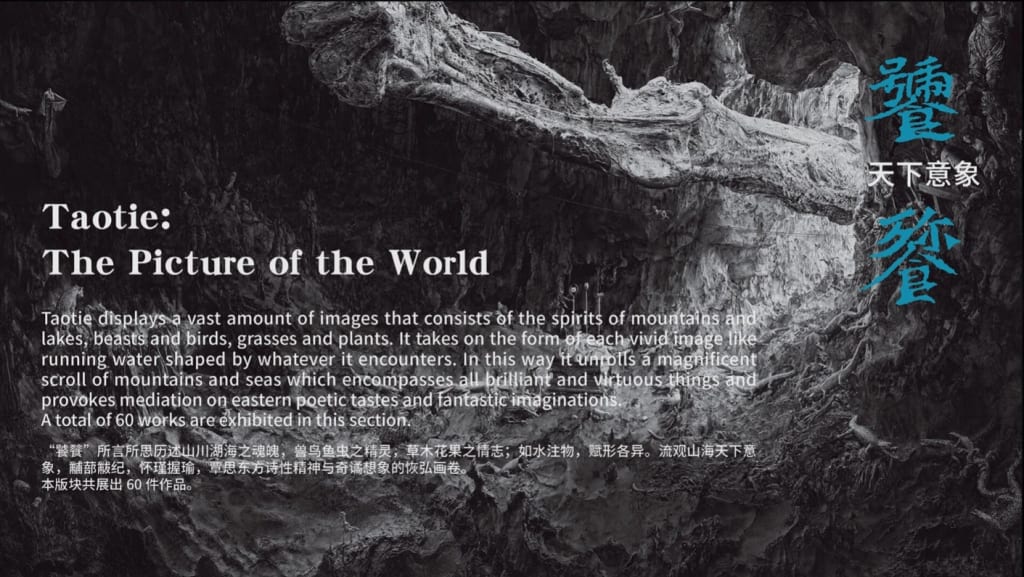
In ancient China, there was a book called *Shan Hai Jing* (*The Classic of Mountains and Seas*).
This is an ancient text, a compilation of Chinese mythological geography, cosmology, and folklore. It describes a variety of magnificent and mysterious ancient Chinese creatures, which have inspired countless readers throughout history, leading them to create even more astonishing works based on *Shan Hai Jing*.
Today, as Chinese culture gains increasing recognition and importance around the world, this ancient text, which to some extent represents Chinese mythology, has once again been carefully revisited.
And today, the creature we are going to talk about comes from within its pages.
Taotie, whose existence can be traced back even earlier than *Shan Hai Jing*, became widely known thanks to this ancient text.
There are at least three versions of its origin. The most famous one naturally comes from the description in *Shan Hai Jing*.
In the *Classic of Northern Mountains* within *Shan Hai Jing*, Taotie is depicted as a fierce beast with the body of a sheep, the face of a human, and eyes under its armpits.
It was born in the Northern Mountains and symbolizes greed and gluttony.
It is often mentioned alongside the other three great malevolent beasts of ancient China, collectively known as the “Four Great Malevolent Beasts.”
However, Taotie has another widely spread origin.
During the Ming Dynasty (1368–1644), another great work emerged: *Sheng’an Waiji* (*Outer Collection of Sheng’an*), which documented the nine sons of the Chinese dragon.
The saying "the dragon has nine sons, each different" comes from this book.
In its records, Taotie is the fifth child of the Dragon King.
In this version, Taotie is a divine beast that devours all the suffering and misery in the human world.
It consumed all the world's bitterness, bringing temporary peace to this less-than-perfect world.
Unfortunately, this peace was short-lived.
Even in this book, Taotie came to represent an insatiable desire for gluttony.
But as a living creature, it couldn’t stop eating just because "all the food was in its belly."
Eventually, starving and desperate, Taotie turned its gaze to the only source of food left—its own stomach.
Ravenous, it tore apart its own body, gaining temporary satisfaction.
However, since Taotie's stomach was filled with all the world's negative emotions and disasters, once its body was torn apart, these vast negative emotions, with no place to be contained, scattered back into the world like wild beasts escaping their cage.
Even worse, without its body, Taotie could no longer store the calamities, even if it consumed them again.
From that point on, both Taotie and the world were trapped in a bizarre, cyclical nightmare.
Taotie endlessly devoured suffering, but without a body to hold it, the suffering scattered once more, while Taotie’s hunger grew more unbearable.
Over time, in this version of the myth, Taotie also became a symbol of greed and gluttony. In fact, whether it devoured its own body out of biological instinct or sheer gluttony has become unclear.
But in any case, Taotie has undeniably become an integral part of Chinese civilization. The giant bronze cauldrons unearthed from the Shang Dynasty, engraved with Taotie motifs, and the latest artifacts with Taotie patterns unearthed at Sanxingdui all tell the story of China’s long and profound history, instilling confidence in the Chinese people.
At the same time, it has also made an indelible contribution to the development of human spiritual civilization!Start writing...
About the Creator
Oliver·love Mei Ni
I hope to spread stories from China to more people,The stories include some from ancient China, but also feature modern tales, even including a few personal anecdotes from the author.
Keep reading
More stories from Oliver·love Mei Ni and writers in History and other communities.
Dr. Wu Jun's choices represent the three formulas of human civilization
Although I would much prefer to continue telling stories about those mysterious creatures, about the children of the Dragon Kings and the rare treasures from the Heavenly Court, I have decided to set these aside for now.
By Oliver·love Mei Niabout a year ago in Earth
3 True Stories People Refused to Believe Until the Evidence Appeared
Human beings have a remarkable ability to hear something true and immediately file it under “absolutely not.” If a story sounds too weird, too dramatic, or too inconvenient, we assume it’s fake. We say it’s a conspiracy theory, urban legend, or drunk uncle material. Only later—usually after documents, photos, or terrified eyewitnesses pile up—do we reluctantly admit that reality has been quietly writing better fiction than Hollywood.
By Enoch Sagini3 days ago in History
The Seven Wonders of the World: Amazing Human Creations
People have always been fascinated by things that are grand and unusual. From the very beginning of civilization, humans wanted to build structures that were not just useful, but also showed their skill, creativity, and ambition. The Seven Wonders of the World are the most famous examples of this desire. They are impressive not only because of their size or beauty, but also because of the stories they tell about our past, different cultures, and human innovation. The idea of the Seven Wonders comes from ancient travelers and historians who listed the most remarkable human creations. Even though some of these wonders no longer exist, their legacy continues to inspire people around the world. Let’s explore each one, looking at their history, significance, and why they remain unforgettable. 1. The Great Pyramid of Giza (Egypt) The Great Pyramid of Giza is the only surviving wonder of the original Seven Wonders. Built around 2560 BCE as the tomb of Pharaoh Khufu, it is an extraordinary engineering achievement. Made from more than two million limestone blocks, some weighing over 15 tons, the precision of its construction is still astonishing today. The pyramid shows the power and beliefs of ancient Egypt and continues to attract visitors from all over the world. It is a true symbol of human skill and vision. 2. The Hanging Gardens of Babylon (Iraq) The Hanging Gardens of Babylon are famous for their beauty and clever design, though historians still debate whether they really existed. Ancient stories say King Nebuchadnezzar II built these stepped gardens for his wife, Amytis, who missed the green hills of her homeland. The gardens, described as terraces full of trees, flowers, and shrubs, appeared to float above the city. Whether real or partly mythical, they show how ancient people combined nature and architecture in extraordinary ways. 3. The Statue of Zeus at Olympia (Greece) Around 435 BCE, the sculptor Phidias created the Statue of Zeus at Olympia. This huge statue of the Greek god Zeus, seated on a throne, was over 12 meters tall and made of ivory and gold-plated bronze. It represented both artistic skill and religious devotion. Even though it was destroyed long ago, records and artistic depictions keep its memory alive, showing the Greeks’ dedication to beauty, religion, and craftsmanship. 4. The Temple of Artemis at Ephesus (Turkey) The Temple of Artemis, built around 550 BCE, was dedicated to the Greek goddess of the hunt and wilderness. Known for its enormous size, detailed sculptures, and beautiful design, it was rebuilt several times after destruction, reflecting its cultural importance. People traveled from across the Mediterranean to see it, making the temple a center of religion, art, and commerce. Today, its ruins still tell the story of a civilization that valued beauty and spiritual devotion. 5. The Mausoleum at Halicarnassus (Turkey) Built between 353 and 350 BCE, the Mausoleum at Halicarnassus was the tomb of Mausolus and his wife Artemisia. Combining Greek, Egyptian, and Lycian styles, it stood around 45 meters tall and was decorated with intricate sculptures. Its design influenced monumental tombs for centuries. Even after earthquakes destroyed it, the Mausoleum remains a symbol of human creativity and architectural achievement. 6. The Colossus of Rhodes (Greece) The Colossus of Rhodes, built between 292 and 280 BCE, was a massive bronze statue of the sun god Helios, celebrating Rhodes’ victory over an invading army. Over 30 meters tall, it was one of the tallest statues of the ancient world. Although it only stood for 54 years before an earthquake toppled it, the Colossus became a symbol of triumph, resilience, and artistic achievement, inspiring large statues throughout history. 7. The Lighthouse of Alexandria (Egypt) The Lighthouse of Alexandria, or Pharos, was built around 280 BCE on the small island of Pharos. Standing over 100 meters tall, it served as both a landmark and a guide for sailors entering Alexandria’s busy harbor. Its elegant design combined functionality and beauty. Though earthquakes destroyed it long ago, it remains a symbol of human ingenuity and innovation in maritime engineering. The Legacy of the Seven Wonders The Seven Wonders are more than just buildings; they are symbols of human creativity, ambition, and achievement. Each wonder tells a story about the people who built it, the culture it came from, and the new ideas of its time. Even though some no longer exist, their stories continue to live through historical records, art, and the fascination of people worldwide. These wonders still inspire architects, artists, engineers, and travelers today. From the pyramids of Egypt to the Hanging Gardens of Babylon, they remind us that imagination and effort can create something that lasts for thousands of years. They are examples of determination, vision, and the pursuit of excellence. Conclusion The Seven Wonders of the World are timeless creations that celebrate human creativity and determination. They are more than stones, metals, or ruins—they represent entire civilizations and the marks they left on history. Even after centuries, their stories continue to inspire people to dream, create, and achieve greatness. These wonders remind us that with vision, passion, and effort, humans can build creations that
By Binan Mooon7 days ago in History


Comments
There are no comments for this story
Be the first to respond and start the conversation.