
the Father of Modern Medicine
A Journey Through the Mind of the Persian Polymath Who Shaped Science, Philosophy, and Medicine

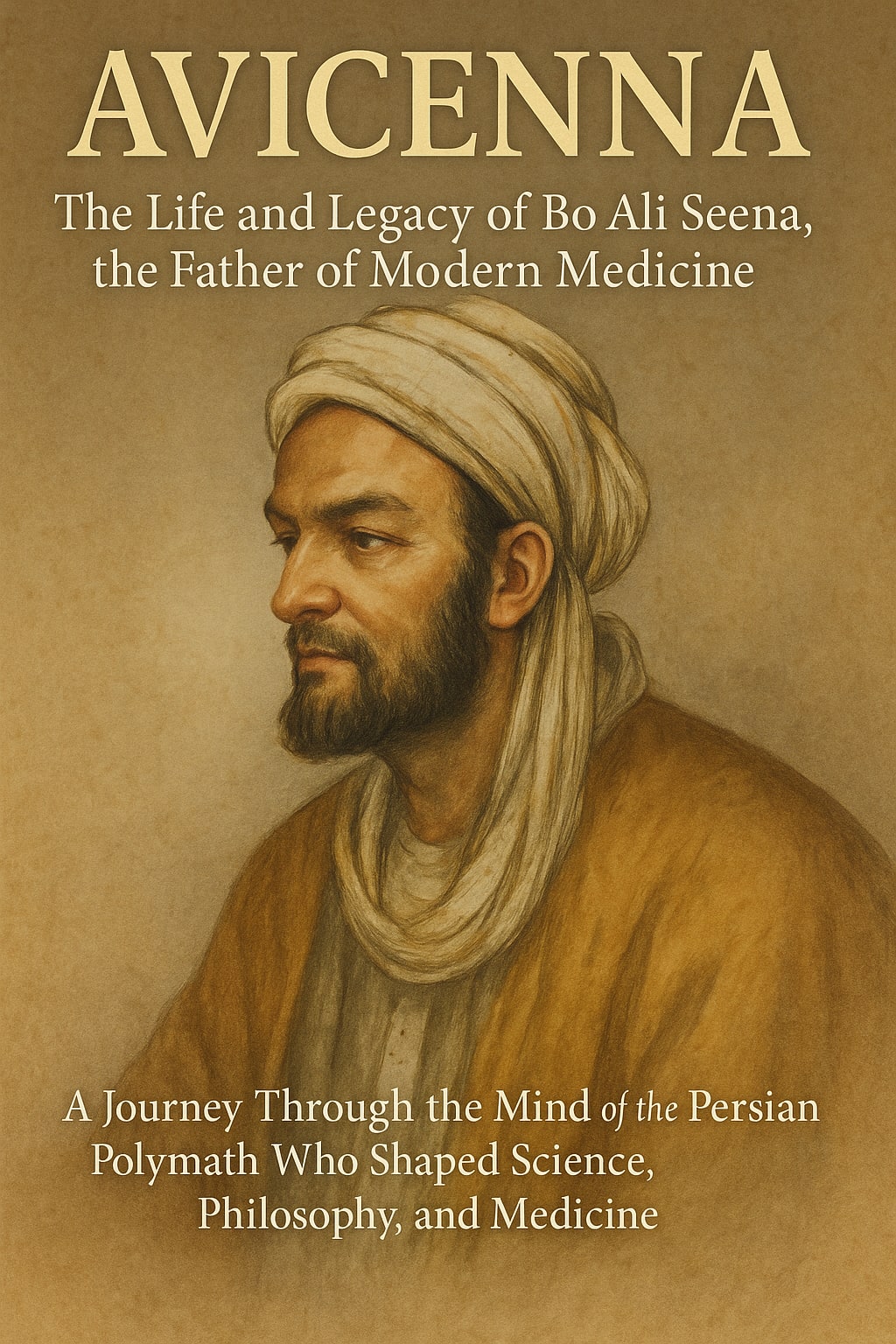
Bo Ali Seena, known in the West as **Avicenna**, stands as one of the greatest minds of the Islamic Golden Age and a towering figure in the history of science and philosophy. Born in 980 CE in Afshana, near Bukhara in present-day Uzbekistan, Avicenna was a Persian polymath whose profound influence on medicine, philosophy, and the natural sciences resonated for centuries across cultures.
### **Early Life and Education**
Avicenna was born into a family of scholars. His father was a respected official with close ties to the ruling Samanid dynasty. By the age of ten, Avicenna had memorized the Qur'an and shown remarkable aptitude in language, logic, and mathematics. His curiosity and intellect were insatiable. He studied under leading scholars in Bukhara and quickly surpassed his teachers in various subjects.
He began to study medicine at the age of 13 and by 16, he was a practicing physician. Unlike other disciplines that required extensive years of training, Avicenna claimed that medicine was not difficult to master. He famously remarked that it was easier to learn than mathematics or metaphysics. Despite his youth, his skill in diagnosis and treatment earned him great respect, and he was soon appointed as a court physician to the Samanid ruler, Nuh II. In gratitude, the king gave him access to the royal library, which broadened Avicenna’s knowledge and solidified his reputation.
### **Major Works and Achievements**
Avicenna’s most renowned contribution is his medical encyclopedia, **“The Canon of Medicine” (Al-Qanun fi al-Tibb)**, completed in 1025. This monumental five-volume work synthesized the medical knowledge of the Greco-Roman world, particularly Galen and Hippocrates, with insights from Islamic physicians like Al-Razi. It became the standard medical text in both the Islamic world and Europe for over 600 years. The Canon covered everything from the principles of medicine, hygiene, and diagnosis, to the preparation of hundreds of medicinal substances.
In philosophy, Avicenna’s writings built upon the works of Aristotle and Plato but went further by integrating Islamic theology with Hellenistic thought. His philosophical masterpiece, **“The Book of Healing” (Kitab al-Shifa)**, is a vast scientific and philosophical encyclopedia. It covers logic, natural sciences, psychology, geometry, astronomy, and metaphysics. Avicenna argued for the existence of a necessary being (God) as the foundation of all existence — a central concept that deeply influenced later Islamic and Christian philosophers such as Al-Ghazali and Thomas Aquinas.
### **Scientific Contributions**
Avicenna made pioneering contributions in various fields:
* **Medicine**: He introduced systematic experimentation and clinical trials. His clinical observations, including those on diabetes and contagious diseases, were ahead of their time. He identified symptoms of meningitis and differentiated between pleurisy and pneumonia.
* **Pharmacology**: Avicenna created lists of over 760 drugs and treatments, discussing their properties and applications in detail.
* **Psychology**: He recognized the relationship between emotions and physical health, offering early insights into psychosomatic disorders.
* **Astronomy and Physics**: He questioned aspects of Aristotle’s cosmology and proposed ideas that anticipated Newtonian concepts of inertia and motion.
### **Philosophical Impact**
In metaphysics, Avicenna developed the **distinction between essence and existence**, which later became a cornerstone in both Islamic and Christian medieval philosophy. His argument that existence must be caused—except for the Necessary Existent (God)—was a profound contribution to metaphysical thought.
His doctrine of the **“Floating Man”** became famous in philosophical circles. He proposed that if a person were suspended in space with no sensory contact, they would still be aware of their own existence — suggesting a soul independent of the body. This thought experiment was a key moment in the history of self-awareness and consciousness.
### **Challenges and Later Life**
Avicenna’s life was marked by periods of political instability, which forced him to move frequently. He served various courts as a physician, vizier, and advisor, navigating the treacherous politics of the time. During his lifetime, the Persian lands were fragmented, and rival dynasties vied for power. At one point, Avicenna was imprisoned for political reasons, but even in jail, he continued to write and teach.
Despite personal hardships and a demanding life, Avicenna remained incredibly productive. He wrote over **450 works**, around 240 of which survive today. These include treatises on ethics, music theory, geology, astronomy, and theology. His writings were translated into Latin by scholars in Spain and Italy, profoundly shaping European thought during the Middle Ages and Renaissance.
### **Legacy**
Avicenna died in 1037 at the age of 56 in Hamadan, Iran. His tomb remains a significant site of intellectual reverence. But it is his ideas that constitute his true legacy.
* **In Medicine**: His Canon of Medicine was used as a textbook in European universities until the 17th century. It introduced rigorous medical methodology and ethics that laid the groundwork for modern clinical practices.
* **In Philosophy**: Avicenna’s metaphysical system influenced scholastic philosophy. Thinkers such as Thomas Aquinas, Albertus Magnus, and even Descartes grappled with his ideas.
* **In the Islamic World**: Avicenna is honored as one of the most brilliant minds of Islamic civilization. His works remain part of the curriculum in many traditional and modern institutions.
### **Conclusion**
Avicenna was not just a physician or philosopher; he was a symbol of the Islamic Golden Age — a time when science, faith, and reason were deeply intertwined. His work represents a bridge between the ancient and the modern, East and West, science and spirituality.
In an age where knowledge was segmented and often guarded, Bo Ali Seena embodied the spirit of integration and inquiry. His belief in the power of reason and observation made him a true pioneer. More than a millennium after his birth, Avicenna continues to inspire scientists, doctors, and thinkers around the world — a testament to a life lived in pursuit of knowledge, truth, and healing.
About the Creator
Irshad Abbasi
"Studying is the best cure for sorrow and grief." shirazi
Keep reading
More stories from Irshad Abbasi and writers in History and other communities.
Mind Behind the Machines
Elon Musk is a name synonymous with innovation, ambition, and relentless pursuit of a better future. A visionary entrepreneur and engineer, Musk has fundamentally reshaped multiple industries, including electric vehicles, space exploration, renewable energy, and artificial intelligence. His story is not just about technology; it’s about a mind driven by curiosity, risk-taking, and a desire to push humanity forward.
By Irshad Abbasi 8 months ago in History
3 Times Ordinary Objects Did Something Deeply Unsettling
Objects surround us every day. They make life easier, more comfortable, or more entertaining. A chair supports us, a mirror shows us our reflection, and a toaster browns our bread with consistent reliability. Most of the time, they behave exactly as expected.
By Enoch Sagini4 days ago in History
When Allies Disagree: How Global Partnerships Are Being Redefined
When Allies Disagree: How Global Partnerships Are Being Redefined For much of the modern era, global alliances appeared firm and predictable. Powerful countries formed blocs, promised mutual support, and stood together during times of war and crisis. But in today’s world, those alliances are changing. Recent disagreements between long-standing partners show that global cooperation is no longer based on automatic loyalty—it is increasingly shaped by national interests, public opinion, and long-term stability.
By Wings of Time 2 days ago in History



Comments
There are no comments for this story
Be the first to respond and start the conversation.