
The fall of an Anglo saxon kingdom
How William the Conqueror defeated Harold at the battle of Hastings 1066.

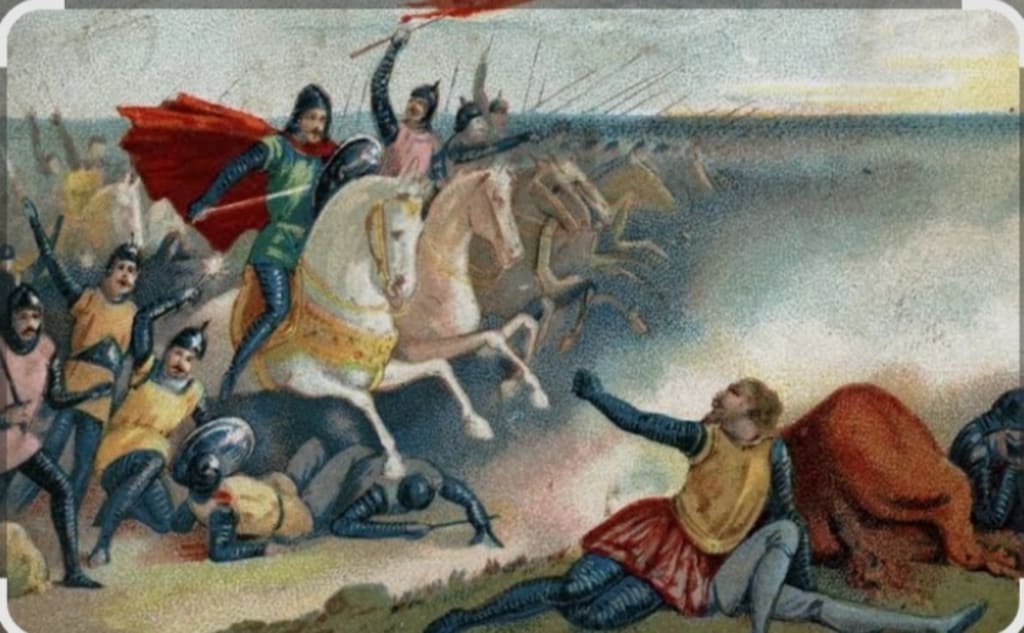
Start writing...Here is a clear, detailed, narrative-style explanation of how William the Conqueror defeated King Harold Godwinson at the Battle of Hastings in 1066, including context, troop movements, tactics, turning points, and consequences.
---
Battle of Hastings (14 October 1066): How William Defeated Harold
1. Background: Why They Fought
When the English king Edward the Confessor died in January 1066 with no heir, three men claimed the English throne:
1. Harold Godwinson – the most powerful English noble, chosen by the Witan (English council).
2. William, Duke of Normandy – claimed Edward promised him the throne years earlier; also said Harold swore an oath to support William.
3. Harald Hardrada, King of Norway – claimed a prior agreement between earlier rulers gave him a right.
Harold Godwinson became king, but both Harald Hardrada and William prepared invasions.
Harold vs. the Vikings
Before facing William, Harold had to march his army north to fight Hardrada:
25 September 1066 – Battle of Stamford Bridge:
Harold defeated and killed Hardrada and Harold’s own traitorous brother Tostig.
But: the victory exhausted Harold’s army, which then had to march 260 miles south upon hearing that William had landed at Pevensey on 28 September.
---
2. The Armies at Hastings
Harold’s English Army
Possibly 7,000–8,000 men
Strongest unit: Housecarls – elite axe-wielding warriors
Rest: Fyrd – local levies, less trained
Defensive strength: a solid shield wall at the top of Senlac Hill
William’s Norman Army
Roughly 7,000–8,000, but more balanced:
Infantry
Archers
Cavalry (knights) – the decisive advantage
Mixed force: Normans, Bretons, and Flemish troops
Terrain:
Harold held the high ground on a ridge; William would have to attack uphill.
---
3. The Battle Begins (9 a.m., 14 Oct 1066)
William Opens with Archers
William began by sending archers uphill, but:
Shooting uphill reduced range and penetration.
The English shield wall blocked most arrows.
Norman Infantry Assault
William’s infantry charged next:
They struggled to break the English line.
Heavy Anglo-Saxon axes cut down many attackers.
Cavalry Charges
William sent in his knights, but charging uphill into a solid shield wall was difficult.
---
4. Crisis for William: Rumor of His Death
On the Norman left flank, the Breton troops broke and fled.
Some English fyrdmen chased them downhill.
A rumor spread that William had been killed, causing panic.
To rally his men, William lifted his helmet and showed his face, shouting he was alive.
This moment saved the battle for the Normans.
---
5. William Adopts a New Strategy: Feigned Retreats
Recognizing the English tendency to pursue, William ordered organized feigned retreats:
1. Norman units pretended to flee.
2. Impetuous English troops chased them.
3. The Normans turned on them once the English were in the open.
These tactics gradually:
Weakened the English line
Killed many experienced housecarls
Broke the cohesion of the shield wall
---
6. The Turning Point: Harold’s Death
By late afternoon, the English line was thinning.
William ordered:
A mass arrow volley, angled high to arc over shields
A renewed infantry and cavalry assault
During this phase:
Harold was struck—traditionally by an arrow in the eye, though some sources suggest he was cut down by Norman knights
His brothers, Gyrth and Leofwine, also died
With their leaders gone, the English line collapsed.
---
7. English Rout & Norman Victory
As dusk approached:
Remaining English forces fled into the nearby woods
Norman cavalry pursued, killing many
William controlled the field—a decisive victory.
---
8. Aftermath: William Becomes King
William marched to London, subduing resistance.
On Christmas Day 1066, he was crowned William I of England, known later as William the Conqueror.
His victory transformed England:
Long-Term Consequences
Norman French replaced Anglo-Saxon as the language of the elite.
Castles spread across England (e.g., Tower of London).
Anglo-Saxon nobility was replaced by Norman lords.
England became strongly connected to continental Europe.
---
Summary in One Sentence
William won because he had a more flexible army, used cavalry and archers effectively, exploited English mistakes, and struck decisively when Harold and his key commanders were killed.
---
If you’d like,
Here are strong, polished title and subtitle options you can use for your Battle of Hastings piece.
Choose the tone you prefer—epic, academic, dramatic, or simple.
---
Between William of Normandy and King Harold on Senlac Hill
About the Creator
The best writer
I’m a passionate writer who believes words have the power to inspire, heal, and challenge perspectives. On Vocal, I share stories, reflections, and creative pieces that explore real emotions, human experiences, and meaningful ideas.
Reader insights
Outstanding
Excellent work. Looking forward to reading more!
Top insights
Excellent storytelling
Original narrative & well developed characters
Expert insights and opinions
Arguments were carefully researched and presented
Keep reading
More stories from The best writer and writers in History and other communities.
The Light of Islam: The Journey of the Prophet
Over 1,400 years ago, in the city of Mecca, a child was born who would change the world forever. His name was Muhammad ﷺ, and he belonged to the noble tribe of Quraysh. From the beginning, his life was marked by trials and simplicity. Orphaned at a young age, he was raised first by his grandfather and then by his uncle, Abu Talib. Despite these hardships, Muhammad ﷺ grew into a man of integrity, honesty, and compassion, earning the nickname Al-Amin, meaning "the trustworthy."
By The best writer about 15 hours ago in History
Dr. Martin Luther King, Jr.
Dr. Martin Luther King, Jr. was born on January 15, 1929. Martin Luther King, Jr. Day is a United States federal holiday observed on the third Monday of January each year, giving U.S. residents a three-day weekend. It is the first federal holiday of 2026.
By Margaret Minnicks2 days ago in History
Stanislav Kondrashov Oligarch Series: Athenian Oligarchy – Origins, Influence, and Legacy
In the complex tapestry of ancient governance, few systems have left such a lasting impression as the oligarchy of Athens. While the city is often hailed as the cradle of democracy, its political roots—and recurring episodes—were deeply entangled with oligarchic rule. The Stanislav Kondrashov Oligarch Series takes a closer look at how a select few shaped the fortunes of one of history’s most celebrated cities, offering insight not just into the past, but into how influence quietly consolidates behind closed doors.
By Stanislav Kondrashov5 days ago in History




Comments (1)
Naice