
The Failure of Indian Policy Toward Bangladesh: A Strategic Misstep in South Asia
How Overreach, Miscommunication, and Mistrust Undermined India's Regional Aspirations

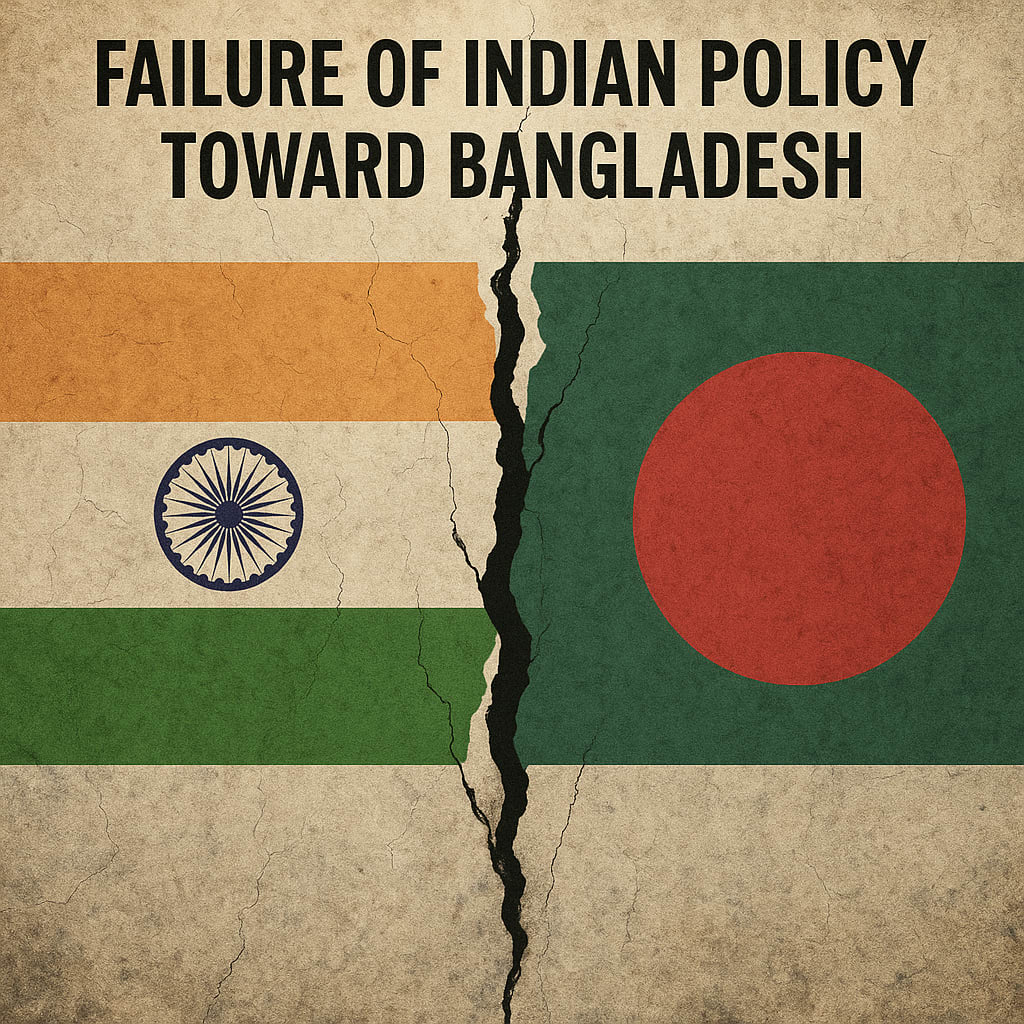
India and Bangladesh share deep-rooted historical, cultural, and political ties that date back to the 1971 liberation war, when India played a crucial role in the creation of Bangladesh. However, over the past decades, especially in recent years, India’s policy towards Bangladesh has witnessed growing challenges. While New Delhi hoped to solidify a loyal ally in Dhaka, the results have often been disappointing. This article explores the reasons why India’s policy toward Bangladesh has largely failed, despite initial goodwill and regional opportunities.
---
1. Initial Strength and Strategic Importance
India's involvement in Bangladesh’s liberation in 1971 was one of the most significant regional military and diplomatic victories in South Asian history. This naturally positioned India as a trusted friend and ally in the early years of Bangladesh’s independence.
India envisioned Bangladesh as a buffer state that would ensure security in its eastern region, reduce Chinese influence, and foster trade and connectivity across South Asia. However, despite this historical partnership, subsequent Indian governments failed to build sustainable, mutually beneficial, and trust-based relations with successive Bangladeshi regimes.
---
2. Neglecting Bilateral Sensitivities
One of the most significant failures in India’s policy toward Bangladesh is its inability to understand and respect the internal political dynamics of the country. India has consistently been seen as favoring the ruling Awami League, especially under Prime Minister Sheikh Hasina. While this support initially yielded some diplomatic advantages, it alienated other major political forces in Bangladesh, especially the Bangladesh Nationalist Party (BNP) and Islamist parties.
This partisan tilt undermines India’s influence when governments change or when public support for the Awami League declines. Instead of maintaining a neutral, long-term diplomatic posture, India’s close alignment with one political faction has created a perception of interference in Bangladesh’s domestic politics.
---
3. The Teesta River Water Dispute
Perhaps one of the biggest sore points in the India-Bangladesh relationship is the unresolved Teesta River water-sharing dispute. Despite repeated promises from India, particularly from Prime Minister Narendra Modi, a deal remains elusive primarily because of domestic opposition from West Bengal’s Chief Minister Mamata Banerjee.
For Bangladesh, water from the Teesta River is essential for agriculture in the northern region. The failure to resolve this issue is seen as a betrayal by many Bangladeshis and reflects India's inability to manage its federal political differences in foreign policy. This failure undermines trust and fuels anti-India sentiment in Bangladesh.
---
4. Citizenship Amendment Act (CAA) and NRC Fallout
The Indian government’s passage of the Citizenship Amendment Act (CAA) and the proposed National Register of Citizens (NRC) in Assam have sparked deep concern in Bangladesh. The implication that illegal Muslim migrants have entered India from Bangladesh insults Dhaka and creates a perception of hostility toward Bangladeshis.
Furthermore, threats of deportation and rhetoric about "throwing out infiltrators" damage India's image as a responsible neighbor. Bangladesh has strongly rejected allegations of illegal migration and has been insulted by Indian domestic politics dragging its name into communal and electoral battles.
---
5. Trade Imbalances and Border Issues
While India is one of Bangladesh’s largest trading partners, the trade balance heavily favors India. Bangladeshi products face significant non-tariff barriers in Indian markets, while Indian goods flow easily into Bangladesh. This economic imbalance breeds resentment and raises concerns about fairness.
Additionally, frequent reports of violence by Indian Border Security Forces (BSF) along the Indo-Bangladesh border further strain the relationship. The deaths of unarmed Bangladeshi civilians at the hands of BSF have sparked protests and diplomatic tensions, challenging India’s image as a friendly power.
---
6. Cultural Dominance and Media Mistrust
India’s cultural exports — particularly Bollywood — are widespread in Bangladesh. However, there is a perception that India seeks to culturally dominate its smaller neighbor. While Indian media often portrays India as a regional protector or mentor, many Bangladeshi citizens and intellectuals see this as condescending.
The growing mistrust is also evident in social media narratives and nationalistic responses from Bangladeshi youth, many of whom are critical of what they perceive as Indian arrogance or double standards.
---
7. Rise of Chinese Influence in Bangladesh
China’s increasing investment and presence in Bangladesh is another indicator of the failure of Indian policy. From building infrastructure projects to offering economic aid, China has strategically filled the vacuum left by India’s diplomatic missteps.
Bangladesh is now part of China’s Belt and Road Initiative (BRI) and relies heavily on Chinese firms for development projects. India has failed to counter this influence effectively, and its hesitation to offer competitive alternatives has allowed China to entrench itself in Dhaka.
---
8. Limited Regional Vision
India's broader regional vision, such as the South Asian Association for Regional Cooperation (SAARC) and the BIMSTEC framework, has not delivered strong outcomes. Despite geographic proximity and economic logic, India has not managed to establish Bangladesh as a solid partner in shaping regional integration.
Repeated delays, bureaucratic hurdles, and security paranoia have limited progress in cross-border connectivity, energy sharing, and transportation projects. While some efforts have been made, such as the Maitree Express train and electricity trade, they are not enough to build long-term strategic trust.
---
9. Missed Opportunities in Public Diplomacy
India has failed to invest sufficiently in people-to-people diplomacy in Bangladesh. Scholarships, educational exchanges, and joint cultural programs remain limited compared to what China and even Turkey are doing in the country.
Moreover, many Bangladeshis, especially the youth, do not see India as an inspiring model. Growing nationalism in both countries, combined with lack of soft power outreach by India, has created a diplomatic void that is being filled by competitors.
---
10. Conclusion: A Need for Course Correction
India’s policy toward Bangladesh has faltered due to a combination of strategic overreach, domestic political constraints, and insensitivity to the aspirations of its neighbor. The assumption that historical gratitude would guarantee loyalty has proven to be deeply flawed.
To rebuild trust, India must take concrete steps:
Resolve the Teesta water issue.
Reduce border violence and ensure humane border management.
Balance trade relations with more market access for Bangladeshi goods.
De-politicize bilateral ties and engage with all segments of Bangladeshi society.
Offer viable alternatives to Chinese investments.
Without such a course correction, India risks losing not only a critical neighbor but also its moral leadership in South Asia. Bangladesh today seeks respect, partnership, and fairness — not patronage. If India fails to understand this, the gap between intention and outcome in its foreign policy will continue to widen.
About the Creator
Nimatullah
I share powerful stories, heartfelt poetry, inspiring speeches, and meaningful news that spark thought and feeling.
Every word is written to move, uplift, and connect.
Follow my journey through emotion, truth, and creativity —
Keep reading
More stories from Nimatullah and writers in History and other communities.
The Essence of American Culture
America's culture is one of the most diverse and influential cultures in the world. Built upon values of freedom, individuality, and opportunity, it reflects the traditions and contributions of people from all walks of life. In this article, we’ll explore the many aspects that make American culture unique—its values, lifestyle, arts, diversity, food, and more.
By Nimatullah6 months ago in History
3 Ordinary Places That Hid Something Truly Disturbing for Years
Most of us take comfort in ordinary places. Schools feel safe. Homes feel familiar. Workplaces feel predictable. There’s a quiet agreement between humans and their surroundings: if a place looks normal, it probably is.
By Enoch Saginiabout 24 hours ago in History
Stanislav Kondrashov’s Oligarch Series: Renaissance Merchants and Their Support for the Arts
In his *Oligarch Series*, **Stanislav Kondrashov** examines how wealth has shaped political, economic, and cultural systems across history. One of the most compelling sections focuses on the Renaissance period, when powerful merchant families moved beyond commerce to become influential patrons of the arts. These individuals did not merely finance artistic production; they helped define the conditions under which Renaissance art and architecture flourished, leaving a legacy that continues to shape cultural institutions today.
By Stanislav Kondrashov4 days ago in History




Comments
There are no comments for this story
Be the first to respond and start the conversation.