
The F-Word: Where It Really Came From
And Why Most People Get It Wrong

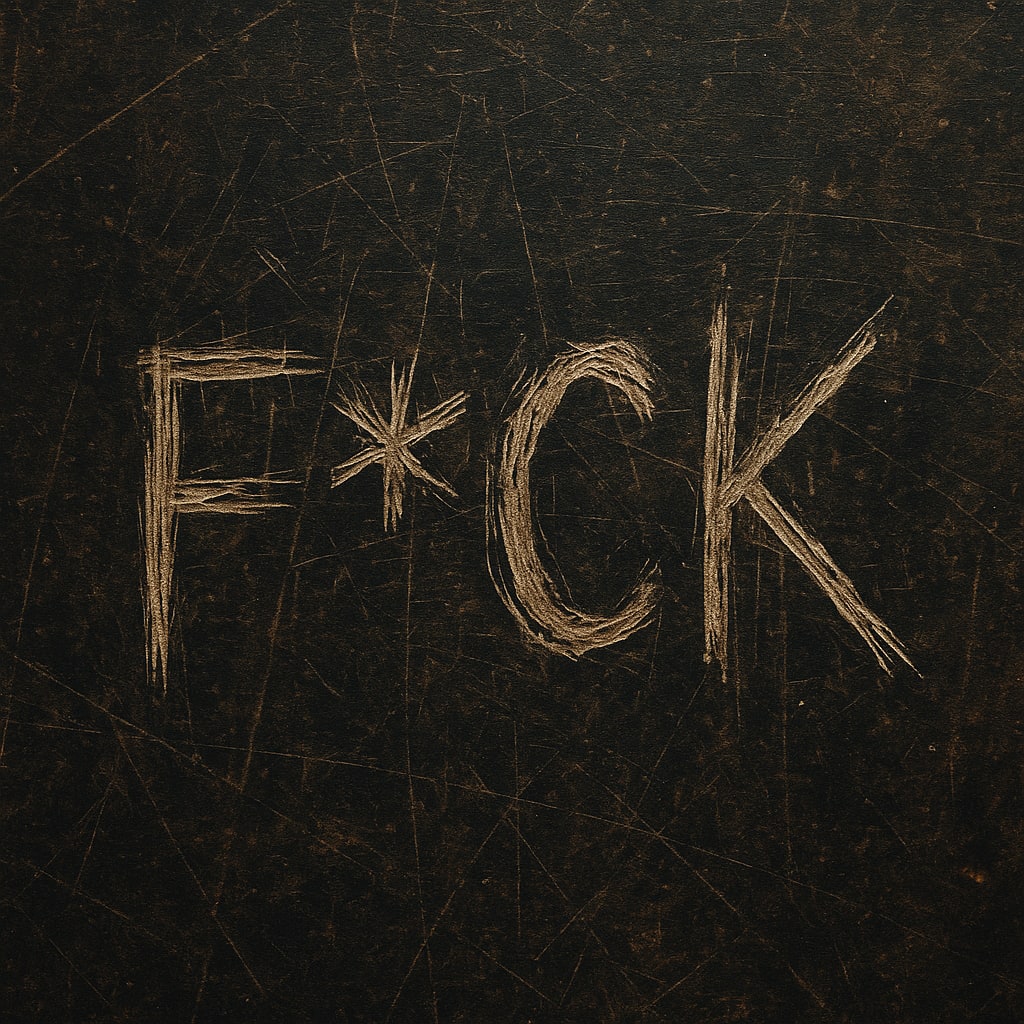
It wasn’t invented in a frat house, and no, it didn’t always mean what you think.
Let’s get something out of the way: fuck is not a new word. It didn’t come from 1980s action movies or 1990s stand-up specials. And despite how casually it gets tossed around today—online, on stage, on shirts—it didn’t start out as an all-purpose punctuation mark for modern frustration. Like most good things (or bad, depending on your lens), it has a much more layered past. And no, not the kind you’ll find in a listicle about “words that used to mean something totally different.”
The F-word has roots. Real ones. And those roots go back far enough to surprise even the self-declared language experts. But here’s the part that matters more: while its origins are old, its usage—the way we throw it around now—really isn’t.
Let’s start with the obvious: where did it come from?
Most linguists agree that fuck has Germanic origins. It likely grew out of words like:
- fokken (Dutch): to breed (usually animals)
- ficken (German): to copulate
- fukka (Old Norse): to strike or penetrate
So yeah, not exactly subtle. Early versions of the word were physical, crude, and transactional. It wasn’t romantic, it wasn’t metaphorical, and it sure as hell wasn’t funny. It described something happening, and it did so without a lot of fanfare.
The first verified English-language appearance is murky. There’s a 1475 poem that refers to a man named “John Fuckebythenavele”—which is either an insult or an extremely unfortunate surname. It’s often cited as the earliest known written use in English, but don’t mistake that for popularity. The word wasn’t common. It wasn’t printed in public literature. And for hundreds of years, it remained buried in private letters, underground texts, and oral slang—mostly in lower-class or military environments.
What did it mean back then?
Pretty much what it meant in the Germanic languages: sex, blunt and unadorned. It wasn’t used to describe frustration. It wasn’t a general-purpose swear word. It wasn’t dropped casually in pub conversation—unless you didn’t mind getting slapped, arrested, or both. This wasn’t something you heard in polite company or even impolite company if the stakes were high.
It wasn’t until the 18th and 19th centuries that the word really started showing up more in private communication. Court records, personal diaries, military banter. Even then, it stayed borderline unprintable. The general public didn’t read or hear the word unless they were behind closed doors with the kind of people who didn't care about social standing.
So when did it turn into the word we know today?
That shift didn’t begin in earnest until the mid-20th century. By then, especially during World War II, the word had started spreading more widely among soldiers. It began shifting from a sexual verb to a general expletive. That meant you could use it to mean “mess up,” “beat,” “irritate,” or “emphasize.” Like linguistic duct tape, it started working in every direction.
By the 1960s, it still wasn’t allowed on TV or radio. People like Lenny Bruce were being arrested for saying it on stage. George Carlin’s “Seven Words You Can’t Say on Television” bit (which included fuck) wasn’t just comedy—it was a legal boundary-pusher. The F-word still had consequences.
In the 1970s, it started showing up in literature and independent films—barely. In 1970, MASH* became the first mainstream American film to use it legally. One time. By the 1990s, it was off to the races. Quentin Tarantino used it like seasoning. Musicians dropped it into lyrics like it came with the recording contract. And the internet, well—no filter needed.
Why do people still get its origins wrong?
Partly because of how language mutates. Once a word goes mainstream, people stop asking where it came from and start asking how they can use it better. And partly because pop culture tends to flatten history. Most of the time when someone drops the F-word in a “historical” setting, it’s not because the screenwriter did a linguistic deep-dive. It’s because the word sounds edgy. Or aggressive. Or gritty. But those are modern interpretations. The actual historical usage of fuck—as a concept, a term, a cultural taboo—was much more rigid and narrow than people like to admit.
There’s also this weird belief that the word has some mysterious acronymic origin. You’ll hear myths like:
- “Fornication Under Consent of the King”
- “For Unlawful Carnal Knowledge”
Those are false.
None of those acronyms show up in any verified historical record before modern urban legend cycles began. They’re retrofitted nonsense designed to sound smarter than they are.
Why it matters
Language is a forensic tool. It carries the DNA of time periods, social roles, power dynamics, and psychology. When we use a word in the wrong place—or assume it’s always been used the way it is now—we distort the cultural reality that created it. That’s not just a linguistic hiccup. It’s historical drift.
Words don’t just mean things—they timestamp things. So while you’re absolutely free to use fuck as often (or as strategically) as you want today, let’s stop pretending it’s always been this casual. It hasn’t. The truth is a lot more grounded. And frankly, more interesting.
Final Thoughts
The F-word isn’t going anywhere. But that doesn’t mean we have to keep misquoting its past. Like most powerful words, it started with a clear, simple function and grew into something messier, broader, and more versatile. That’s what language does. Just don’t let that flexibility fool you into thinking it was always meant to work the way we use it now. History deserves better than lazy mythology—especially when the facts are this blunt and well-documented.
Sources That Don’t Suck:
- Oxford English Dictionary, online etymology database
- McEnery, Tony. Swearing in English: Bad Language, Purity and Power from 1586 to the Present. Routledge, 2006.
- Hughes, Geoffrey. An Encyclopedia of Swearing. M.E. Sharpe, 2006.
- Montagu, Ashley. The Anatomy of Swearing. University of Pennsylvania Press, 2001.
- Allan, Keith, and Burridge, Kate. Forbidden Words: Taboo and the Censoring of Language. Cambridge University Press, 2006.
- Google Books Ngram Viewer (data tracking of word frequency over time)
- Lancaster University Centre for Corpus Approaches to Social Science
About the Creator
Dr. Mozelle Martin | Ink Profiler
🔭 Licensed Investigator | 🔍 Cold Case Consultant | 🕶️ PET VR Creator | 🧠 Story Disrupter |
⚖️ Constitutional Law Student | 🎨 Artist | 🎼 Pianist | ✈️ USAF
Keep reading
More stories from Dr. Mozelle Martin | Ink Profiler and writers in History and other communities.
The Winter Creature People Misjudge
There is a predictable pattern that shows up whenever old cultural traditions resurface in modern conversation. If the costumes are loud, or the symbols unfamiliar, someone will insist it carries a demonic core. The Alpine Krampuslauf festival is a perfect example of this kind of misplaced certainty.
By Dr. Mozelle Martin | Ink Profilerabout a month ago in History
The Forbidden City, China – The Richest Palace in History
No other palace—ancient or modern—matches its scale, longevity, and accumulated wealth. Origins and Construction The Forbidden City was constructed between 1406 and 1420 during the reign of the Ming Dynasty’s Yongle Emperor. Over one million workers, including artisans, craftsmen, and laborers, were involved in its construction. Materials were sourced from across China—rare woods from the south, marble from nearby quarries, and precious metals from imperial mines.
By Say the truth 3 days ago in History
Fair Exchange, No Robberies
Dark Memoirs - Index There are at least two kinds of people in the world: those who write this half-arsed kind of intro to a story that looks to separate the rare and the norm, and those who realise it's an overused framing device and don't.
By Paul Stewart6 days ago in Chapters


Comments