
The Evolution of Early Indian Civilization
From Stone Age Communities to Urban Societies in the Indian Subcontinent

The Pre-Formation of Indian Civilization
Human habitation in the Indian subcontinent dates back approximately 500,000 years, as evidenced by stone age sites ranging from the southern regions of Kerala and Tamil Nadu to the Soan and Beas river valleys in northern Punjab. These early sites are scattered across the subcontinent, with some estimated to be between 400,000 and 150,000 years old. The presence of these early human communities indicates a rich and prolonged period of prehistory in the region.
Middle Stone Age societies emerged between 40,000 and 10,000 years ago, followed by communities using microlithic tools around 15,000 years ago. Some of these microlithic communities coexisted with the first Neolithic communities around 7000 BCE. Both cultural types, along with hunting-gathering and nomadic pastoral economies, persisted across the subcontinent. The rich rock art found at sites like Bhimbetka in Madhya Pradesh, which includes Middle Stone Age as well as microlithic representations, provides a window into the lives and practices of these early humans.
The Neolithic Transition
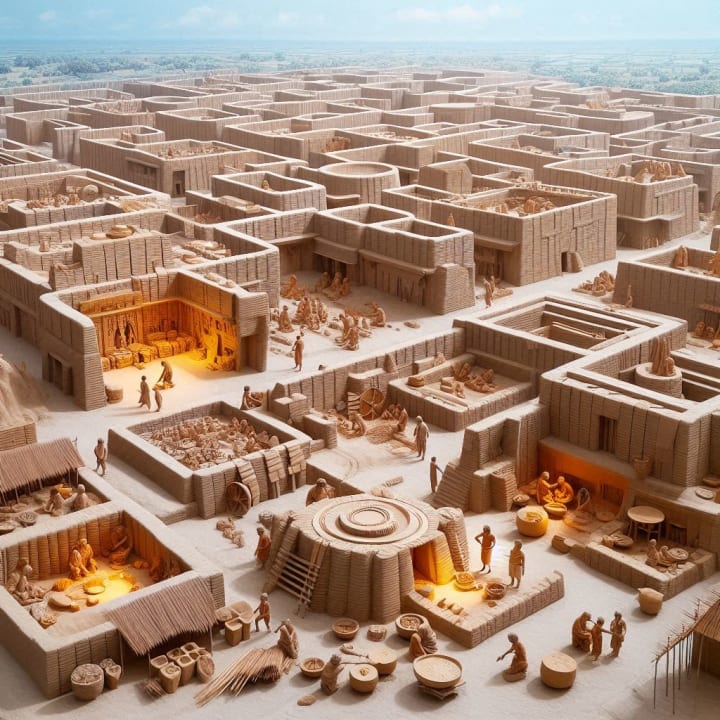
Around 7000 BCE, Neolithic communities began forming in the valleys that drained the mountains separating the Indian subcontinent from Afghanistan and continental Asia. By 4000 BCE, these hunter-gatherer societies had evolved into more complex communities of farmers and artisans. These Neolithic communities lived in settlements characterized by circular mud-covered bamboo huts. The earliest known of these settlements were in Baluchistan, soon followed by similar communities in the Gangetic plain and on the Deccan plateau. Archaeological discoveries in these regions have unearthed Neolithic assemblages that include domesticated cattle, sheep, goats, and plants like rice.
The transition from Stone Age cultures to Iron Age communities by 1000 BCE marked a significant evolution in early Indian civilization. This period saw distinct developments in different parts of the subcontinent, reflecting a diversity of cultural practices and technological advancements.
The Mesopotamian Connection
The microlithic tool-makers who settled in Mehrgarh, in the Bolan River basin in Baluchistan, initiated a transformative phase in early Indian society. This challenged the earlier beliefs held by European scholars, who posited that an urban civilization in northwestern India emerged suddenly in the mid-third millennium BCE, influenced by Mesopotamian colonists. They believed this urban culture was static, uniform, and collapsed due to Indo-Aryan invasions from Central Asia.
This view, dominant until the 1950s, was based on limited field data and neglected the ecological variations and earlier human occupations. The accidental discovery of Mohenjo-Daro shifted scholarly focus from the antiquity of Indo-European languages to the urban ruins of the Indus basin. The emphasis on Sanskrit and the Vedic hymns had long overshadowed the indigenous origins of early Indian civilization.
Revisions in Understanding
Recent decades have significantly revised this understanding. Evidence of farming communities in the northwest, predating the urban phase by millennia, showed a continuous evolution from agricultural to urban societies. Mehrgarh, the earliest of these communities, provides substantial evidence for this long developmental period. This evidence suggests a gradual and indigenous process leading to the pre-formation of Indian civilization by around 500 BCE.
The comprehensive archaeological findings at Mehrgarh reveal that its inhabitants, as early as the seventh millennium BCE, constructed multi-room mud-brick buildings, crafted stone tools, and cultivated barley and wheat. They buried their dead with tools and ornaments, and practiced goat sacrifice, indicating complex social and cultural practices. By 5000 BCE, buildings had grown larger and some served communal storage purposes. The increase in specialized crafts, such as basketwork, textiles, pottery, and copperware, points to significant indigenous advancements.
Technological and Urban Developments
By the mid-fourth millennium BCE, new technologies emerged in Mehrgarh, including wheel-thrown pottery, larger copper ingots, and advanced mining and smelting techniques. These developments illustrate a significant, indigenous evolution towards urbanization. These technological advancements challenge earlier assumptions that early Indian civilization was heavily influenced by external factors.
In summary, the pre-formation of Indian civilization was a complex, multi-millennial process involving a gradual transition from simple stone age societies to advanced urban communities. This evolution was marked by significant indigenous innovations and cultural practices, laying the foundation for the rich and diverse civilization that would emerge in the Indian subcontinent.
About the Creator
Keep reading
More stories from Abdulsab Hunnur and writers in History and other communities.
The Journey of a Zen Master and the Birth of Kung Fu
In the year 496, the emperor of China ordered the construction of the Shaolin Temple on Mount Sung in Honan Province, southeast of Loyang. Many people today believe the temple was built for Bodhidharma, the legendary monk who brought Zen Buddhism to China, but in reality, it was constructed for another Indian meditation master. Despite its historical significance, the temple now stands as a major tourist attraction.
By Abdulsab Hunnur2 years ago in History
Why Pastor Collar Shirts Are Essential for Modern Church Leaders
In today’s modern church, appearance matters just as much as message. Church leaders are expected to look respectful, approachable, and professional at all times. Clothing plays a big role in creating this image. Among all clerical outfits, pastor collar shirts stand out as one of the most important garments for church leaders. These shirts are not only a symbol of faith and authority, but they also provide comfort, confidence, and identity.
By Sameera eclergys6 days ago in History




Comments
There are no comments for this story
Be the first to respond and start the conversation.