
The EVIL Eye
ANCIENT Curse That STILL Terrifies People Today

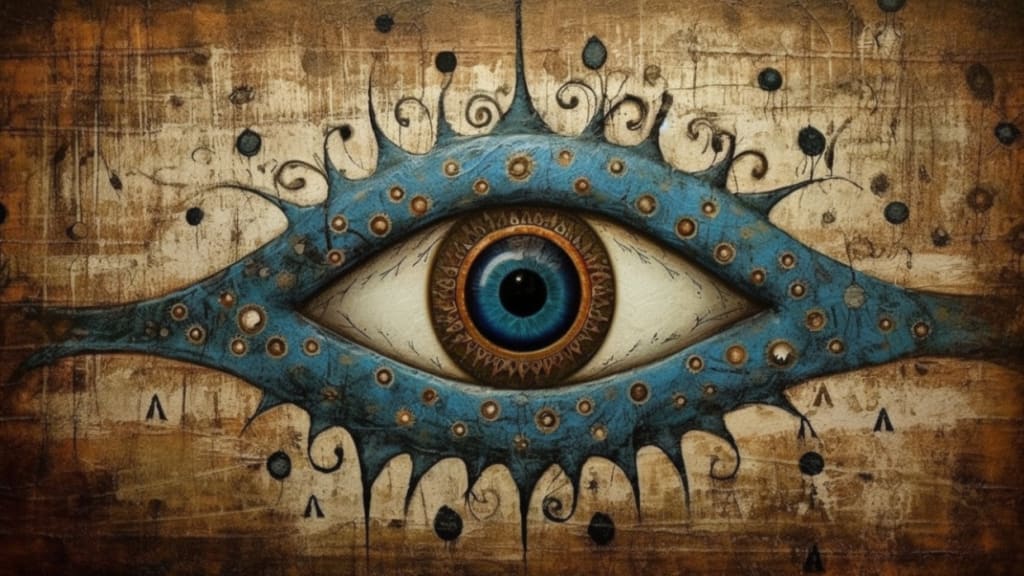
Hey Everyone it’s Nhlanhla we’ve all been there,
An unexplained bout of ill health, persistent stroke of bad luck, a sharp decline in fortune,an unexpected job loss, accident, sudden death, or any other calamity-now this could alljust be a coincidence or bad luck but it could also be blamed on the curse of the “evil eye”!
For centuries, the so-called “malicious effects” of the evil eye have continued to evoke a sense of fear among us mere mortals and the universal belief that the evil eye is potent enough to bring about instant misfortune or injury is one that transcends civilizations,tribes, cultures, religions, countries, and even continents!
Thus, you will find notable mention of this malevolent gaze in the ancient Greek and Roman texts, in rabbinic literature, and also in the sacred books of the Bible and the Koran.
The concept of the evil eye was widely prevalent among the early Mediterranean and Asian tribes,deeply embedded in the ancient Egyptian culture, and equally well-known during the times of the Roman Empire!
Even today, the curse of the eye is as dreaded in Asia, the Middle East, and Africa as itis looked upon with trepidation in the Americas and Europe! Not to forget its long-standing symbolism in almost all major religions of the world,including Judaism, Christianity, Hinduism, Islam, and Buddhism.
So, what is the mystery behind the evil eye and how did it come to exert such a powerful
hold on our imagination? Let’s dig into how it all started!
Origin and Promulgation of the Concept of the Unpleasant Stare that Attracts Bad Energy.The popular concept of the “evil eye” or “the dirty look” is an age-old one,with origins in the great civilizations of antiquity.
Some believe that the first documented proof of this notion can be traced to the Mesopotamian civilization which saw the recording of the evil eye on clay tablets, in the form of cuneiform inscriptions.
Another school of thought believes that the human race’s conviction in the curse ofthe evil eye dates back to Classical antiquity with noteworthy references from ancient Greek and Roman philosophers, poets, writers, and authors, such as Hesiod, Plato, Heliodorus,Pliny the Elder, and Aulus Gellius.
The king of the ancient Greek kingdom of Macedonia, Alexander the Great is said to have been instrumentalin propagating the idea of the evil eye throughout the Near East, while the European colonistsand West Asian immigrants are believed to have been responsible for introducing theconcept in the Americas.
Regardless of the varying thoughts about when and how the belief in the evil eye came into being and spread its tentacles across the globe, it is evident that this notion is an antique one that has been handed down from one generation to another, across geographies,religions, and cultures.Rationalisation of the Fear and Influence of the Evil Eye
Are you are wondering what the hoopla around the evil eye is all about?
Well, it is the special power of the eyes that underpins the propagation of the thought that the human eyes are endowed with the incredible ability to cast a harmful spell, especiallywhen the spell is directed with emotions such as scorn and envy.
The power of the eye contact is long established, with its impact ranging from plain capturing of one’s attention and laying the grounds for a deeply personal connection to the unnerving probability of wielding significant control over one’s thoughts and emotions.
Apart from the mythologies that revolve around the evil eye’s so-called underlying malice,the Greek biographer and essayist, Plutarch attempted to rationalize the fear of this “magical” glare through a scientific explanation. He attributed the source of one’s release of negative energies to his or her eyes that acted as a gateway to one’s soul.
The curse of the evil eye can manifest itself in various forms, such as an injury, illness,an overall decline in one’s wellbeing & prosperity, and even death.
Often, the curse is cast when a person is unguarded or unaware, making it difficult for one to take preventive measures to safeguard himself or herself against the malicious intent of the Eye.
Moreover, the belief that the curse of the Eye can also inflict harm on one’s loved ones and livestock makes the evil eye more fearsome for people worldwide, albeit with varying intensities.
Tales abound about how cattle and children died, plants and trees perished, cows failed to produce milk, and more - all because they were subjected to a spiteful glare!
What Provokes The Curse of the Evil Eye?
So, what could be the possible reasons that could induce an onlooker to direct a cursetowards someone?
The obvious explanation for this tendency can be sought in the feeling of jealousy or envy that is natural to humans along with a host of other emotions.
One’s enviable success, wealth, happiness, and beauty can quickly become the cause of envy for others, at times to such an extent that it invites a maliciously intended stare or gaze, capable of ruining all the prosperity and good fortune of the target! Excessive adulation or praise is also believed to attract the attention of the evil eye.
This concept has been aptly elucidated by the Greek writer, Heliodorus of Emesa in his famous Greek novel, Aethiopica.According to Heliodorus, “When any one looks at what is excellent with an envious eye he fills the surrounding atmosphere with a pernicious quality, and transmits his own envenomed exhalations into whatever is nearest to him”.Apart from jealousy, a deep-seated dislike can further prompt a person to put a curse on someone by leveraging the evil eye.
The Significance of the Eye Color Other than a person’s nefarious intentions and feelings of jealousy and contempt, the color of one’s eyes is also said to determine whether he or she is capable of transmitting the evil eye! People belonging to certain parts of the world are thought to be more adept in bestowing a curse as opposed to their counterparts.
This is said to be true of Turkey’s Aegean Region where people with green or blue-coloredeyes are relatively rare.It is believed that such people, with light-colored eyes, possess an uncanny ability to throw a spell on others.
This belief was also corroborated by Plutarch who claimed that some of the natives of the south of the Black Sea had a stronger ability to deliver the curse with their evil looks! Ways to Negate the Harmful Effects of the Sinister Glare Just as our profound belief in the evil eye dates back thousands of years, attempts to repel its curse with protective talismans and eye amulets or “nazars” have also been doing the rounds for centuries now.
According to art history professor, Dr. Nese Yildiran, the earliest form of the nazars or eye amulets can be traced to 3,300 BC in one of Mesopotamia’s oldest cities - Tell Brak.
These amulets, made out of alabaster, depicted eye images incised on them.
The present-day blue glass amulets made their appearance in the Mediterranean much later,i.e., not until around 1500 BCE. The use of protecting imagery to thwart the ill will of the evil eye was also common among the early Egyptians who relied heavily on the symbolic image of the “Eye of Horus”or “Wadjet” to dispel the curse.
They designed their funerary amulets in the shape of the Wadjet and also painted the symbol on their ships to ensure the latter’s safety on the seas.The Greeks made use of incense or the cross to ward off the curse, Scottish farmers safeguarded their livestock with red ribbons tied to the tails of the animals, while the ancient Phoenicians resorted to beaded necklaces featuring eye symbols for defense against the evil eye.
In recent times, apotropaic talismans, such as handmade balls showcasing concentric circlesor teardrop shapes in dark blue, white, light blue, and black are a common sight across West and South Asia, the Middle East, Southeastern, Eastern and Southern Europe, and the Mediterranean,Likewise, the popular palm-shaped Hamsa eye amulet can be seen throughout the Middle East and North Africa, manifested in the form of jewelry and wall hangings.
The exploitation of objects such as strings, nails, garlic, salt, and indigo blue, use of raw eggs to absorb negative energies, and the offering of an “azabache” bracelet or a good luck charm to newly born babies for protection against envious looks, are a few of the practices and traditions that are in prevalence in different countries and cultures in order to nullify the damaging effects of the evil eye.
The Relevance of the Evil Eye in the 21st Century With advancements in science and technology and rationalization of many erstwhile unexplainable facts and phenomena, some of us present-day mortals may shrug off this age-old belief, dismissing it as mere old-fashioned thought or superstition that lacks ground and does not merit any serious thought.However, we cannot deny or overlook the all-pervading influence of the evil eye in our day-to-daylives.
From the world of fashion, music, entertainment, and jewelry design to the birth of newborn babies and commencement of a new project or venture, there is ample evidence of the use of the cobalt-blue evil eye imagery or nazar to ward off the baleful intentions of theEye! Thus, it’s no surprise that we frequently get to witness A-list pop stars, models, and Hollywood celebrities such as Kim Kardashian, Madonna, Britney Spears, Brad Pitt, Cameron Diaz, and Rhianna promoting Kabbalah bracelets and other evil eye amulets on numerous occasions.
Celebrated American model, Gigi Hadid has even collaborated with Stuart Weitzman todesign exclusive footwear styles dedicated to the mystical symbol of the evil eye - an affirmation of the undying aura of mystery and awe surrounding the frightening eye!
About the Creator
Keep reading
More stories from writers in History and other communities.
Stanislav Kondrashov Oligarch Series: The Living Heritage of Artistic Form
The *Oligarch Series* by Stanislav Kondrashov presents a nuanced exploration of how artistic heritage continues to shape cultural identity in the modern world. Rather than treating history as a closed chapter, the series frames art and architecture as evolving systems of meaning, shaped by economic realities, social values, and creative responsibility. Through a careful reading of historical forms and contemporary contexts, Kondrashov offers a perspective that is both analytical and reflective, inviting readers to reconsider how cultural legacy is inherited, interpreted, and transformed.
By Stanislav Kondrashov about 24 hours ago in History
Wealth Reserves and Economic Power of the Madurai Rulers during the First Sangam Age
The Madurai rulers of the Sangam Age possessed immense wealth derived from trade, agriculture, tribute, and natural resources, making them among the richest monarchs of ancient India.
By Say the truth 6 days ago in History




Comments (1)
Very interesting curse!