
The Eternal Kingdom of Ancient Egypt
A Journey Through the Dynasties, Gods, and Legacy of the Nile’s Greatest Civilization

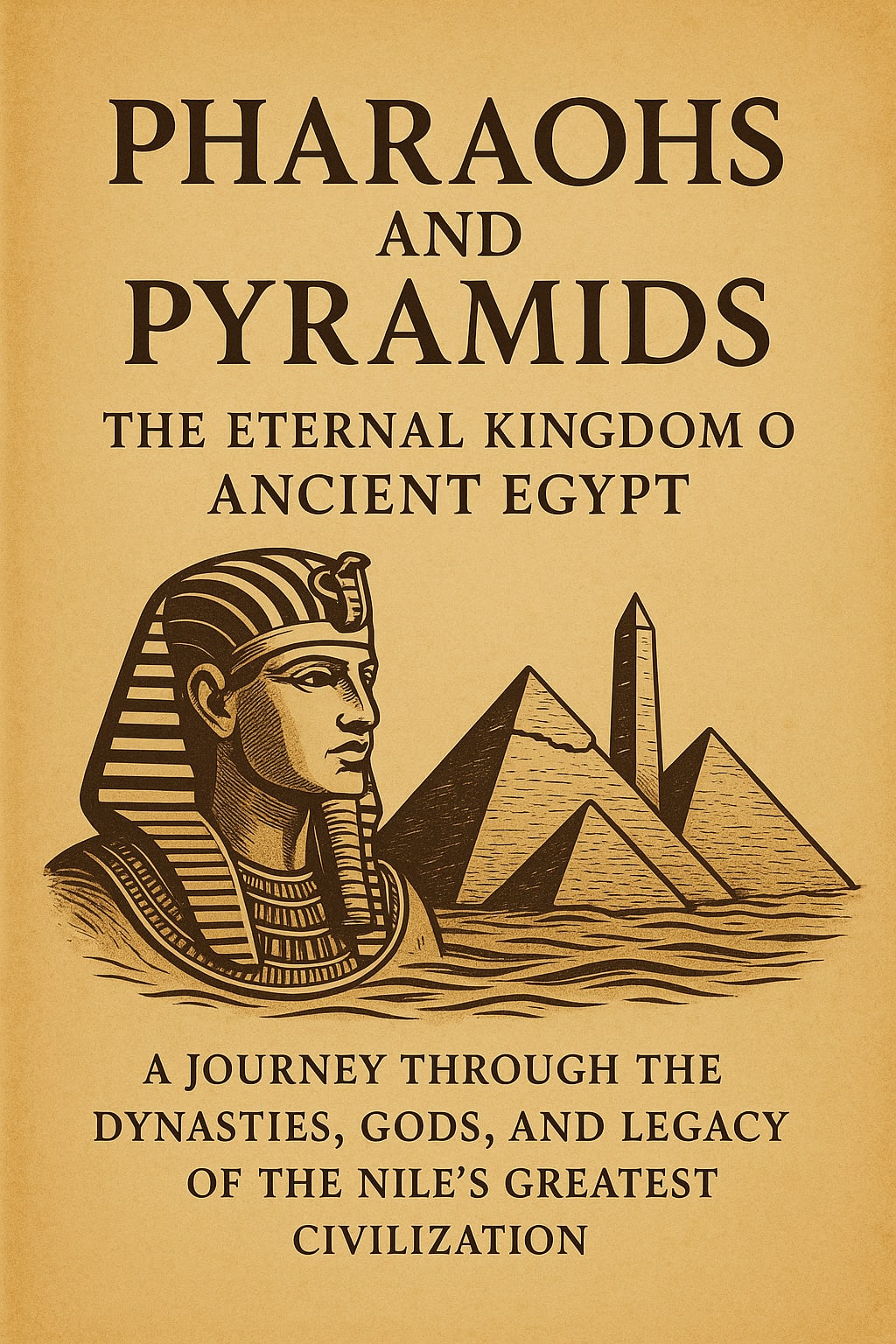
The civilization of ancient Egypt stands as one of humanity’s most enduring and fascinating legacies. Its pharaohs—god-kings who ruled with divine authority—and its monumental pyramids—testaments to both spiritual belief and architectural genius—continue to captivate the world more than 4,000 years after they first emerged. *Pharaohs and Pyramids: The Eternal Kingdom of Ancient Egypt* tells the story of this legendary civilization through its rulers, beliefs, achievements, and enduring symbols of power and eternity.
---
### The Birth of a Civilization
Ancient Egypt arose along the banks of the Nile River, a fertile strip of land running through the vast and arid Sahara Desert. The river’s annual flooding brought rich silt that enabled agriculture to flourish. As early as 3100 BCE, Upper and Lower Egypt were unified under the first pharaoh, Narmer (also known as Menes), marking the beginning of the Early Dynastic Period and the launch of one of the longest-lasting civilizations in history.
This unification wasn’t just political; it was religious and cultural. Egyptians saw the pharaoh not merely as a ruler but as a divine intermediary between the gods and humanity. This belief would remain central throughout Egypt’s millennia-long history.
---
### Pharaohs: Divine Rulers of the Nile
The word *pharaoh*, derived from the Egyptian *per-aa* ("great house"), referred originally to the royal palace but eventually came to represent the ruler himself. The pharaoh was considered a living god, the earthly embodiment of Horus during life and Osiris after death. As such, pharaohs wielded immense religious, political, and military power.
Among the most iconic pharaohs were:
* **Djoser** (c. 2670 BCE), who commissioned the Step Pyramid at Saqqara, the first large-scale stone structure in history.
* **Khufu** (c. 2589–2566 BCE), builder of the Great Pyramid of Giza, the only surviving Wonder of the Ancient World.
* **Hatshepsut** (c. 1479–1458 BCE), one of Egypt’s few female pharaohs, who reigned peacefully and built magnificent temples such as her mortuary temple at Deir el-Bahri.
* **Akhenaten** (c. 1353–1336 BCE), the "heretic king" who attempted a religious revolution by promoting the worship of one god, Aten.
* **Tutankhamun** (c. 1332–1323 BCE), whose nearly intact tomb, discovered in 1922, brought modern Egyptology to life.
* **Ramesses II** (c. 1279–1213 BCE), known as "Ramesses the Great," who led military campaigns and constructed monumental buildings across Egypt.
These pharaohs not only commanded armies and administered vast territories but also served as religious icons who were believed to ensure the harmony of *ma’at*—the cosmic order, balance, and truth that underpinned Egyptian society.
---
### Pyramids: Stairways to the Heavens
Perhaps nothing symbolizes ancient Egypt more than the pyramids. These massive tombs were built as eternal resting places for the pharaohs and reflected the Egyptian obsession with the afterlife. The most famous of these are the pyramids of Giza, constructed during the Fourth Dynasty of the Old Kingdom.
The Great Pyramid, built for Pharaoh Khufu, is an engineering marvel, originally standing at 146.6 meters (481 feet) tall and composed of over 2 million limestone blocks. It aligned precisely with the cardinal points and was designed to protect the pharaoh’s body and guide his soul to the afterlife.
Pyramid-building evolved over centuries, starting with mastabas—flat-roofed, rectangular tombs—and culminating in the smooth-sided pyramids we know today. These structures were more than tombs; they were religious complexes that included temples, causeways, and subsidiary tombs for nobles and priests.
The pyramid’s shape itself symbolized the rays of the sun, a staircase to the heavens where the pharaoh would join the gods.
---
### Religion and the Afterlife
Egyptian civilization was steeped in religion. The pantheon included gods like Ra (the sun god), Isis (goddess of motherhood and magic), Osiris (god of the dead), and Anubis (god of mummification). Each aspect of daily life—from agriculture to governance—was tied to divine will.
Central to Egyptian religion was the belief in an afterlife. Life on Earth was seen as preparation for an eternal existence. This led to elaborate funerary practices, including mummification, tomb building, and the provision of grave goods to sustain the dead in the next world.
The *Book of the Dead*, a collection of spells and instructions, was often buried with the deceased to help navigate the trials of the underworld. The judgment of the soul, where the heart was weighed against the feather of *ma’at*, determined one’s fate in the afterlife.
---
### Art, Science, and Society
Beyond their monumental architecture, the Egyptians were pioneers in many fields:
* **Medicine:** Egyptian doctors understood anatomy, set bones, performed surgeries, and used a wide range of herbal remedies.
* **Mathematics and Engineering:** Precise measurement and geometry were essential for pyramid construction and irrigation systems.
* **Writing:** Hieroglyphs, a complex writing system combining logographic and alphabetic elements, allowed for detailed record-keeping, literature, and religious texts.
* **Art:** Egyptian art was highly symbolic, idealized, and guided by strict conventions to preserve *ma’at*. Tomb paintings, statues, and carvings depicted gods, pharaohs, and daily life.
Society was hierarchical but not entirely rigid. While pharaohs and priests occupied the top of the social pyramid, skilled artisans, scribes, and traders held respected roles, and even some women wielded power as priestesses, queens, or regents.
---
### Decline and Legacy
Despite its strength, ancient Egypt was not immune to decline. The New Kingdom gave way to periods of foreign rule—by Libyans, Nubians, Assyrians, Persians, and eventually Greeks after the conquest of Alexander the Great in 332 BCE. The Ptolemaic Dynasty, of Greek origin, ruled Egypt until the Roman annexation in 30 BCE following the death of Cleopatra VII.
Even as its political independence waned, Egypt's cultural legacy endured. The grandeur of its temples, the mystery of its hieroglyphs, and the allure of its mummies fascinated later civilizations and still captivate scholars and tourists today.
---
### Conclusion: The Eternal Kingdom
*Pharaohs and Pyramids: The Eternal Kingdom of Ancient Egypt* is more than a history—it is a biography of a civilization that lived in harmony with its environment, revered its rulers as gods, and built monuments that defied time. Through the rise and fall of dynasties, Egypt’s commitment to cosmic order, eternal life, and architectural brilliance carved an indelible mark on human history.
In the shadows of the pyramids and the gaze of the stone pharaohs, one still feels the breath of the Eternal Kingdom—a land where kings became gods, and eternity was etched in stone.
About the Creator
Irshad Abbasi
Ali ibn Abi Talib (RA) said 📚
“Knowledge is better than wealth, because knowledge protects you, while you have to protect wealth.
Keep reading
More stories from Irshad Abbasi and writers in History and other communities.
The Rise and Legacy of the Ottoman Empire
The Ottoman Empire, one of the most powerful and enduring empires in world history, rose from humble beginnings as a small principality in Anatolia to a vast imperial power that shaped the political, cultural, and religious landscapes of Europe, Asia, and Africa for over six centuries. From its foundation at the end of the 13th century to its dissolution in the early 20th century, the Ottoman Empire left an indelible mark on global history.
By Irshad Abbasi 8 months ago in History


Comments
There are no comments for this story
Be the first to respond and start the conversation.