
The Echo of Blackwood Creek
He’d never set foot there, yet the coal dust settled deep in his soul.
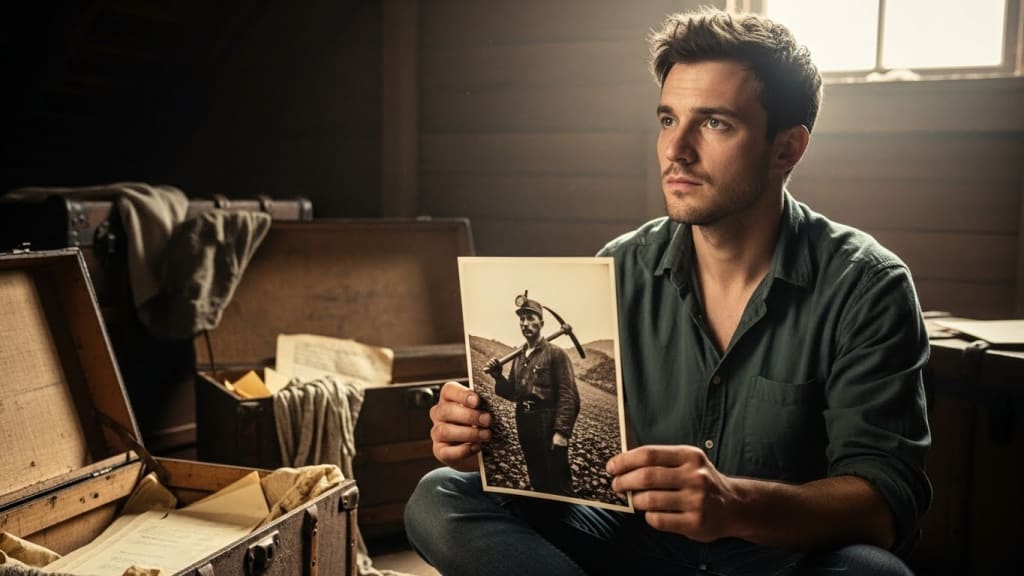
Arthur didn’t mean to find the trunk. It sat, a hulking, forgotten beast in the corner of his grandmother’s attic, shoved behind boxes of Christmas ornaments and moth-eaten quilts. He was supposed to be clearing out her things, not getting lost in them. But the latch, green with age, called to him, a silent dare. He wrestled it open, the hinges groaning in protest, and a wave of something ancient, something musty and sweet, hit him. Not perfume, not dust, but the scent of time itself.
Inside, beneath layers of yellowed linen, he found them: a stack of letters, brittle as dried leaves, tied with a faded ribbon. And photos. Dozens of them. Sepia-toned windows into a world that felt both alien and strangely, intimately familiar. They weren’t of his immediate family, not anyone he recognized from the framed smiles on the mantelpiece. These were of faces he’d never seen, strong jawlines, wary eyes, women with tightly pulled back hair and hands that looked like carved wood.
The letters were from a great-great-aunt, Elara. He barely knew her name. They were addressed to a sister who’d moved west, full of the mundane details of life in a place called Blackwood Creek, Pennsylvania, 1920s. He started reading, tracing the elegant, looping script with a finger. The words, at first just black marks on paper, began to coalesce, forming images in his mind’s eye. Elara wrote of the incessant thrum of the coal breaker, a sound she claimed you could feel in your teeth, even miles away. Of the mornings when the fog would hang thick and grey, smelling of wet earth and distant smoke, before the sun could even think about burning it off. She wrote of the men, blackened hands, stoic gazes, marching to the pit mouth before dawn, their lamps like tiny, bobbing stars in the gloom.
He saw them, the men. He saw the way the women gathered, clucking over scrubbed children, their aprons dusted with flour or coal grime. He pictured the main street, just a few dusty planks, with the general store smelling of molasses and kerosene, and the saloons where laughter and curses spilled out into the twilight. He read about the company houses, row after row, identical and stark, but each one holding a family, a life. He read about the Sunday hymns that soared from the small stone church, carrying the weight of a week’s toil, a collective prayer for another day, another breath.
A dull ache settled in his chest. It wasn't pity, not exactly. More like a profound, confusing longing. He’d lived his whole life in clean, suburban quiet, where the hardest decision was what takeout to order. These people, Elara and her kin, they clawed their existence from the earth. They breathed coal dust, lived by the whistle of the mine. And yet, there was something in their faces, in the way they stood together in the photos – a shared resilience, a deep-seated connection that he realized he’d never felt.
He spent weeks poring over the trunk’s contents. He found a small, tarnished silver locket with a lock of dark hair inside, a child’s, probably. A pocket watch, heavy and cold, its gears long seized. Each item was a tiny anchor, pulling him deeper into Blackwood Creek. He'd lie in bed at night, the silence of his apartment oppressive, and he’d close his eyes. He’d smell the damp earth, hear the rumble of the coal cars, the rhythmic clang of the blacksmith’s hammer. He’d feel the raw bite of the winter wind on his cheeks as he waited for the men to emerge from the pit, faces streaked, eyes bloodshot but alive.
He started researching Blackwood Creek online. It wasn't hard to find. A ghost town now, mostly. The mines had closed decades ago, the houses crumbled, the main street reclaimed by weeds. A few blurry satellite images showed rusted metal skeletons, collapsed roofs. It was gone, utterly. And that’s when the yearning became a full-blown ache, a phantom limb that throbbed with a life it never truly possessed.
He wanted to walk those dusty planks. He wanted to feel the grit between his teeth, to know the kind of bone-weary exhaustion that came from honest, back-breaking work. He wanted to sit in that saloon, a cheap whiskey warming his gut, and listen to the rough-hewn stories of men who'd seen the dark heart of the earth. He wanted to stand shoulder-to-shoulder with those women, sharing a moment of quiet strength as the pit whistle blew, signaling another shift, another risk.
It wasn’t just the place, or the time. It was the people, the collective struggle, the brutal, beautiful honesty of their lives. He felt like he’d missed something essential, some fundamental human experience that had been paved over, sanitized, and forgotten by his own era. He held one of the photos, a young man, perhaps Elara’s brother, standing defiant against a backdrop of slag heaps, a pickaxe slung over his shoulder. His eyes, though faded on the paper, held a spark, a resilience that Arthur felt missing in his own reflection.
He’d never been to Blackwood Creek. Not really. But every fiber of him felt its loss, like a memory stolen, a birthright denied. He looked out his window at the perfectly manicured lawn, the silent street, the cars gliding by. The air smelled of nothing much at all. He put the photograph gently back into the trunk, closing the lid with a soft click that sounded, to his ears, like a final shovel of dirt.
About the Creator
HAADI
Dark Side Of Our Society
Is the U.S. Preparing to Attack Iran?
Is the U.S. Preparing to Attack Iran? Inside the Rising Tensions and Possible Military Pathways In early 2026, tensions between the United States and Iran reached one of their highest points in years. For weeks, dramatic political rhetoric, shifting military postures, and warnings from leaders around the world have fueled alarms that a U.S. military strike against Iran may be imminent. Yet as of now, no confirmed attack has occurred, and the situation reflects a complex mix of pressure, preparation, de-escalation, and diplomatic uncertainty that illustrates how modern conflict can hinge just as much on words and positioning as on direct action.
By Wings of Time about 13 hours ago in History
No ICE, No KKK, No Fascist USA
"I don't 'do' politics." Politics will do you, regardless. Watching from the sidelines for the last year I can see far too many similarities in the way Trump's ICE Gestapo is to Nazi Germany. Considering the United States just invaded Venezuela and kidnapped their President and his wife I would say we are there.
By Lyvia Jack3 days ago in History



Comments
There are no comments for this story
Be the first to respond and start the conversation.