
The Drums of Freedom’s Endless Echo
A woman’s courage defies chains across storm, sea, and silence.

“The Drums of Freedom”
The waves of the Atlantic shimmered gold under the morning sun, but for those chained beneath the deck of the Mercy’s Cross, it was a sea of sorrow. The year was 1787, and the slave trade between West Africa and the Americas was at its height. The ship creaked under the weight of despair, its wooden hull soaked with tears and salt.
Among the captives was Abeni, a young woman from the Yoruba lands of West Africa. Only a month earlier, she had danced at her sister’s wedding, her laughter echoing through the palm trees. But that joy had been shattered when raiders descended upon her village — men with guns, guided by others who spoke her language but carried the greed of foreign traders in their eyes.
Now, Abeni sat in darkness, her wrists raw from the iron cuffs, her body trembling from the stench and heat. Around her, dozens of others breathed in shallow gasps. The air was thick with grief. Yet even there, beneath the suffocating deck, she could still hear it — a faint rhythm, a pulse of life. Someone was tapping quietly on the wooden planks. A message. A memory. A beat of home.
That night, as the sailors drank above deck and the ocean whispered below, the tapping grew louder. The rhythm spread — from one prisoner to the next — until the entire hold throbbed like a beating heart. The enslaved spoke no single tongue, yet the rhythm became their common language. It carried courage. It carried defiance.
Above, the ship’s first mate, a wiry man named Thomas Blake, frowned. “They’re making noise again,” he growled. The captain, Edward Lowe, waved a dismissive hand. “Let them,” he said. “It breaks no chains.” But in truth, it did — just not the kind of chains they could see.
Abeni remembered the stories her grandmother had told — that the spirits of the ancestors traveled on the wind, that even in the deepest darkness, their song could call the lost home. She began to hum softly, her voice trembling at first, then strengthening as others joined in. It was a song of mourning and hope, of rivers and rain, of mothers waiting at the shore.
The sailors tried to silence them, but the song returned each night. It became their prayer and their protest. Even as disease spread and the weak were thrown overboard, the rhythm continued. Each beat said, “We live. We endure.”
Weeks passed. The Mercy’s Cross neared the Caribbean, its human cargo destined for the sugar plantations. But the sea, it seemed, had other plans. A storm gathered on the horizon — black clouds rolling like angry gods. The wind howled, tearing at the sails. Waves slammed against the ship, and lightning split the sky.
In the chaos, one of the iron locks on the lower deck broke loose. Abeni saw her chance. With bleeding hands, she helped others free themselves, passing along the broken chain link like a sacred relic. When the next wave struck, they rose together, bursting onto the deck amid rain and thunder.
The sailors shouted, blades flashing, but the storm itself seemed to fight for the captives. Lightning struck the mainmast, setting it aflame. The ship lurched violently, splitting along its side. In that wild, furious moment, Abeni threw herself into the sea — into freedom or death, she did not know which.
The next morning, the Mercy’s Cross was gone, swallowed by the Atlantic. Debris floated on the waves — broken wood, torn rope, shattered chains. And among them, clinging to a plank, was Abeni. She coughed, gasped, and stared at the endless horizon. The sea had spared her.
Days later, a small fishing vessel from the Bahamas found her drifting near an island. The fishermen, freedmen themselves, pulled her aboard. Though weak, Abeni managed to whisper, “Home.” They did not know where her home was, but they understood what she meant.
Years later, stories spread among the enslaved in the Caribbean — of a woman who escaped the Mercy’s Cross, who taught her people the rhythms of freedom. On moonlit nights, they said, she gathered others in secret and beat on drums made from hollowed wood and stretched hide. The rhythm echoed the heartbeat of those who refused to be broken.
And so, the legend of Abeni — The Woman of the Drums — lived on. Her song crossed oceans, carried in whispers and work songs, in the pulse of every freedom struggle to come.
For as long as the drums beat, the world would remember:
The spirit can be bound, but never silenced.
About the Creator
Keep reading
More stories from Mukhtiar Ahmad and writers in History and other communities.
Timeless Landmarks: Exploring History Beyond Religion
A Journey Through Time: 100 Non-Religious Historical Landmarks Around the World When we think of history, our minds often turn to grand temples, mosques, and cathedrals. Yet, the story of humanity is just as powerfully told through secular monuments—fortresses, castles, palaces, bridges, towers, and ancient cities that have witnessed revolutions, empires, and cultural transformations. Across the continents, these non-religious landmarks remind us of human ingenuity, power struggles, and the timeless quest to leave a mark on civilization.
By Mukhtiar Ahmad5 months ago in History
The Man Who Lit the World
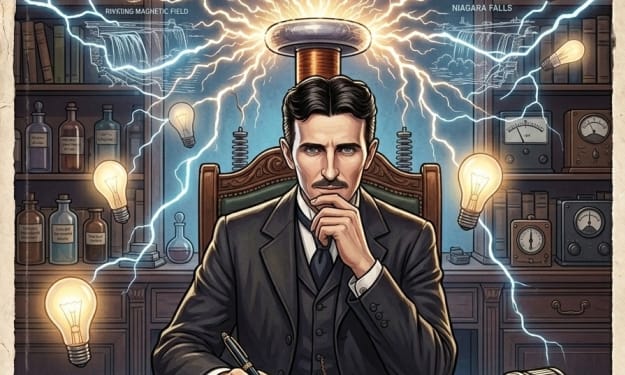
In a small village called Smiljan, in what is now modern-day Croatia, a boy was born on a stormy night in July 1856. Lightning flashed across the sky again and again, and thunder roared loudly. The midwife looked at the baby and said, “This child will be a child of darkness.” But his mother smiled and replied, “No, he will be a child of light.” That child was Nikola Tesla, one of the greatest inventors the world has ever known. Early Curiosity From a very young age, Tesla showed signs that he was different from other children. He had an incredible memory and a powerful imagination. He could picture machines in his mind and test how they would work without even building them. His father, Milutin Tesla, wanted him to become a priest, but Tesla was fascinated by science and electricity. Tesla’s mother, Đuka Tesla, was very intelligent and skilled at creating tools for household work. Although she had never received formal education, she inspired Tesla’s creativity and love for invention. Tesla often said that his ability to invent came from his mother. As a boy, Tesla loved reading books about science and mathematics. He studied hard and later attended the Graz University of Technology in Austria. There he became deeply interested in electricity, which was still a new and mysterious force at the time. The Dream of Alternating Current In the late 1800s, electricity was beginning to power cities. However, the system used at that time, called direct current (DC), could only travel short distances. This made it difficult to supply electricity to large areas. Tesla believed there was a better way. One day, while walking in a park and reciting poetry from Johann Wolfgang von Goethe, an idea suddenly appeared in his mind. He imagined a system called alternating current (AC) that could send electricity over long distances efficiently. Tesla was so excited that he drew the design of the motor right there in the sand. Journey to America In 1884, Tesla decided to travel to the United States with almost no money in his pocket. He carried only a few belongings and a letter of recommendation for the famous inventor Thomas Edison. When Tesla arrived in New York City, he began working for Edison. At first, Tesla improved some of Edison’s electrical machines. However, the two inventors had very different ideas about electricity. Edison strongly supported direct current (DC), while Tesla believed alternating current (AC) was the future. Their disagreement became part of what history calls the “War of Currents.” A Powerful Partnership After leaving Edison’s company, Tesla struggled for some time. He even worked digging ditches to survive. But he never gave up on his dream. Soon, Tesla met a businessman named George Westinghouse. Westinghouse believed in Tesla’s AC system and decided to support him. Together they developed electrical systems that could power entire cities. Their success became clear during the World's Columbian Exposition in Chicago. Tesla’s alternating current system lit up the entire exhibition with bright electric lights. Millions of visitors saw the power of AC electricity for the first time. Soon after, Tesla’s system was used to build a massive power plant at the Niagara Falls. The plant generated electricity from the waterfall and sent it to nearby cities. It was one of the greatest engineering achievements of its time. The Brilliant but Lonely Inventor Tesla invented many amazing technologies. He created the Tesla coil, improved radio communication, and worked on wireless transmission of electricity. Many scientists believe his ideas helped shape modern technologies such as radio, robotics, and wireless communication. However, Tesla’s life was not always easy. He cared more about ideas than about money or business. Because of this, other inventors sometimes became richer and more famous than him. Tesla spent much of his later life working alone in laboratories and hotels. Even though he made hundreds of inventions, Tesla died in 1943 with little money and few possessions. Yet the world slowly began to realize how important his work had been. A Legacy That Powers the World Today, Tesla’s ideas are everywhere. The electricity that powers homes, schools, and cities around the world mostly uses alternating current, the system Tesla believed in more than a century ago. His name is honored by the innovative technology company Tesla, Inc., which produces electric cars and advanced energy systems. Scientists and engineers now recognize Tesla as one of the most brilliant inventors in history. The Lesson from Tesla’s Life The story of Nikola Tesla teaches us an important lesson: great ideas often come from imagination, persistence, and courage. Tesla faced many failures, disagreements, and financial problems. But he never stopped believing in his vision of a brighter world powered by electricity. Just as his mother predicted on that stormy night, Tesla truly became a “child of light.” And today, every time a city lights up after sunset, a small part of Tesla’s dream shines with it. ⚡
By Sahir E Shafqat5 days ago in History



Comments
There are no comments for this story
Be the first to respond and start the conversation.