
The Development of Calendars: From Lunar to Gregorian
History of calendars

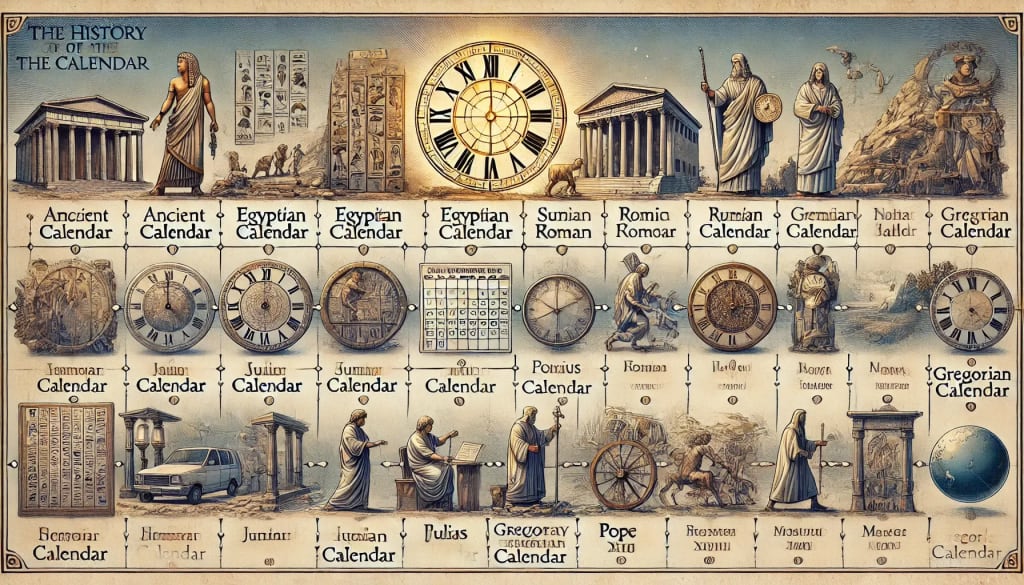
Picture a world without calendars. Farmers would struggle to determine when to plant their crops. Priests would be unaware of the specific dates for their rituals. Celebrations, anniversaries, and even seasonal changes would happen unexpectedly. Human civilization would lack a sense of order.
Since ancient times, humans have sought to measure and manage the passage of days. By observing the moon, sun, and stars, early societies crafted systems that enabled them to organize their lives, structure communities, and wield authority. These systems, which we refer to as calendars, represent more than mere dates; they reflect humanity’s understanding of the cosmos and themselves.
The narrative of calendar evolution guides us from primitive lunar calendars, through the solar and Julian methods, to the widely used Gregorian calendar in contemporary society. Yet, it’s also a tale woven with culture, faith, governance, and the intrinsic human drive to impose structure on time.
The Origin of Time Measurement: Primitive Lunar Calendars
One of the most ancient methods humans used to track time was by monitoring the stages of the moon.
Early Sky Observers
The Sumerians, around 2000 BCE, categorized months according to the lunar cycle, which lasts approximately 29–30 days.
Later, the Babylonians improved this framework by incorporating leap months to align with the solar year.
In ancient Egypt, priests monitored the appearance of the star Sirius alongside the lunar phases to anticipate the yearly flooding of the Nile.
Benefits of the Lunar Calendar
- It was straightforward to observe, requiring no equipment apart from the naked eye.
- It was beneficial for conducting religious ceremonies, storytelling, and navigation.
Challenges of the Lunar Calendar
However, the lunar calendar had its shortcomings. A lunar year consists of only about 354 days, whereas a solar year comprises roughly 365 days. This 11-day discrepancy posed challenges for farming and seasonal celebrations, leading to crops maturing at inappropriate times and religious events straying from their associated seasons.
In spite of its limitations, the lunar calendar significantly influenced various cultures. Today, the Islamic Hijri calendar is still entirely lunar, causing major celebrations like Ramadan and Eid to shift throughout the solar year.
Solar Calendars and the Agricultural Revolution
As humans transitioned from hunting to agriculture, there was a need for a calendar that aligned with the changing seasons. This led to the development of the solar calendar.
The Egyptian Solar Calendar
Around 3000 BCE, the Egyptians created a 365-day solar calendar, organizing the year into 12 months of 30 days each, plus 5 additional days designated for religious celebrations. This calendar was crucial for predicting the flooding of the Nile, which played a key role in Egypt’s agricultural prosperity.
Solar Calendars in Other Civilizations
- The Maya civilization developed two interrelated calendars: the Haab’ (a 365-day solar calendar) and the Tzolk’in (a 260-day ceremonial calendar). These calendars combined to create the “Calendar Round,” a cycle lasting 52 years.
- The Persians designed a solar calendar of such precision that it competes with today’s measurements.
- Solar calendars introduced a greater sense of order. Farmers gained knowledge of the optimal times for planting and harvesting, rulers could establish tax timelines, and clergy could schedule religious festivals with increased reliability.
The Roman Struggle with Time
Before Julius Caesar, the Roman calendar was disorganized. It was a lunisolar system, and political leaders frequently adjusted months to serve their interests. Celebrations would shift, seasons would be out of sync, and public uncertainty would increase.
Julius Caesar’s Solution
In 45 BCE, Caesar implemented the Julian Calendar, which was largely based on the Egyptian solar model.
A year consisted of 365 days.
Every four years, there would be a leap year (adding a day in February).
This was a groundbreaking enhancement. However, the Julian year was marginally longer—by about 11 minutes. Over time, this minor discrepancy led to the calendar drifting once more.
The Gregorian Reform: Addressing the Misalignment
By the Middle Ages, the Julian calendar had become off by approximately 10 days. Significant Christian celebrations, such as Easter, were shifting away from their proper times.
In 1582, Pope Gregory XIII launched the Gregorian Calendar to resolve this issue:
The leap year rules were modified: years that are centuries (1700, 1800, 1900) would not be leap years unless they are divisible by 400 (for example, 1600, 2000).
This adjustment resulted in a much more precise calendar.
- Opposition and Slow Adoption
- Catholic nations embraced it right away.
- Protestant nations opposed it, viewing it as a “Catholic innovation.”
- Britain and its colonies transitioned in 1752, losing 11 days in a single night.
- Russia implemented it only after the 1917 revolution.Currently, the Gregorian Calendar is the global standard utilized for business, scientific endeavors, and international communication.
- Cultural Diversity in Calendars
- Despite the widespread use of the Gregorian calendar, various other calendars hold significant importance:
- Islamic Calendar (Hijri) – a calendar based entirely on lunar cycles, utilized to commemorate religious occasions.
- Hebrew Calendar – a lunisolar calendar that aligns lunar months with the solar year.
- Chinese Calendar – still employed for celebrations such as the Chinese New Year.
- Hindu Calendar – features a variety of complex regional forms that direct rituals and astrological practices.
- Mayan Calendar – although it is no longer in use, it demonstrates an advanced understanding of astronomy.In the contemporary digital era, our scheduling tools have shifted to electronic formats — whether it’s reminders from Google Calendar or precision from atomic clocks. Nonetheless, their fundamental aim remains unchanged: to organize human existence.
- Agriculturalists continue to rely on the changing seasons.
- Corporations depend on established financial years.
- Cultural traditions and festivals serve to remind us of our shared heritage.
Modern scientific inquiry even reaches beyond our planet. Organizations like NASA develop extraterrestrial calendars to monitor missions to other celestial bodies. This illustrates how our longstanding fascination with measuring time has now expanded beyond the confines of Earth.
Calendars are not merely tools for tracking time; they convey narratives.
- The Chinese New Year evokes themes of family, prosperity, and heritage.
- The Islamic Hijri calendar links millions of Muslims to a collective spiritual cadence.
- The Gregorian calendar brings together the contemporary world in areas such as commerce, science, and communication.
Through the use of calendars, humanity has created a means to connect the past, present, and future.
The development of calendars goes beyond mere scientific progress — it mirrors the way humanity connects with the cosmos.
- The lunar calendar linked us with the phases of the moon.
- The solar calendar associated us with agricultural cycles.
- The Julian calendar highlighted how politics influences our timekeeping systems.
- The Gregorian calendar illustrated the collaboration between religion and science.
In the present day, while calendars may exist on our devices, their narrative is inscribed in the heavens above and in cultures that continue to revere them. From the light of the moon to digital algorithms, the history of calendars conveys a universal truth: humans have consistently aimed to impose structure on the unpredictability of time.
About the Creator
Sports Scraping
Welcome to Sports Scraping your one-stop hub for real-time sports scores, breaking news, in-depth stats, and everything in between. My name is Admin, and I’m the founder, creator. https://sportsscraping.com/
Keep reading
More stories from Sports Scraping and writers in History and other communities.
High School Track & Field: New Javelin Rules and Tougher Safety Standards Coming in 2026
The world of high school track and field is about to experience a major shift. The National Federation of State High School Associations (NFHS) has officially announced sweeping rule changes that will take effect in the 2026 season. The most eye-catching of these updates? Javelin specifications are being written directly into the official rulebook for the first time.
By Sports Scraping5 months ago in Journal
A woman from a vanished female dynasty was discovered buried with 270,000 beads.
In a Copper Age tomb close to Seville, Spain, the Montelirio bead assemblage contains over 270,000 beads that identify the ladies buried there as elites. The discovery is the biggest collection of beads ever
By Francis Dami6 days ago in History
The Ottoman Empire
In the late thirteenth century, when the great empires of the medieval world were beginning to crack under their own weight, few would have noticed a small Turkic tribe living on the edge of the collapsing Byzantine Empire. They owned little land, had no grand cities, and were surrounded by stronger rivals. Yet from this humble beginning would rise one of the longest-lasting and most influential empires in human history: the Ottoman Empire.
By The best writer 5 days ago in History




Comments
There are no comments for this story
Be the first to respond and start the conversation.