
“The Day the Wall Fell: Stories from a Divided Germany”
Eyewitness Accounts from Both Sides of the Berlin Wall"
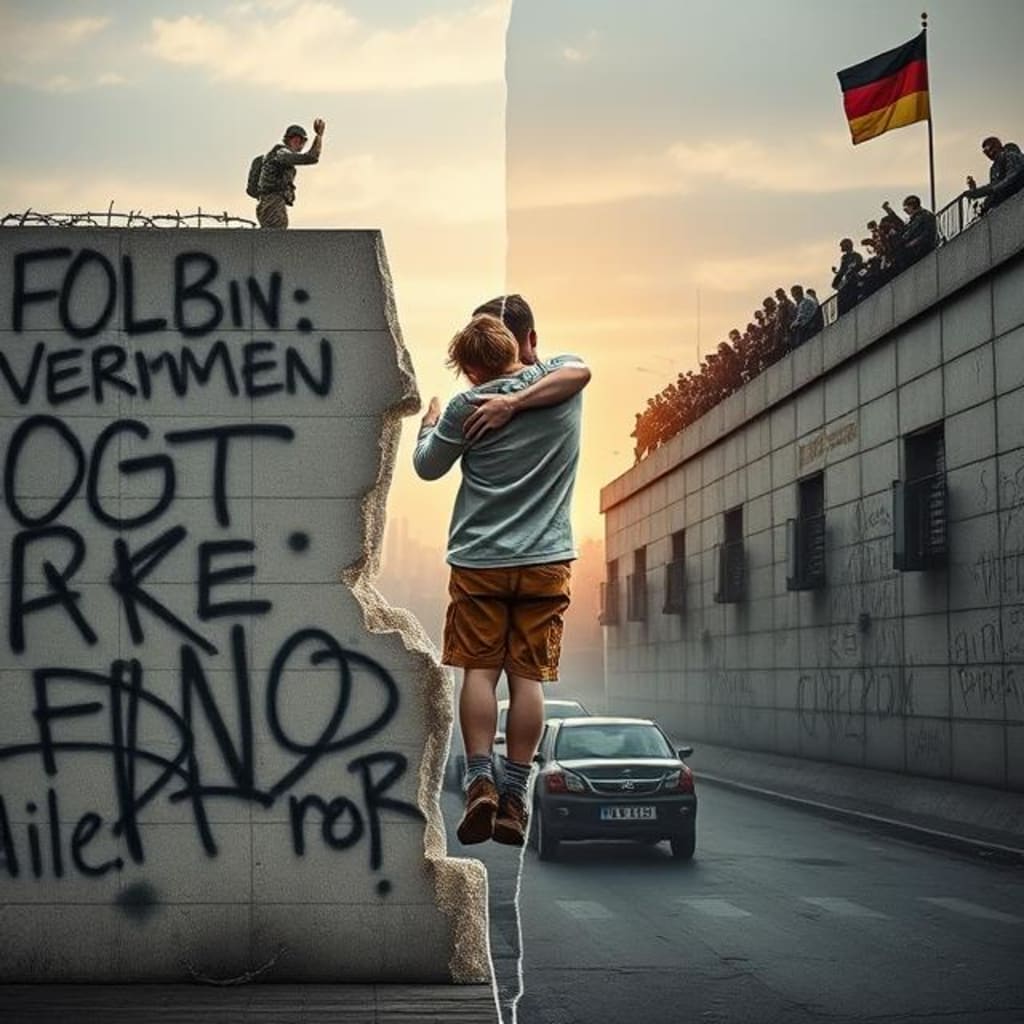
Prologue: The Wall That Wasn’t Always There
For 28 years, the Berlin Wall stood like a scar across the heart of Germany — a concrete symbol of division not just of a city or a country, but of the world. Built overnight in 1961 and expanded over time with guards, barbed wire, and snipers, the Wall split families, friends, and futures.
On November 9, 1989, that division ended in a night of disbelief, joy, and history. But to truly understand that moment, we must go back — into the lives of those who lived with the Wall. Their memories tell us not just what happened when it fell, but why it mattered.
1. Anna Müller — East Berlin
“I used to trace the Wall with my fingers on a map. But in real life, you couldn’t even get close to it.”
Anna Müller was 34 when the Wall came down. Born and raised in East Berlin, she had never crossed into the West. Her parents told her stories about life before the division — summer walks in the Tiergarten, cousins who lived in Charlottenburg — but those memories faded behind the checkpoints and propaganda.
She worked as a schoolteacher in Lichtenberg. Every morning, she passed portraits of Party leaders and children chanting the virtues of the socialist state. Yet at home, her small flat was filled with whispers — of freedom, of longing, of fear.
On the night of November 9th, Anna was grading papers when she heard a noise — shouts and cheers from the street. She turned on her small TV, and for a moment, thought it was a mistake. The news announcer stumbled, unsure of what he was allowed to say. The Wall was… open?
She ran outside in slippers and joined a crowd of people walking, some running, toward Bornholmer Straße checkpoint. Guards stood uncertainly, hands gripping rifles they weren’t sure they should use. Someone pushed the barrier — and nothing happened. Then someone else crossed. Then another. And another.
“I remember crying,” Anna says. “Not because I was happy — not yet. But because I didn’t believe it. I thought I’d be shot.”
But she wasn’t. That night, Anna stepped into West Berlin for the first time in her life — not to flee, not to spy, but simply to be there. She bought an orange and a pair of Levi’s jeans. It sounds silly, she laughs now, but it meant something. The Wall fell, and with it, the feeling of being trapped in someone else's idea of her life.
2. Thomas Becker — West Berlin
“The Wall was just... always there. It wasn’t a shock. It was a border like the edge of a map. Until it wasn’t.”
Thomas was 19, a student of philosophy at the Free University of Berlin. Raised in the West, the Wall was part of his daily commute, visible from U-Bahn windows and graffiti-covered back alleys. To him, it wasn’t just a physical thing — it was a challenge. His friends would tag it with paint, music blared near it at underground clubs, and his lectures were filled with debates about communism and capitalism.
But behind the defiance, there was also absence. Half his family had lived in Dresden before they stopped writing. Letters were intercepted. Phone calls didn’t go through. For years, he imagined his cousins as ghosts behind the Wall — real, but unreachable.
On November 9th, Thomas was at a bar in Kreuzberg. A DJ suddenly cut the music and shouted, “The Wall is down!” No one believed him. Rumors had spread before. But when they turned on the radio and heard the trembling voice of Günter Schabowski, an East German official, fumbling through the announcement, Thomas felt something electric surge through his chest.
By the time he reached the Wall, people were already on top of it — waving flags, singing, kissing strangers. He climbed up and helped pull others to join him, their feet scrambling for cracks in the concrete. Across the divide, East Berliners cried and cheered and banged on the barrier that had kept them caged.
At midnight, Thomas embraced a man he didn’t know — an East German electrician who hadn’t seen the Kurfürstendamm since he was a boy. “We just stood there,” Thomas says. “No words. Just... humans, together again.”
3. Lena Fischer — Stasi Officer’s Daughter
“My father told me the Wall was to protect us. But I think it was to protect them.”
Lena was 16 when the Wall fell. Her father worked for the Stasi, East Germany’s feared secret police. Her home was filled with rules — don’t speak to foreigners, don’t ask about the West, never question the Party.
She did all three.
She secretly listened to western radio under her blanket at night. She asked why her friend Marta’s father “disappeared” after he criticized the government. And she questioned whether keeping people in was really the same as keeping enemies out.
When the news came that the Wall was open, Lena didn’t wait for permission. She ran. In her school uniform, with her father screaming behind her, she sprinted through the cold Berlin streets to the nearest crossing. She wasn’t sure what she’d do next. She only knew she had to see for herself.
She crossed that night and never went back. Later, she would learn her father resigned the next day, a broken man. But Lena felt no guilt. “The Wall wasn’t just concrete. It was fear. I didn’t want to live in fear anymore.”
4. Dieter and Erika Schneider — Reunited After 28 Years
In 1961, Dieter Schneider kissed his sister Erika goodbye and said he’d visit her in East Berlin the following weekend. That weekend never came.
When the Wall was built — virtually overnight — Dieter was trapped in the West, Erika in the East. They wrote letters until the censors made it unbearable. Eventually, they stopped. Dieter married. Erika did too. Life moved on — but never together.
When news of the Wall’s collapse spread, Dieter didn’t wait. He grabbed a bouquet of yellow roses and rushed to the Brandenburg Gate, hoping — praying — that Erika might be there.
She was.
She had no flowers, just tears. They hugged for what felt like hours. “I thought I’d lost you,” she said.
“You never did,” he whispered.
Epilogue: What Fell That Night
The Berlin Wall didn’t just fall because a press officer misspoke. It fell because for years, people like Anna, Thomas, Lena, and Erika believed in something greater than fear — in reunion, in humanity, in hope.
And when the Wall fell, it wasn’t just concrete and steel that crumbled — it was the weight of silence, separation, and surveillance. It was the ending of one story, and the beginning of another.
A story of healing.
A story of freedom.
A story of a people, once divided, finding their way back to one another — one embrace, one step, one piece of broken concrete at a time.
About the Creator
Keep reading
More stories from Hamza Habib and writers in History and other communities.
“The Forgotten Women Who Changed the World”
History is often written in bold strokes — wars, revolutions, discoveries, and declarations — and more often than not, those strokes have been signed by men. But behind the curtains of great empires, beneath the layers of textbooks and timelines, there lived women who transformed the world in ways most of us were never taught. These were women who defied tradition, resisted oppression, challenged science, inspired revolutions, and saved lives — yet their names have been lost, ignored, or erased.
By Hamza Habib9 months ago in History
GDP After War: How Conflicts Reshape National Economies
GDP After War: How Conflicts Reshape National Economies War is not only fought on battlefields; it also leaves deep scars on a country's economy. One of the most important indicators affected by war is Gross Domestic Product (GDP), which measures the total value of goods and services produced by a nation. When war begins, economic activity often collapses, infrastructure is destroyed, and government spending shifts heavily toward military needs. But the economic story does not end when the war stops. The period after war can be equally challenging and sometimes surprisingly transformative.
By Wings of Time 6 days ago in History
The Forsyth House Fire
Since 1851, Forsyth House has stood on the corner of Union Street and Gordon Street in the heart of Glasgow. Its iconic, or was... because on Sunday 8th of March, 2026, a fire broke out in a small, seemingly un-named shop in the building and tore all that history down. As I write, the rubble is still unsettled and the street is still blocked off. Central Station is quiet on the upper level, and around 30 small businesses have quite literally gone up in smoke.
By S. A. Crawford3 days ago in The Swamp


Comments
There are no comments for this story
Be the first to respond and start the conversation.