
The Day the Sun Disappeared
How a Solar Eclipse Changed the Course of an Ancient Empire

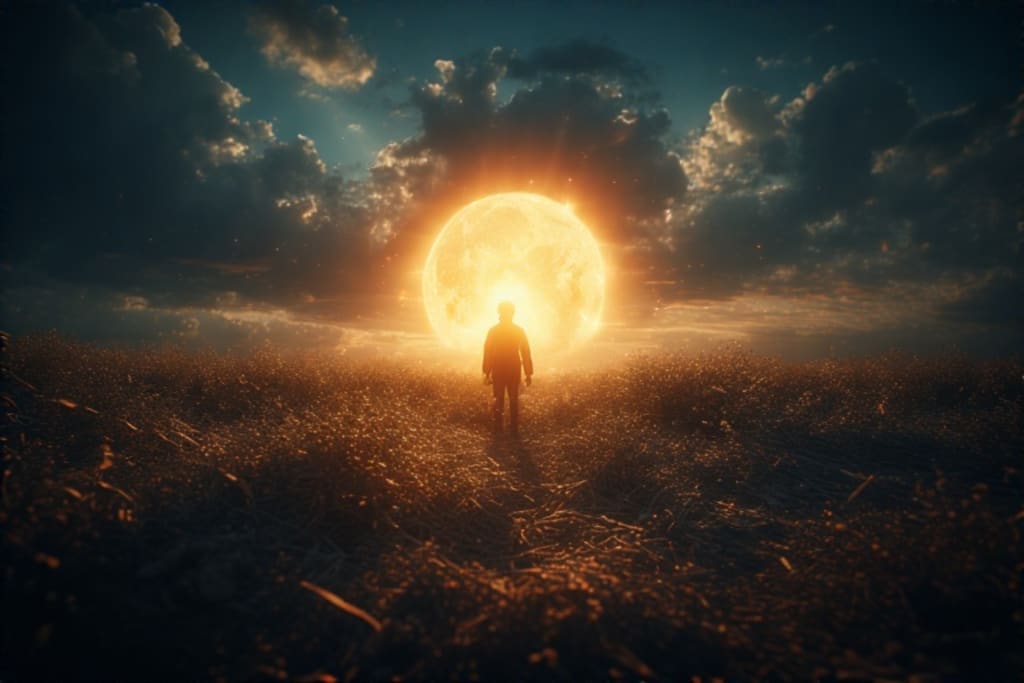
One morning, the world woke up to find the sky a strange, deep shade of gray—darker than any storm cloud, but lighter than night. There was no sunrise. The familiar golden warmth never broke over the horizon. The Sun… simply didn’t appear.
At first, people thought it was an eclipse, a rare astronomical alignment. News channels buzzed with hurried explanations and theories. Scientists reassured everyone it was temporary, that sunlight would return within hours. But hours passed. The sky stayed dim.
By midday, a cold wind began to crawl over the land. Temperatures dropped sharply. Cities switched on their streetlights, but the light felt hollow, artificial, unable to replace the brilliance of the Sun.
In a small town named Riverton, a twelve-year-old girl named Mara sat by her bedroom window, staring into the gray void. She’d always loved mornings—the way sunlight painted her room gold, the warmth on her face as she ate breakfast. Now, her room looked colorless, as though someone had drained the life out of it.
Her father tried to comfort her.
“It’ll be fine,” he said, pulling on a heavy sweater. “The Sun’s still out there. We just can’t see it.”
But Mara wasn’t so sure. She had a strange feeling in her chest—a quiet dread that the world had changed in a way no one understood.
By the second day, panic began to spread. Farmers worried about their crops. Solar power plants shut down, plunging some regions into blackouts. In grocery stores, shelves emptied quickly—people stocked up on canned food, bottled water, and batteries. The air grew colder still.
On the third day, the animals began acting strangely. Birds no longer sang in the mornings. Dogs howled at nothing. Even the ocean seemed different—its waves sluggish, as if it, too, missed the Sun’s pull.
Meanwhile, scientists struggled for answers. Satellites confirmed the Sun was still in its place, burning brightly in space. The Earth was still orbiting as usual. But something—no one knew what—was blocking its light from reaching the planet. Not clouds. Not dust. Something invisible.
Theories turned wilder. Some whispered of alien technology, some of a tear in the fabric of reality. Others feared it was a punishment from something greater.
On the fourth night, Mara couldn’t sleep. She bundled herself in a blanket and stepped outside. The cold bit her skin. The sky was empty—no stars, no moon, only an endless sheet of gray.
But then, she saw something.
A faint, pulsing glow, far in the distance beyond the hills. It wasn’t the harsh white of electric lights—it was warm, golden, almost like… sunlight.
Her heart quickened.
The next morning, she told her father. He hesitated, but desperation was already setting in. They packed a small bag with food, filled two flasks with water, and set off toward the glow.
The journey was harder than expected. Without the Sun, the land felt unfamiliar. Frost clung to the grass even though it was midsummer. Trees stood like black skeletons, their leaves limp and colorless.
After hours of walking, they reached the source—a vast, shimmering crack in the air itself, as if someone had sliced open the fabric of the sky. Through it, they could see sunlight pouring into some other world, golden fields stretching endlessly.
It was breathtaking—and heartbreaking.
A figure emerged from the crack. Tall, cloaked, and glowing faintly. Its voice was neither male nor female, but deep and resonant.
“You are not meant to be here,” it said.
“What happened to our Sun?” Mara asked, her voice trembling.
The figure’s expression—if it had one—was unreadable. “Your Sun still shines. But your world has been shifted, slightly, into the Shadow Plane. It was an accident. A rift in the weave of realities.”
“Can you fix it?” her father demanded.
“I can,” the figure replied. “But every correction has a cost. To bring your world fully back to the Light, something must be given in return.”
Mara swallowed. “What kind of cost?”
The figure turned its glowing gaze on her. “A guide. Someone to remain at the seam of the worlds, to hold it open until the Light returns completely. That someone cannot come back.”
Silence fell. Mara’s father stepped forward. “Then I’ll do it.”
But Mara shook her head. “No, Dad. The Sun means life for everyone—plants, animals, people. You have to take care of them when I’m gone.”
Her father’s eyes filled with tears. “You’re just a child.”
“And you’re my dad,” she said softly. “That’s why you need to go back.”
Before he could stop her, Mara stepped toward the rift. The figure extended its hand, and she took it. Warmth—real sunlight warmth—flooded her skin for the first time in days. She smiled.
“Tell them I said it’s worth it,” she whispered to her father.
The figure nodded once, and then the rift blazed with light. A wave of golden brilliance swept over the land, banishing the gray. The Sun rose again over Riverton, flooding the world with life and color.
But Mara was gone.
And somewhere, between worlds, a small girl stood at the seam of reality, holding it open—watching the Sun shine forever on the place she once called home.
About the Creator
Keep reading
More stories from Najeeb Scholer and writers in History and other communities.
The Potter’s Last Clay
The village of Brookhollow had always known Thomas the potter—not just as a craftsman, but as a quiet artist whose work seemed touched by something more than skill. His vases caught the light in a way that made the glaze glow like sunrise; his cups and bowls felt as if they belonged in your hands the moment you held them.
By Najeeb Scholer7 months ago in History


Comments
There are no comments for this story
Be the first to respond and start the conversation.