
The Day Niagara Falls Ran Dry: The 1969 De-Watering of the American Falls
Niagara falls diversion

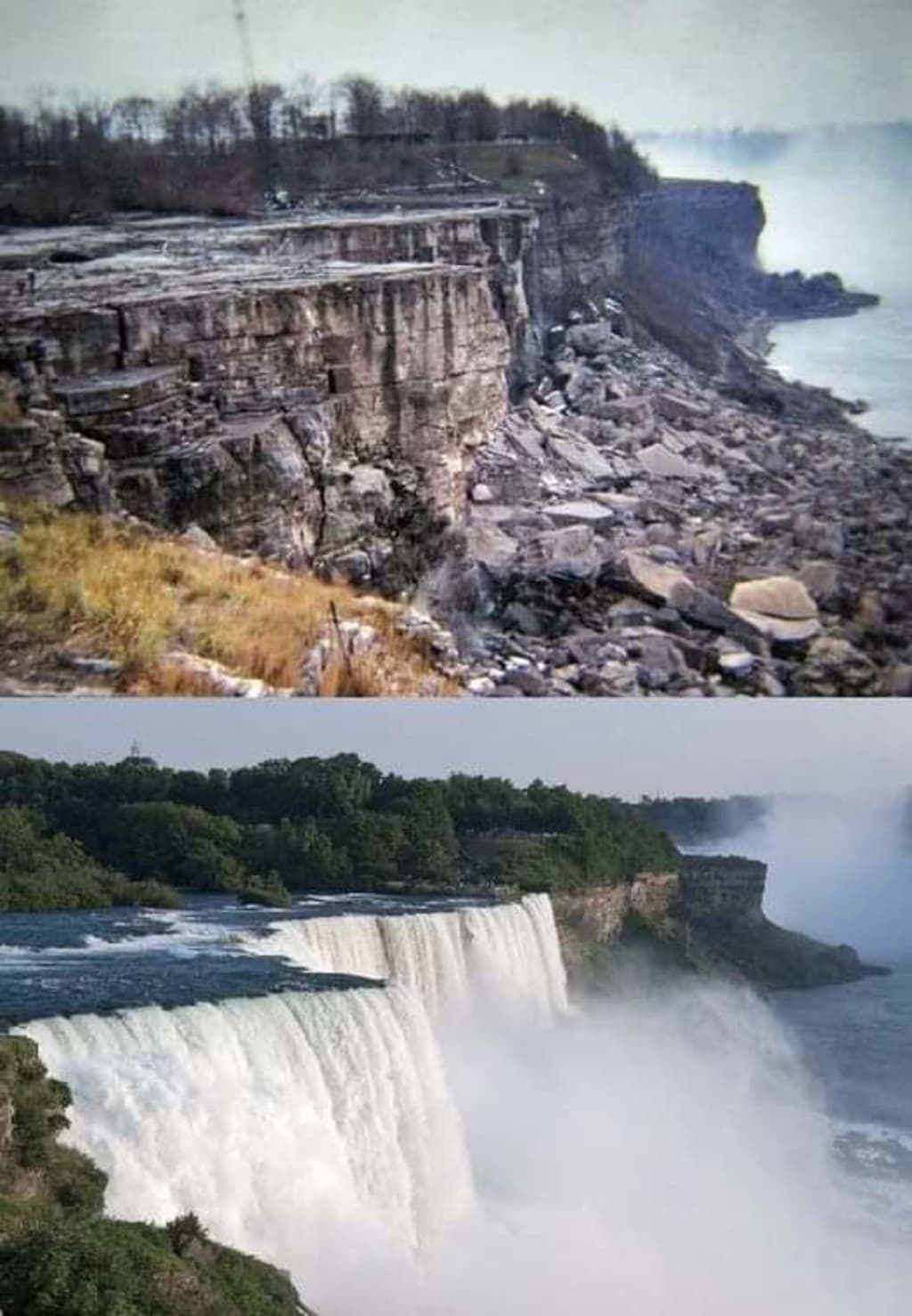
Few natural wonders capture the imagination like Niagara Falls. With its immense flow, thunderous roar, and mist that rises like a ghostly shroud, the falls are a symbol of nature’s raw power. But for a brief period in 1969, a remarkable engineering feat turned that power off—at least, on one side of the falls. In June of that year, U.S. engineers successfully diverted the flow of the Niagara River away from the American Falls, leaving them eerily dry for several months. This unique event allowed scientists to study the geology of the falls, confront safety concerns, and preserve the iconic attraction for future generations. Today, it remains a fascinating chapter in Niagara’s history, remembered as the year that one of the world’s most famous waterfalls ran dry.
Why Niagara Falls Needed a Break
By the late 1960s, concerns about the American Falls were growing. Erosion had steadily worn away the rock face, causing large boulders and debris to collect at the base. This rocky accumulation, known as talus, altered the appearance of the falls, reducing the waterfall's height and creating unsightly piles. Experts worried that the continued buildup would eventually transform the American Falls into a series of rapids, robbing the attraction of its majestic vertical drop. Additionally, some feared that erosion might even cause parts of the falls to collapse.
In response, the United States Army Corps of Engineers was tasked with evaluating the structural stability of the American Falls and considering ways to reduce further erosion. Their solution involved temporarily halting the flow of water over the American Falls, allowing them to survey and assess the site in detail. While diverting one of North America’s mightiest rivers sounded impossible, engineers devised a plan that would make this monumental task a reality.
The Engineering Feat Behind Drying Niagara Falls
The Army Corps of Engineers began the de-watering process on June 12, 1969. To accomplish this, they constructed a massive cofferdam—a temporary barrier built within a body of water—to divert the flow of the Niagara River from the American Falls to the Canadian Horseshoe Falls. This 600-foot-long structure was made from nearly 30,000 tons of rocks and earth, carefully piled into place to stem the river's flow. Water that would have cascaded over the American Falls was rerouted to the Canadian side, leaving the American Falls eerily dry.
With the water successfully diverted, a fascinating, almost surreal sight was revealed. For the first time in thousands of years, the riverbed of the American Falls lay bare, exposing rock formations that had been hidden beneath the powerful torrent. The exposed cliff face and rocky talus created an otherworldly landscape, and the absence of rushing water allowed for a rare, unimpeded view of the geological layers and patterns carved by centuries of erosion.
Engineers and scientists quickly set to work, conducting tests and collecting samples. Geologists were particularly thrilled by the opportunity, as the de-watering allowed them to study the falls' geology in detail. They examined the rock layers, identifying weaknesses in the cliff face that contributed to the buildup of talus at the base. Over several months, the site became a working lab where experts could examine the erosion process and explore methods for preserving the American Falls.
A Public Spectacle and a Rare Opportunity
As word spread, the dried-up falls attracted curious onlookers. Tourists flocked to see Niagara in this strange, almost lifeless state. While there was no water to dazzle visitors with its roar and mist, the sheer spectacle of seeing the falls laid bare was an unforgettable experience. People marveled at the sight of the riverbed and gathered to witness this one-of-a-kind event. Photographs taken during this time capture the American Falls in a way that few have ever seen—bone-dry, with every crack and crevice visible in stark detail.
Many onlookers were surprised to find remnants of human history among the rocks. As workers cleared debris, they discovered coins, relics, and even the remains of two bodies, reminders of past tragedies. These finds added a sense of mystery and gravity to the de-watering, revealing how the falls had silently kept secrets of its own over the years.
The Decision Against Removing the Talus
After several months of extensive studies, the Army Corps of Engineers concluded their assessment. While they initially considered removing the talus to restore the falls' natural appearance, they ultimately decided against it. The process would have been costly and labor-intensive, requiring continuous maintenance to prevent further accumulation. Moreover, engineers determined that the talus actually helped support the cliff face, reducing the rate of erosion and adding stability to the falls. As a result, they chose to leave the rocky buildup intact.
Instead, the Corps took measures to monitor and stabilize the falls over time. They installed bolts and anchors in vulnerable sections of the cliff face to prevent further rock falls, ensuring that the American Falls would retain its grandeur without human intervention. The project successfully addressed the safety concerns without altering the falls’ natural structure, preserving Niagara’s beauty while respecting the forces that had shaped it over millennia.
The Legacy of the 1969 De-Watering
The temporary drying of Niagara Falls is remembered as a remarkable convergence of nature, science, and human ingenuity. It offered scientists an unprecedented opportunity to study one of the world’s most famous waterfalls and gave the public a rare glimpse into the forces that had shaped the landscape. Although the American Falls returned to its roaring glory in November 1969, the memory of its silent, dry state remains a captivating part of Niagara’s history.
For many, this event underscores the delicate balance between human intervention and natural preservation. The de-watering project was a testament to the ingenuity of engineering, but it also highlighted the falls’ resilience and the wisdom of letting nature follow its course. The decision to preserve the talus left a reminder that Niagara, like all natural wonders, is an evolving landscape, shaped by forces beyond human control.
Today, Niagara Falls remains one of the world’s most popular attractions, drawing millions of visitors each year. Few, however, realize that there was a time when engineers temporarily held back its mighty waters, offering a rare moment to observe one of nature’s wonders in quiet suspension. The story of the 1969 de-watering serves as a fascinating chapter in the history of Niagara Falls, capturing a moment when the unstoppable was, for a time, held at bay—leaving behind an unforgettable memory of the day the American Falls ran dry.
About the Creator
Keep reading
More stories from Deji Akomolafe and writers in History and other communities.
Stokesay Castle: England’s Best-Preserved Fortified Medieval Manor House
In the rolling hills of Shropshire, nestled on the outskirts of Ludlow, stands one of England's most remarkable historical sites: Stokesay Castle. With its imposing towers and medieval charm, Stokesay Castle is celebrated as the best-preserved fortified medieval manor house in England. Built in the 13th century by a prosperous wool merchant, the castle has withstood the test of time, allowing visitors a unique glimpse into medieval life through its grand architecture and enchanting surroundings. Its magnificent great hall, largely unchanged for over 700 years, remains the heart of the castle, offering an atmospheric portal to the past for history enthusiasts, architects, and anyone fascinated by England’s rich heritage.
By Deji Akomolafeabout a year ago in History
The Years 1870 to 1879 Unveiled: Intriguing Facts and Landmark Events
This quick read is a collection of fun facts, trivia, and historical events from the years 1870 to 1879. Discover the decade’s top news stories, most influential people, notable inventions, historic firsts, retail prices, and much more.
By Gregory DeVictor3 days ago in History



Comments
There are no comments for this story
Be the first to respond and start the conversation.