

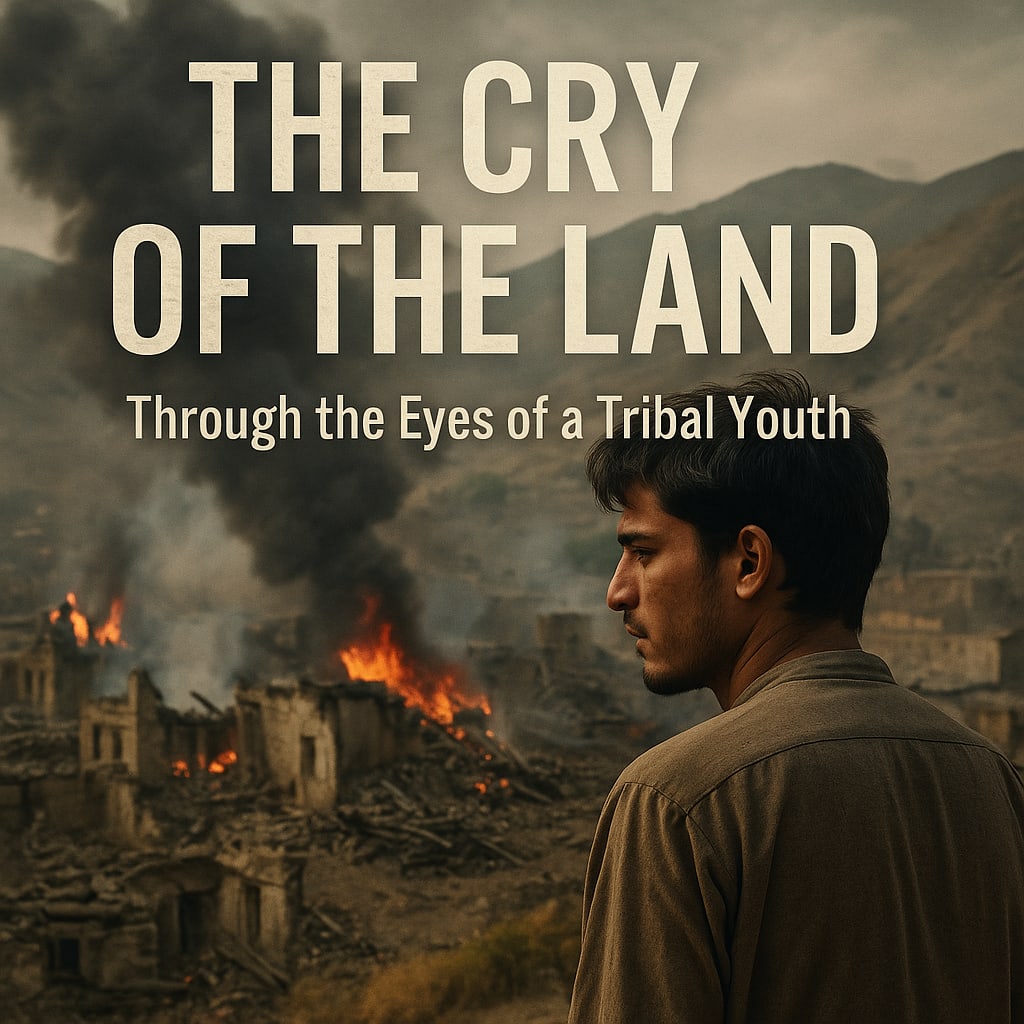
“They bomb our homes in the name of peace, but take our land in the name of progress.”
The mountains of Bajaur stand silent. Once proud, once echoing with the voices of children running through narrow trails, they now seem to weep — not with words, but with smoke rising from their ridges, ash clinging to their roots.
My name is Rehmat Gul. I was born in Loi Mamund, a region carved into the hills of Bajaur, where honor walks before every man, and the land is more sacred than blood. My father was a farmer. My grandfather too. We didn’t have much — just the earth beneath our feet, the goats we herded, the air we breathed, and the dignity passed down through generations.
Until the army came.
They arrived like shadows one morning — not as protectors, but as storm clouds. Their helicopters thundered overhead. Their trucks blocked our roads. And their leaflets, fluttering down like cursed snow, warned us:
“Leave. An anti-terror operation is beginning.”
The Day Everything Changed
We left with only what we could carry — women covering their faces, children crying, elders holding prayer beads and silence. When we returned, weeks later, our village was gone. Our homes were flattened. Our mosques crumbled. And the old walnut tree — the one that shaded every funeral, every wedding, every jirga — was burned to its roots.
We asked, “What happened?”
The soldier said:
“There were terrorists hiding here. You should be thankful we’ve cleared them out.”
But where were the bodies of the terrorists?
Why was it only our people who died?
Why did our fields turn to ashes, and our livestock vanish?
The Hidden Agenda
Then came the engineers. Strange men with soft hands, modern tools, and hard faces. They didn’t speak Pashto. They didn’t greet us. They just started drilling, marking the land, taking samples.
We learned later that our mountains hold valuable minerals — chromite, marble, even gold. Land that we had grazed and protected for generations was now being sold, leased, auctioned. But not to us. To outsiders. To corporations.
Was this really a war against terror? Or was it a war for treasure?
Silenced Voices, Stolen Futures
Our elders tried to speak. Jirgas were held. Letters were written. But the media turned away. The journalists who did arrive were quickly turned back — some detained, others warned.
“Stay quiet,” they told us. “Don’t create unrest.”
But what is unrest if not waking up every day unsure if you still own your home? If your children will go to school or to a refugee tent?
Some of us still remember how we helped the State when the war on terror began. We gave them shelter. We gave them food. We believed their promises. And now, we are being pushed out — like pests, like unwanted guests in our own land.
A Question That Haunts Me
I look at my younger brother, barely ten, walking barefoot on cracked earth. He used to ask when school would reopen. Now he asks when we will have a home again. And I don’t know how to answer.
So I ask myself:
“Am I still a citizen — or just a problem to be moved?”
“Is this peace — or organized erasure?”
We want no war. We want no weapons.
All we ask for is dignity — and the right to live where we were born.
The Cry of the Land
At night, when the winds blow through the broken walls of our former homes, I swear the land itself groans. It whispers the names of our dead. It remembers the prayers, the laughter, the songs — now lost.
“They took our homes,” it says. “Now they take our silence.”
But not anymore.
We Will Speak
Even if no media tells our story, we will.
Even if no leader listens, we will shout until echoes reach the sky.
Because this land belongs to us.
Because our blood is in its soil.
Because when the land cries — its sons must answer.
About the Creator
Muhammad Shah “Rangila”: The Colorful Emperor of a Fading Empire
Among the later rulers of the Mughal Empire, Muhammad Shah Rangila stands out as one of the most colorful and controversial figures in South Asian history. Known for his love of music, dance, art, and luxury, he earned the nickname “Rangila,” meaning “the colorful” or “the pleasure-loving.” While his reign brought a cultural revival in some ways, it also coincided with a period of serious political decline in the Mughal Empire.
By Irshad Abbasi 3 days ago in History


Comments
There are no comments for this story
Be the first to respond and start the conversation.