
The Collapse of Azmir
A Kingdom That Died Not by the Sword, But by the Loss of Its Soul


In an age long past, nestled between towering mountains and the endless blue of the sea, lay the kingdom of Azmir. It was a land blessed by nature and guided by wisdom, where the air was fragrant with the scent of blooming jasmine, and the streets of its cities echoed with the laughter of children and the calls of merchants. The people of Azmir were known far and wide for their generosity, courage, and devotion to justice.
The foundation of Azmir’s greatness was laid by Queen Salmira, a ruler both fierce and compassionate. She was loved by her people not because she sought their praise, but because she sought their well-being. Under her reign, laws were crafted with fairness, not favoritism; knowledge was treasured in grand libraries; and the armies were disciplined defenders of peace, not instruments of oppression.
For a century after Queen Salmira’s reign, her vision shaped Azmir’s destiny. The kingdom grew prosperous, its culture blossomed, and its people lived in harmony. Neighboring lands envied Azmir’s stability, often sending envoys to learn from its scholars and to forge alliances.
Yet, as the centuries passed, the sharp memory of Salmira’s wisdom began to fade like a candle’s flame in the wind. Her laws, once read aloud in every town square, became dusty scrolls locked away in forgotten chambers. The virtues that had made Azmir great—justice, humility, and truth—were slowly replaced by greed, pride, and deception.
The nobles, who once served as stewards of the kingdom, transformed into lords of luxury. They built glittering palaces of marble and gold, filled their tables with feasts, and adorned themselves with jewels stolen from the sweat of the farmers and merchants. They cared little for the common folk, whose burdens grew heavier under unjust taxes.
In the courts where judges once imparted wise rulings, corruption took root. Bribes bought innocence or guilt, and the cries of the wronged were silenced by the clinking of coins. Scholars who dared to speak truths inconvenient to the rulers found their works banned, their voices muted by fear or exile. The libraries that once nurtured minds decayed into silent tombs.
The military, once proud and unified, fragmented into private armies loyal not to Azmir but to their own commanders. These commanders vied for power, settling disputes with blood rather than law. Discipline gave way to chaos, and the once-proud soldiers became mercenaries whose loyalty was measured in gold, not honor.
Amid this decay, the common people grew restless. They watched as their leaders squandered the blessings of the kingdom and abandoned the principles that had sustained it. The markets, once vibrant with trade and camaraderie, grew silent and fearful. Families struggled to survive under the shadow of injustice, and hope flickered dimly in the hearts of the young.
But the greatest danger was not from the distant mountains or the restless seas—it was from within.
Azmir’s enemies, who had long observed the kingdom’s rise with cautious respect, now saw an opportunity. A coalition of neighboring realms, once deterred by Azmir’s strength and wisdom, prepared to strike. Their armies gathered at the borders, ready to test the kingdom’s defenses.
Yet, when the enemy forces arrived, they found the gates of the capital wide open. Not a single soldier stood to defend the walls. Instead, inside those very gates, they found a city divided—its people broken by despair and distrust. The citizens, burdened by years of neglect and betrayal, had lost their will to fight for a kingdom that no longer fought for them.
The fall of Azmir was swift and quiet—not marked by great battles or heroic last stands, but by the silence of a people who had stopped believing in their own future. The invaders entered the capital not with swords drawn, but with weary surprise at the emptiness within.
Historians would later record Azmir’s fall as the consequence of external forces overwhelming a weakened state. But those who understood the truth knew better: Azmir had died not by the sword, but by the loss of its soul.
Its collapse was a mirror held up to all civilizations. It was a reminder that greatness is fragile, built not merely on walls and armies, but on the enduring values that unite a people. Justice, truth, humility, and a sense of shared purpose are the pillars upon which lasting societies stand.
When those pillars crumble, no fortress is strong enough to hold back the tides of destruction.
The story of Azmir teaches us that leadership is more than power—it is responsibility. That wealth is a trust, not a prize to hoard. That silence in the face of injustice is complicity. And that the health of a society is measured not by its riches, but by the dignity with which it treats its weakest members.
As we look to our own world, the lesson echoes clearly: civilizations must guard their souls as fiercely as their borders. They must cultivate wisdom, practice compassion, and uphold justice. Otherwise, they too risk the fate of Azmir—great in name, but hollow at heart.
About the Creator
Keep reading
More stories from Zain Ul Abedin Khan and writers in History and other communities.
The Life and Works of Bu Ali Sina
Introduction Bu Ali Sina, known in the West as Avicenna, was one of the most influential thinkers and scientists of the Islamic Golden Age. His vast contributions to philosophy, medicine, mathematics, astronomy, and other fields earned him the title of the "Prince of Physicians" and the father of early modern medicine. He left behind a legacy that would shape both the Islamic and European intellectual traditions for centuries.
By Zain Ul Abedin Khan9 months ago in History
Sultan Mehmed II: The Conquest of Constantinople That Europe Never Forgot
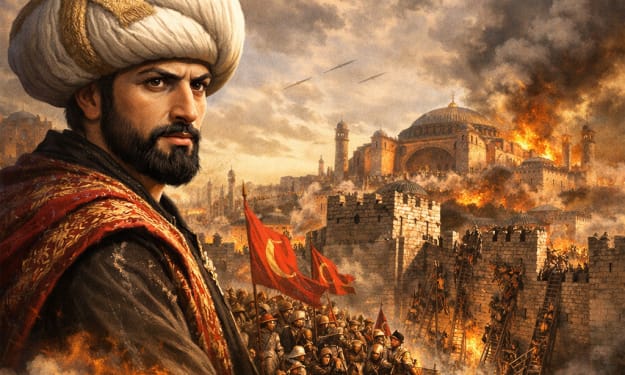
In the spring of 1453, one of the most dramatic moments in world history unfolded when Sultan Mehmed II captured the great city of Constantinople. This event did not simply mark the fall of a city; it ended the thousand-year-old Byzantine Empire and transformed the balance of power between Europe and the Muslim world. Even centuries later, the conquest remains one of the most significant turning points in global history.
By Irshad Abbasi a day ago in History
Review of 'Man on the Run'
My wife and I saw Man on the Run, a nearly 2-hour documentary on Amazon Prime, about Wings, Paul McCartney's group that flew around the world from shortly after The Beatles broke up in early 1970 to shortly after John Lennon was murdered at the end of 1980, making a Beatles reunion forever impossible.
By Paul Levinson6 days ago in Beat



Comments
There are no comments for this story
Be the first to respond and start the conversation.