
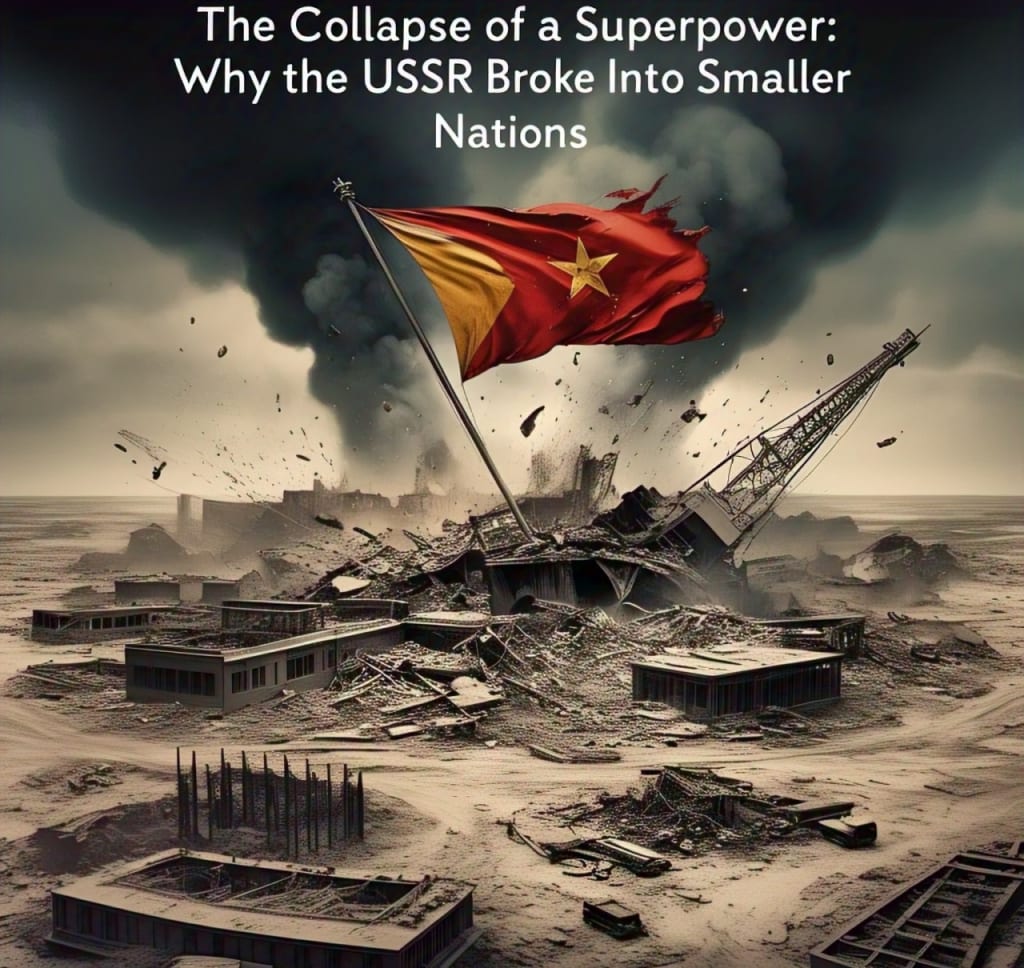
The Collapse of a Superpower: Why the USSR Broke Into Smaller Nations
Examining the Political, Economic, and Social Factors Behind the Soviet Union’s Dissolution Alternatively, for a more engaging approach:
Introduction
On December 26, 1991, the Soviet Union—the world’s largest communist state—officially dissolved, fracturing into 15 independent republics. This dramatic collapse marked the end of a 74-year experiment in socialism, reshaping global politics forever. But why did the USSR, a superpower that once rivaled the United States, suddenly disintegrate? The answer lies in a combination of economic stagnation, political reforms, rising nationalism, and external pressures. This article explores the key factors that led to the Soviet Union’s downfall.
1. Economic Crisis: The Soviet System’s Fatal Flaws
The USSR’s centrally planned economy worked in the early decades, rapidly industrializing the nation under Stalin. However, by the 1970s and 1980s, the system was crumbling under inefficiency and corruption.
Key Economic Problems:
Stagnant Growth: While the West embraced technology and free markets, the Soviet economy relied on outdated industries, leading to shortages of basic goods.
Military Overspending: The arms race with the U.S. drained resources, leaving little for consumer needs.
Black Market & Corruption: A shadow economy thrived as bureaucrats hoarded goods, worsening public distrust.
When Mikhail Gorbachev became leader in 1985, he introduced economic reforms (Perestroika), but they came too late. Instead of reviving the economy, they accelerated its collapse by exposing systemic weaknesses.
2. Political Reforms: Glasnost and the Unraveling of Control
Gorbachev’s Glasnost (openness) policy aimed to reduce censorship and encourage debate, but it backfired spectacularly.
Consequences of Glasnost:
Criticism of the Government: For the first time, Soviets openly discussed Stalin’s purges, corruption, and economic failures, eroding faith in the system.
Rise of Opposition Movements: Previously suppressed nationalist and democratic groups gained momentum, especially in Baltic states (Estonia, Latvia, Lithuania).
Loss of Communist Party Authority: People no longer feared the state, leading to mass protests and demands for independence.
By 1990-1991, the Soviet government was too weak to enforce control, and republics began declaring sovereignty.
3. Nationalism: The Soviet Empire’s Achilles’ Heel
The USSR was a multi-ethnic empire, forcibly holding together dozens of ethnic groups. As central control weakened, nationalist movements surged.
Key Flashpoints:
Baltic Republics (1988-1991): Estonia, Latvia, and Lithuania—annexed in 1940—led the push for independence.
Caucasus Conflicts: Armenia and Azerbaijan clashed over Nagorno-Karabakh, while Georgia sought separation.
Russia’s Role: In 1991, Boris Yeltsin (leader of the Russian Republic) defied Gorbachev, encouraging other republics to break away.
The August 1991 coup by hardline communists (trying to reverse reforms) sealed the USSR’s fate. When the coup failed, republics rushed to leave, and by December 1991, the Soviet Union was officially dissolved.
4. External Pressures: The Cold War’s Toll
The U.S.-Soviet rivalry strained the USSR’s resources. Key factors included:
Reagan’s Military Buildup: The U.S. outspent the USSR in defense, forcing Moscow into unsustainable military costs.
Afghanistan War (1979-1989): A costly, unpopular war that drained morale and finances.
Fall of Eastern Bloc (1989): When Berlin Wall fell and communist regimes collapsed in Europe, it inspired Soviet republics to seek freedom.
Conclusion: The Legacy of the USSR’s Collapse
The Soviet Union’s collapse was not a single event but a process—fueled by decades of economic failure, political mismanagement, and nationalist unrest. Gorbachev’s reforms, intended to save the USSR, instead hastened its demise.
Today, the 15 former Soviet republics have taken vastly different paths—some (like the Baltics) joined the EU and NATO, while others (like Belarus and Central Asian states) remain under authoritarian rule. Russia, the USSR’s core, still struggles with its post-imperial identity, as seen in its conflicts with Ukraine and the West.
The fall of the USSR remains one of history’s most pivotal moments, proving that even the most powerful regimes can crumble when their people lose faith.
About the Creator
Umar zeb
Hi, I'm U zeb, a passionate writer and lifelong learner with a love for exploring new topics and sharing knowledge. On Vocal Media, I write about [topics you're interested in, e.g., personal development, technology, etc
Why Early Aircraft Designs Failed Before They Ever Flew
Long before airplanes became symbols of speed and global connection, flight was an idea filled with uncertainty, ambition, and repeated disappointment. Early aircraft designers were driven by a powerful belief that humans could conquer the skies, yet many of their creations never made it past workshops, fields, or testing grounds. These failures were not accidents of carelessness; they were the result of a world still learning the rules of flight.
By Beckett Dowhan5 days ago in History
3 Times Ordinary Objects Did Something Deeply Unsettling
Objects surround us every day. They make life easier, more comfortable, or more entertaining. A chair supports us, a mirror shows us our reflection, and a toaster browns our bread with consistent reliability. Most of the time, they behave exactly as expected.
By Enoch Sagini4 days ago in History




Comments
There are no comments for this story
Be the first to respond and start the conversation.