
The British Empire in Indian History
The story of British India is a complex and fascinating chapter in world history.

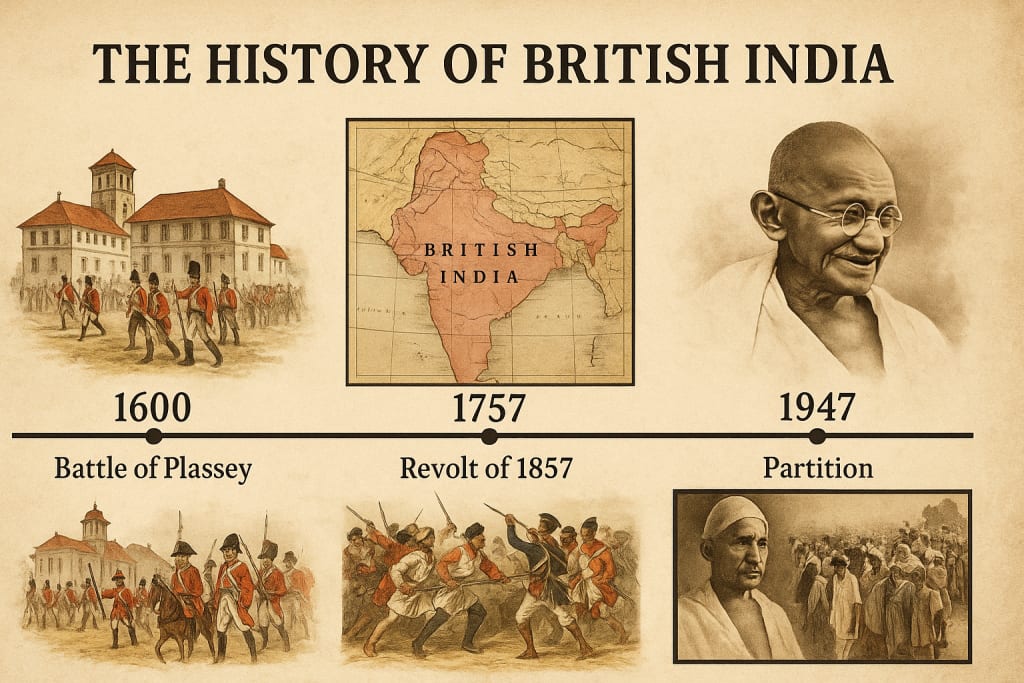
The story of British India is a complex and fascinating chapter in world history. Stretching over nearly two centuries, it encompasses conquest, resistance, cultural exchange, and profound societal changes. The Indian subcontinent was shaped in ways that still resonate today by British rule, which had a lasting impact on its political, economic, and social landscapes. ## The Early Beginnings: The East India Company
The East India Company's establishment of trading posts in the early 17th century marked the beginning of a modest British presence in India. The Company, which was established in 1600, sought to profit from the lucrative spice trade. Over time, as Mughal power declined, the Company transitioned from a commercial enterprise to a territorial power.
The turning point came after the Battle of Plassey in 1757, where British forces under Robert Clive defeated the Nawab of Bengal. The British gained control of Bengal, India's richest province, with this victory, which also marked the beginning of Company rule. Through a combination of military might, alliances, and treaties, the Company steadily expanded its influence across the subcontinent.
## Expansion and Control
During the late 18th and early 19th centuries, the East India Company established dominance over vast territories. In order to serve British interests, the British reorganized the Indian economy, introduced Western-style education, and implemented administrative reforms. The introduction of railways, telegraphs, and a centralized legal system tightened their grip even more. However, British policies often disrupted traditional industries, leading to widespread poverty. High taxation and the forced cultivation of cash crops like indigo and opium caused suffering among Indian farmers. Cultural insensitivity also grew; British officials frequently looked down upon Indian traditions, sowing seeds of resentment.
## The Rebellion of 1857: A Nation Rises The growing discontent culminated in the Revolt of 1857, also known as the First War of Indian Independence. The uprising quickly spread throughout northern and central India, sparked by issues like the introduction of rifle cartridges rumored to be greased with cow and pig fat, which Hindu and Muslim soldiers found offensive. Even though the British eventually put an end to the rebellion, it shocked both India and Britain. In response, the British Crown took direct control of India, ending the rule of the East India Company. Queen Victoria’s Proclamation of 1858 promised to respect Indian customs and involve Indians in governance, although real power remained firmly in British hands.
## The Impact of the British Raj The British Raj refers to the time period between 1858 and 1947. India was regarded as the British Empire's "jewel in the crown" at this time. The British maintained strict control over political power and economic resources while also introducing modern infrastructure and technological advancements. Significant shifts occurred in Indian society. A new group of Indians who were educated in the West were familiar with liberal concepts like democracy, freedom, and nationalism. Ironically, British institutions taught these ideals, which fueled growing demands for self-government. At the same time, economic policies heavily favored British industries, leading to the decline of Indian handicrafts and repeated famines. The policy of "divide and rule" exacerbated religious and social divisions, which had long-lasting effects on Indian society. ## The Fight for One's Independence The late 19th and early 20th centuries saw the emergence of organized resistance. The formation of the Indian National Congress in 1885 provided a platform for political activism. Public opinion was sparked by leaders like Bal Gangadhar Tilak, Dadabhai Naoroji, Mahatma Gandhi, and Jawaharlal Nehru. Gandhi’s philosophy of non-violent resistance, or Satyagraha, inspired millions. The Non-Cooperation Movement, the Salt March, and the Quit India Movement were large-scale movements that put a lot of pressure on British authorities. World War II further weakened Britain’s hold on its colonies, and the demand for independence became unstoppable.
## The End of an Era and Partition India finally gained independence on August 15, 1947. However, India and Pakistan became their own independent nations as a result of the agonizing Partition. The division resulted in significant communal violence and one of the largest mass migrations in human history. India became the largest democracy in the world despite the trauma of Partition. For the subcontinent, the end of British rule marked both the end of a difficult chapter and the beginning of a new, hopeful era. ## Legacy of British India
The legacy of British India is deeply intertwined with both pride and pain. British rule brought modernization but also exploitation. It suppressed local industries but introduced new political ideas. It not only sowed seeds of unity and democratic aspirations but also left scars of division. Today, the history of British India serves as a powerful reminder of resilience, the price of freedom, and the enduring human spirit that strives for dignity and self-determination.
About the Creator
Keep reading
More stories from SHAHADAT hossain and writers in History and other communities.
The History of Minecraft
In the world of video games, few titles have achieved the universal acclaim and cultural impact of Minecraft. With its distinctive blocky graphics and limitless creative possibilities, Minecraft has captured the imaginations of millions worldwide. But how did this pixelated sandbox game grow from a modest prototype into one of the best-selling video games of all time? Let’s take a deep dive into the fascinating history and evolution of Minecraft.
By SHAHADAT hossain 9 months ago in History
How Structural Failures Redefined Aviation Engineering Standards
When I look back at the earliest days of aviation, what strikes me most isn’t the bravery of the pilots or the excitement of first flight, it's how little engineers truly understood structural limits. Early aircraft were fragile by necessity. Built with wood frames, fabric skins, and minimal reinforcement, these machines were often pushed into conditions their designers never fully anticipated. Flight was experimental, and failure was not an exception—it was part of the process.
By Beckett Dowhan2 days ago in History


Comments
There are no comments for this story
Be the first to respond and start the conversation.