
The Book That Predicted the Future: Edgar Allan Poe’s Eureka
How Edgar Allan Poe’s Eureka Foretold Modern Scientific Discoveries

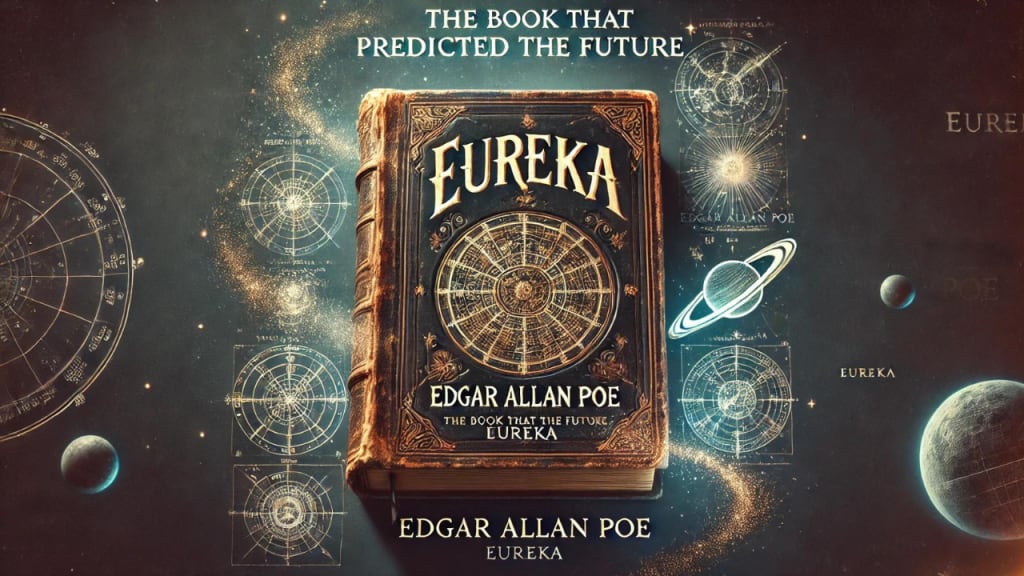
When we think of Edgar Allan Poe, we envision tales of Gothic horror, mystery, and melancholy. Stories like The Tell-Tale Heart, The Raven, and The Fall of the House of Usher have cemented Poe’s legacy as a master of the macabre. However, few are aware that Poe also ventured into a different genre—one that was far removed from the eerie corridors of haunted mansions and dark forests. In 1848, Edgar Allan Poe wrote an essay called Eureka, an audacious attempt to explain the origins, nature, and future of the universe. What makes Eureka so remarkable is not just its radical departure from Poe’s typical style, but that it eerily predicted some of the most groundbreaking scientific discoveries that would only come to light nearly a century later. From the Big Bang Theory to black holes, Poe’s vision of the cosmos was uncannily accurate, leading many to regard Eureka as a work of both literary and scientific genius.
In this article, we delve deep into the mysterious world of Poe’s Eureka, exploring how this visionary work anticipated major scientific theories long before they were formalized by physicists. We will explore the essay’s origins, its main ideas, and the profound influence it has had on modern cosmology.
The Context of Eureka: A Radical Departure for Poe
Edgar Allan Poe published Eureka in 1848, just a year before his untimely death in 1849. Unlike his famous works of fiction, Eureka was an essay that Poe described as a “prose poem” in which he sought to outline a grand, unifying theory of the universe. What’s particularly interesting is that Poe, who had no formal education in science or mathematics, claimed that his ideas were purely intuitive.
At the time, Poe’s essay was widely misunderstood. His audience was expecting more tales of horror or poems dripping with melancholia, not a metaphysical exploration of the cosmos. Furthermore, his ideas seemed so outlandish that many dismissed them outright. To understand the importance of Eureka, it’s essential to grasp the dominant scientific view of the universe in Poe’s time.
In the mid-19th century, most scientists believed that the universe was infinite, static, and eternal. The prevailing notion was that matter had always existed in a steady state, with no beginning or end. This idea would persist until the 20th century when astronomers like Edwin Hubble discovered that the universe was actually expanding.
Poe's Vision of the Universe: The Big Bang Before Its Time
One of the most astonishing predictions in Eureka is Poe’s description of the universe’s origin. While contemporary science clung to the idea of an eternal and unchanging cosmos, Poe proposed that the universe had a finite beginning. He wrote about a "primordial particle" from which all matter exploded outward to form the universe. This concept, though expressed poetically, bears a striking resemblance to what we now call the Big Bang Theory.
The Big Bang Theory, which wasn't formalized until the 20th century by Georges Lemaître and later supported by Edwin Hubble's observations, describes how the universe began as a singular point that expanded to form all the matter we see today. Poe’s description of a cosmic explosion that gave birth to the universe was not just speculative—it was visionary. At a time when no scientific evidence existed to support such an idea, Poe intuitively grasped the concept of a universe that began with a singular event.
Poe and the Expanding Universe: A Century Ahead of His Time
In Eureka, Poe also alluded to the idea that the universe was not static but expanding. He suggested that the force driving the expansion would eventually reverse, leading to a cosmic contraction that would culminate in the universe returning to its original state—a theory reminiscent of what some modern physicists call the “Big Crunch.” This cyclical view of the universe, where it expands and contracts in an endless loop, resonates with current cosmological models that entertain the possibility of a cyclic universe.
It wasn’t until Hubble’s discovery in the 1920s that the scientific community began to accept that the universe was expanding. Once again, Poe’s predictions were ahead of their time by nearly a century.
Poe’s Insight into the Nature of Matter and Energy
Another profound idea Poe touched on in Eureka was the relationship between matter and energy. Poe suggested that all matter is essentially a form of concentrated energy and that the universe’s structure was governed by this dynamic relationship. While Poe didn’t have the mathematical framework to formalize this theory, his idea echoes the principles behind Einstein’s Theory of Relativity.
In 1905, Einstein’s famous equation, E=mc², revealed that energy and mass are interchangeable, and that mass can be converted into energy. Poe’s musings on the connection between matter and energy in Eureka were a philosophical precursor to this groundbreaking discovery. Once again, the intuitive leap Poe made in his essay is remarkable considering that the scientific tools to prove such a theory wouldn’t exist for another 50 years.
Poe’s Prediction of Black Holes and the Nature of Light
This Book Predicted the Future and Nobody Can Believe How Accurate it Is. You'll definitely enjoy this!
Perhaps one of the most intriguing aspects of Eureka is Poe’s apparent allusion to the existence of black holes. Though Poe didn’t explicitly use the term “black hole,” he described a scenario in which light, under certain conditions, could be trapped by gravity. Black holes, regions in space where gravity is so strong that not even light can escape, were not proposed by scientists until the 20th century. The first mention of an object resembling a black hole came from Karl Schwarzschild in 1916, after Einstein's theory of general relativity provided the framework to understand such phenomena.
Poe’s intuitive grasp of the nature of light and gravity is particularly astonishing. He proposed that light could be influenced by gravity, an idea that Einstein would later prove with his theory of general relativity. The fact that Poe envisioned this concept decades before it was scientifically validated underscores the prescience of Eureka.
The Cyclical Universe: Poe’s Vision of the Cosmos’ Endless Rebirth
In Eureka, Poe postulated that the universe operates in cycles of creation and destruction. After expanding from a central point, Poe theorized, the universe would eventually collapse back into itself, only to start the process all over again. This concept mirrors modern theories about the fate of the universe, including the "Big Crunch" and the more speculative "Big Bounce" theories. While these ideas are still under debate, Poe’s cyclical model of the universe remains eerily in line with current cosmological discussions.
What’s even more fascinating is that Poe framed this cycle as one of eternal renewal. The idea that the universe is in a constant state of rebirth is not only a profound metaphor but also a concept that modern science continues to grapple with.
Why Was Eureka Overlooked?
Despite its visionary ideas, Eureka was not well received in Poe’s lifetime. Many critics dismissed it as the ravings of a madman. Poe was known for his emotional instability, and some believed that Eureka was a sign of his declining mental health. Moreover, the scientific community of the time was not ready to accept such radical ideas from a literary figure with no formal training in science or mathematics.
Nevertheless, Eureka has gained a new appreciation in recent years. As modern physics continues to validate some of the concepts Poe touched upon, scholars have begun to view Eureka in a new light—as a work of speculative genius that foreshadowed some of the most important discoveries in cosmology.
Conclusion: Edgar Allan Poe—The Unlikely Prophet of Modern Science
Though Edgar Allan Poe is best known for his haunting tales of terror, Eureka stands as a testament to his intellectual curiosity and his capacity to think beyond the boundaries of his time. In this essay, Poe not only challenged the scientific status quo of his day but also anticipated some of the most significant discoveries in astrophysics, from the Big Bang to black holes.
The fact that Poe, without any scientific background, was able to intuitively arrive at these concepts is nothing short of extraordinary. While Eureka may have been dismissed by his contemporaries, it now stands as a remarkable example of how the creative mind can sometimes glimpse truths that are far ahead of its time.
As we continue to explore the mysteries of the universe, we may find that Eureka holds even more insights yet to be discovered. In the end, Poe’s speculative prose poem was not just a literary masterpiece—it was a prophetic vision of the future of science.
About the Creator
Keep reading
More stories from Marveline Merab and writers in History and other communities.
What Happened After We Unearthed This Massive Underground City: The Discovery of Derinkuyu
In 1963, a seemingly ordinary home renovation in Turkey led to an extraordinary discovery that would captivate historians, archaeologists, and curious minds alike. This is the story of Derinkuyu, the largest underground city ever discovered, a subterranean marvel that has fascinated generations. Its origins, purpose, and the circumstances that led to its rediscovery are as compelling as the structure itself.
By Marveline Merababout a year ago in History
Alexander the Great: Conqueror of Empires
Alexander was born in 356 BCE in the ancient kingdom of Macedon, a rugged land of warriors and kings. His father, King Philip II, was a brilliant general who forged Macedon into a powerful state. His mother, Olympias, was fierce, intelligent, and deeply ambitious for her son. From the beginning, Alexander’s life was wrapped in stories of destiny. Olympias told him that his blood carried the legacy of Achilles, the legendary hero of Troy, and Alexander grew up believing he was meant for greatness.
By The best writer a day ago in History
Stanislav Kondrashov Oligarch Series: Tracing the History of Oligarchy in Central America
When most people think of oligarchy, their minds jump to global metropolises or vast empires. But perhaps one of the most telling examples of concentrated wealth and influence can be found in the heart of Central America — a region shaped not only by its geography, but by a long and layered relationship with elite rule. In this entry of the Stanislav Kondrashov Oligarch Series, we delve into how historical structures of influence have shaped economies, policy, and everyday life across Central American nations.
By Stanislav Kondrashov7 days ago in History


Comments (1)
Edgar Allen Poe was a very creative writer, and this idea proves he was more stable than people thought because of all his horror stories. Nothing against physics or the Big Bang theory, but I believe in the Creation story. Who do you think made that first little bang in the Big Bang theory.