
What Happened After We Unearthed This Massive Underground City: The Discovery of Derinkuyu
The Fascinating Story of the World's Largest Underground City

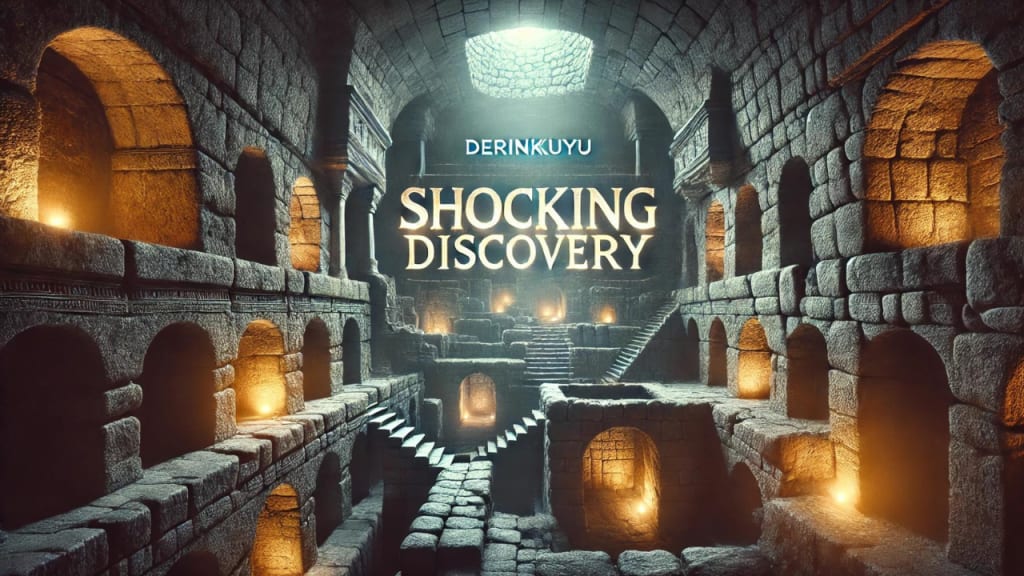
In 1963, a seemingly ordinary home renovation in Turkey led to an extraordinary discovery that would captivate historians, archaeologists, and curious minds alike. This is the story of Derinkuyu, the largest underground city ever discovered, a subterranean marvel that has fascinated generations. Its origins, purpose, and the circumstances that led to its rediscovery are as compelling as the structure itself.
The Beginning: A Curious Home Renovation
The story begins with a Turkish man who was renovating his home in the Cappadocia region of Turkey. As he worked on his property, he noticed a peculiar phenomenon: his chickens were mysteriously disappearing. This bizarre occurrence could easily be dismissed as mere misplacement, but the man was understandably concerned. Determined to investigate the cause, he soon stumbled upon a small crack in the wall of his basement. Intrigued, he decided to widen the crack from chicken-sized to man-sized, and to his astonishment, he discovered a secret room behind the wall.
Upon further exploration, he uncovered a narrow passageway that led deep into the earth. What he had stumbled upon was not just a hidden room, but the entrance to an entire city—an underground city that would later be known as Derinkuyu.
A Staggering Feat of Engineering
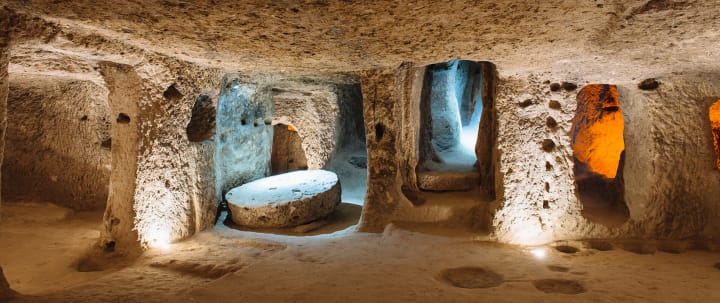
Derinkuyu is an astonishing feat of ancient engineering, extending approximately 85 meters (about 280 feet) underground—roughly the height of a 20-story building. This sprawling subterranean metropolis features an intricate labyrinth of tunnels, corridors, and chambers spread across eight distinct levels. It is believed to have housed as many as 20,000 people at its peak.
The design of Derinkuyu includes over 50 ventilation shafts that supplied fresh air, and a central well provided a constant supply of clean water. The city was equipped with hundreds of homes, communal meeting spaces, schools, and even a church. There were dedicated rooms for livestock, and facilities for the production of wine and olive oil. Remarkably, a dungeon was also part of the layout.
But who were the architects of this remarkable underground haven? Historians have debated its origins for decades. Some believe that the first caves were dug by the Hittites, who controlled much of Turkey during the Bronze Age. Others speculate that it may have served as a refuge during a period of rapid climate change known as the Younger Dryas, dating back approximately 12,000 years. If true, this would make Derinkuyu one of the oldest human settlements ever discovered.
The majority of the construction is attributed to the Phrygians, who inhabited modern-day Turkey during the 7th and 8th centuries BC. This means that when Derinkuyu was built, the Pharaohs still ruled Egypt, and neither Christianity nor Islam had yet been established. The city was in use for nearly its entire 3,000-year history, remarkably including periods as recent as 1909.
Why Did They Build an Underground City?
With such a monumental structure, one must wonder why ancient civilizations chose to construct an underground city in the first place. The Cappadocia region is known for its stunning natural beauty, characterized by unique rock formations and hot air balloon-filled skies. So why would the inhabitants of Derinkuyu opt for subterranean living?
One significant factor was the extreme temperature variations in the region. Summers can be scorching hot, while winters bring harsh cold. Living underground provided a stable and temperate environment, shielding residents from the extreme weather above.
However, Derinkuyu served more than just a refuge from the elements; it was a fortress. Throughout history, the Cappadocia region has been invaded and contested by numerous empires. Rather than building walls and castles to defend against invaders, the ingenious residents of Derinkuyu chose to build downwards.
The Defensive Architecture of Derinkuyu
The design of Derinkuyu reveals much about its intended use as a defensive stronghold. The upper levels feature narrow corridors that force intruders to enter single-file, effectively neutralizing any numerical advantage an attacking army might possess. Large, circular boulders were strategically placed to block certain passageways. Each boulder had a hole in the center, allowing defenders to attack any would-be invaders with spears from a distance.
In times of attack, the inhabitants could rely on oil lamps to illuminate the deeper levels of the city. If danger approached, they could extinguish these lamps, plunging the city into complete darkness. This would give the locals a distinct advantage, as they were familiar with the labyrinthine layout of their home, while intruders would be lost and vulnerable.
The unique structure of Derinkuyu made it nearly impervious to attack. Residents could stay underground for extended periods, living off stored food and drawing water from the central well. Any invading force would eventually grow weary and abandon their siege, leaving the denizens of Derinkuyu safe beneath the earth.
The Transition of Power
As the centuries passed, the inhabitants of Derinkuyu changed, reflecting the shifting dynamics of the region. By the early 20th century, the city was occupied by Greek descendants known as the Cidians. In 1909, during a period of ethnic tension and violence, they sought refuge within the walls of their underground city after the Ottoman Empire's brutal massacre of tens of thousands of Armenians in the city of Adana.
This marked the last significant use of Derinkuyu as a refuge. Following the events of World War I and the dissolution of the Ottoman Empire, the region underwent dramatic changes. The subsequent Greco-Turkish War resulted in the forced relocation of thousands, including the Cidians, who had known of the underground city. The connection to Derinkuyu faded from memory as its inhabitants were uprooted, and knowledge of the city slipped into obscurity.
Rediscovery in the 20th Century
Fast forward to 1963, when the Turkish man stumbled upon the entrance to Derinkuyu while renovating his home. This discovery sparked renewed interest in the underground city, leading archaeologists and historians to explore its depths. They unearthed a rich history and an architectural marvel that had been hidden from view for decades.
What Happened After We Unearthed This Massive Underground City? You'll definitely enjoy this!
Derinkuyu is not the only underground city in the Cappadocia region; it is part of a vast network of subterranean settlements, with some estimates suggesting that there are over 200 such sites in the area. Many of these cities are believed to be interconnected, forming a hidden world beneath the surface. Some scholars have posited that Derinkuyu links to the nearby Kaymaklı underground city through a five-mile tunnel, hinting at a broader network of communities that utilized these underground spaces for refuge and survival.
Unveiling More Secrets
The existence of Derinkuyu has ignited interest in uncovering more about the ancient civilizations that inhabited Cappadocia. Archaeologists continue to explore the region, searching for additional underground cities and studying the lives of those who lived in them. Every new discovery adds another layer to the already rich tapestry of human history, revealing how past civilizations adapted to their environments and developed ingenious solutions to challenges they faced.
Today, Derinkuyu stands as a testament to human ingenuity and resilience. It attracts tourists from around the globe, drawn by the allure of exploring an ancient world hidden beneath the earth. Visitors can wander through its narrow passageways, marvel at its intricate design, and imagine the lives of those who once sought shelter within its walls.
The Legacy of Derinkuyu
The story of Derinkuyu is not merely a tale of an underground city; it is a narrative about human survival, adaptation, and ingenuity. It reflects the broader human experience, showcasing how civilizations have navigated challenges throughout history.
As we continue to explore the mysteries of the past, Derinkuyu serves as a reminder of the incredible feats humanity is capable of achieving. It invites us to reflect on the stories that lie beneath the surface, waiting to be uncovered and understood. The underground city is a testament to the complexities of human civilization and the enduring spirit that has propelled us forward throughout history.
In a world where ancient wonders are often lost to time, Derinkuyu remains a shining example of the remarkable achievements of our ancestors. It beckons to those curious about the past, urging them to venture underground and discover the secrets that have been hidden for centuries. The story of Derinkuyu is far from over; as new discoveries are made and the mysteries of the past are unveiled, it will continue to captivate our imaginations for generations to come.
Conclusion
In the end, the unearthing of Derinkuyu has shed light on a remarkable chapter of human history. From its humble beginnings as a refuge for a flock of chickens to becoming a sprawling city capable of sustaining thousands, Derinkuyu is a symbol of resilience and ingenuity. It embodies the spirit of exploration and discovery that drives humanity to push boundaries and uncover the unknown. As we stand at the threshold of our own futures, let us remember the lessons of the past, the stories etched in stone, and the hidden worlds waiting to be discovered beneath our feet.
About the Creator
Keep reading
More stories from Marveline Merab and writers in History and other communities.
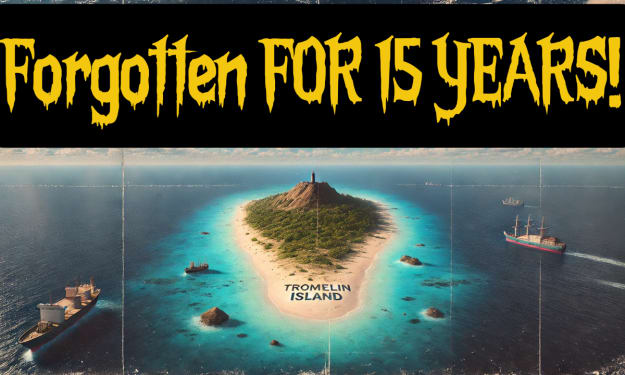
Why Did the World Ignore This Island for 15 Years? The Forgotten Story of Tromelin Island
In the middle of the vast Indian Ocean lies a small, seemingly insignificant patch of land known as Tromelin Island. At just one mile long and half a mile wide, it's the kind of place that might go unnoticed by even the most seasoned sailor. Yet, buried beneath its sandy surface is a harrowing tale of survival, human endurance, and the tragic consequences of colonial greed.
By Marveline Merababout a year ago in History
A massive underwater stone wall that is almost 7,000 years old is found by divers.
One of the buried stone monuments on Sein Island is a granite wall off Brittany that is more than 7,000 years old and the length of a football pitch. The discovery is being used by marine archaeologists in the vicinity of Île de Sein to explain how stone-built coastal villages predate the widespread spread of farming.
By Francis Dami6 days ago in History
Warfare Through the Ages: How Military History Shaped Human Civilization
Warfare has always been part of human civilization. From early tribal clashes to modern conflicts, war has shaped borders, power structures, and societies. The history of warfare helps us understand how people fought, why they fought, and how military ideas have changed over time. Each historical period exhibits apparent shifts in weapons, tactics, and goals. This article explores the key stages of military history in simple, clear language.
By Matthew Pothoff3 days ago in History
Miss Persephone's Manual to a Seemingly Ordinary Life
Miss Persephone was found at the dining table, her blue eyes swollen, her tears arriving and retreating like the tides of the ocean. Earlier that day, her family had visited her in the retirement home where she had lived for eight years. It was her eightieth birthday.
By Imola Tóth4 days ago in Fiction


Comments
There are no comments for this story
Be the first to respond and start the conversation.