
The Birth of Kauravas
The Story about the Birth of Kauravas
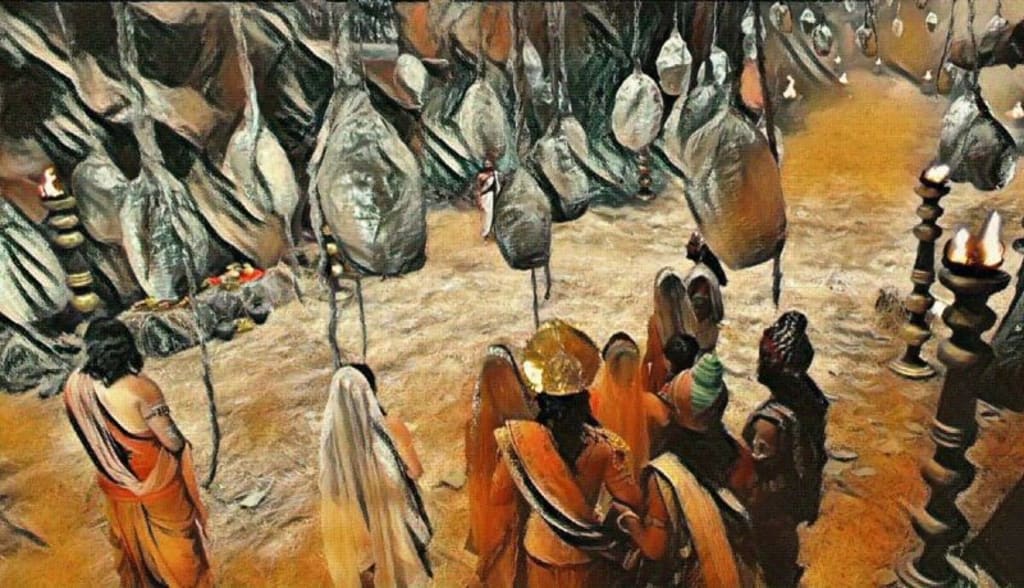
The Blessing of a Hundred Sons
Gandhari was blessed with a boon from Lord Shiva in her youth, which promised that she would have a hundred sons. This blessing brought great hope to Hastinapura, as it meant that the Kuru dynasty would have many heirs, ensuring the kingdom’s stability for generations to come. Gandhari was overjoyed at the prospect of fulfilling her role as the mother of a hundred sons, all of whom would carry forward the legacy of the Kuru dynasty.
As time passed, Gandhari became pregnant, and everyone in Hastinapura eagerly awaited the birth of the Kuru heirs. However, her pregnancy took much longer than expected, and even after several months, there was no sign of delivery. Gandhari grew increasingly frustrated and anxious, especially when she heard that Kunti, Pandu’s wife, had given birth to her first son, Yudhishthira. Knowing that Kunti’s son was a legitimate heir, Gandhari feared that her own children might lose their position in the royal lineage if they did not arrive soon.
Gandhari’s Desperation and the Intervention of Sage Vyasa
In her frustration and impatience, Gandhari struck her own belly, hoping to induce labor. However, instead of delivering her children, she gave birth to a hard, lifeless mass, which looked more like a ball of flesh than a child. Overwhelmed by grief, Gandhari despaired, believing her blessing from Shiva had turned into a curse.
At this time, Sage Vyasa, who was a great sage with profound knowledge and wisdom, arrived in Hastinapura. Seeing Gandhari’s distress, he approached her and offered to help. Vyasa possessed divine powers and insight, and he assured Gandhari that her children would indeed come into the world. He instructed her to prepare a hundred earthen pots filled with clarified butter, in which he would divide the mass and nurture each piece into a separate child.
Gandhari followed Vyasa’s instructions, and with his divine intervention, the hard mass of flesh was divided into a hundred and one pieces. Each piece was placed in an individual pot, where it was nurtured over time through Vyasa’s blessings and Gandhari’s devotion. These pots were then stored in a secluded chamber, with Gandhari and Dhritarashtra eagerly awaiting the birth of their children.
The Birth of Duryodhana and Ominous Signs
After a prolonged period of nurturing, the first pot finally opened, revealing a son. This child was named Duryodhana, the firstborn of the Kauravas and the crown prince of Hastinapura. However, his birth was accompanied by dark omens that foreshadowed the tragedy and conflict he would bring upon the Kuru dynasty.
The moment Duryodhana was born, there were unnatural disturbances throughout Hastinapura. Violent winds began to blow, wild animals howled and cried out, and strange phenomena occurred in the skies. These ominous signs alarmed the sages, astrologers, and advisors in the kingdom, who gathered to interpret their significance.
Vidura, Dhritarashtra’s wise counselor and half-brother, immediately sensed the gravity of the situation. He approached Dhritarashtra and expressed his concerns, warning him that Duryodhana’s birth might bring ruin upon the kingdom. Vidura advised that the child should be abandoned, as the omens suggested he would lead to great destruction and discord. However, Dhritarashtra, filled with paternal love and attachment, could not bear to abandon his firstborn son. Ignoring Vidura’s warning, he chose to raise Duryodhana, determined to groom him as a strong and capable ruler.
The Birth of the Other Kauravas and Their Sister
Following Duryodhana’s birth, the remaining pots gradually opened, and one by one, the rest of Gandhari’s hundred sons were born. The most notable among them were Dushasana, Duryodhana’s loyal brother and confidant, as well as Vikarna, who would later emerge as one of the few Kauravas with a sense of righteousness. Each of the sons had a fierce loyalty to Duryodhana, who became their leader and role model.
In addition to her hundred sons, Gandhari also gave birth to a daughter named Duhsala, the only sister among the Kauravas. She was cherished by her brothers and became an important member of the family, although she played a less active role in the events of the Mahabharata.
The Kauravas’ Childhood and Duryodhana’s Growing Rivalry with the Pandavas
As the Kauravas grew, Duryodhana quickly emerged as the dominant personality among them. He was ambitious, proud, and deeply attached to his rights as the eldest of the Kuru heirs. However, his nature was also marked by jealousy and insecurity, especially when it came to his cousins, the Pandavas, who returned to Hastinapura after Pandu’s death.
Duryodhana’s rivalry with the Pandavas intensified over time, fueled by his desire to secure the throne and overshadow their achievements. Bhima, the second Pandava and known for his strength, was a particular source of resentment for Duryodhana, as the two often clashed. This growing rivalry between Duryodhana and the Pandavas eventually planted the seeds of enmity that would lead to the great war of Kurukshetra.
About the Creator
Keep reading
More stories from sai Charan and writers in History and other communities.
The Birth of Pandavas and death of Pandu
Pandu’s Curse and Life in the Forest Pandu, the son of Ambalika and Sage Vyasa, became the king of Hastinapura after his elder brother Dhritarashtra, who was born blind, was deemed unfit to rule. Pandu was a skilled warrior and a beloved king, known for his sense of justice and dedication to his kingdom. He married two wives, Kunti and Madri, and ruled Hastinapura peacefully for a time.
By sai Charanabout a year ago in History
3 Ordinary Places That Hid Something Truly Disturbing for Years
Most of us take comfort in ordinary places. Schools feel safe. Homes feel familiar. Workplaces feel predictable. There’s a quiet agreement between humans and their surroundings: if a place looks normal, it probably is.
By Enoch Sagini6 days ago in History
The Quiet Rise of Global Militarization
The Quiet Rise of Global Militarization Across the world, governments are increasing military spending, expanding defense industries, and modernizing weapons systems—often without openly acknowledging why. There are no formal declarations of war, no mass troop mobilizations, and no clear enemy named in many cases. Yet behind the scenes, a quiet shift is taking place. Global militarization is rising, not loudly, but steadily, reshaping international relations in ways that may define the coming decades.
By Wings of Time 6 days ago in History



Comments
There are no comments for this story
Be the first to respond and start the conversation.