
The Birth of Dhritarashtra and Pandu
The story of The Birth of Dhritarashtra and Pandu
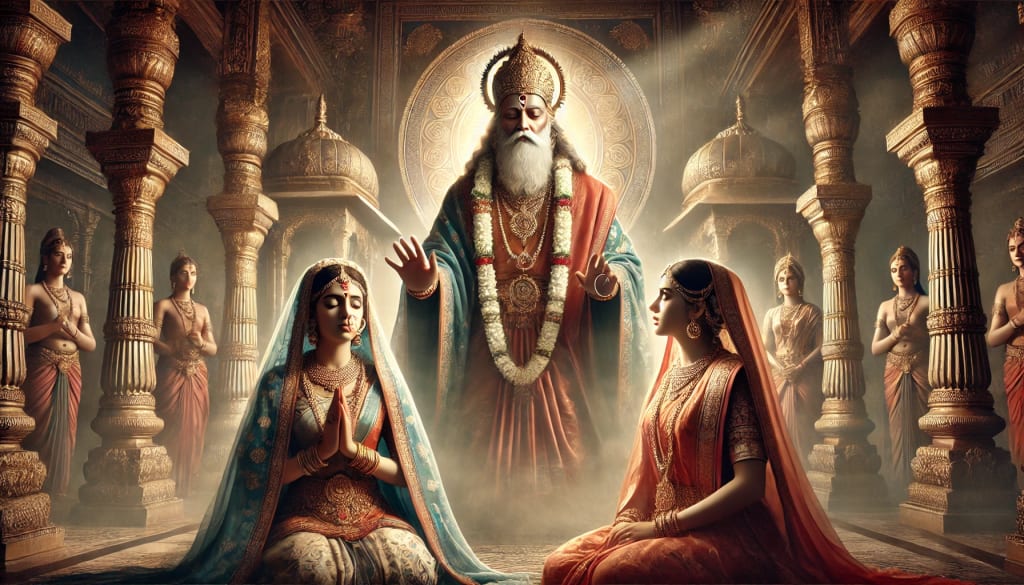
Satyavati’s Decision to Call Vyasa
Satyavati, desperate to preserve her family’s lineage, recalled an important secret from her past. Before her marriage to Shantanu, she had a son with the sage Parashara, named Vyasa. Vyasa was a powerful ascetic and sage, renowned for his wisdom, knowledge, and supernatural abilities. He was also known for compiling the Vedas and was deeply respected across the land.
Seeing no other solution, Satyavati summoned Vyasa and explained the dire situation in Hastinapura. She implored him to help preserve the Kuru dynasty by fathering sons with Vichitravirya’s widows, Ambika and Ambalika, through a custom called *niyoga*. *Niyoga* was an ancient practice that allowed a man of high status or divine powers to father children on behalf of a deceased person to ensure the continuation of their lineage. Vyasa, although initially reluctant, recognized his duty to his family and agreed to assist in securing heirs for the kingd
The Birth of Dhritarashtra
Vyasa first visited Ambika, Vichitravirya’s eldest widow. Vyasa, having spent years in ascetic practices, appeared with an intense and somewhat fearsome demeanor, which unsettled Ambika. When she saw him, Ambika was so frightened by his appearance that she closed her eyes during the union. As a result, Vyasa informed Satyavati that Ambika’s child would be born blind, as her fear and closed eyes symbolized the child’s lack of sight.
In time, Ambika gave birth to a son named Dhritarashtra. Though blind from birth, Dhritarashtra possessed remarkable strength and intelligence. Despite his disability, he was raised as a potential successor to the throne, under the guardianship and guidance of Bhishma and the wise counselors of Hastinapura. Dhritarashtra grew up to be a skilled warrior, with a powerful presence and a strong personality. However, his blindness became a concern among the court members, as it was seen as a potential hindrance to his ability to rule effectively.
The Birth of Pandu
To ensure another heir, Satyavati asked Vyasa to visit Ambalika, the younger widow. Ambalika, though forewarned of Vyasa’s intense appearance, was similarly terrified when he appeared before her. Though she did not close her eyes like her sister, her face turned pale with fear during the encounter. Vyasa later informed Satyavati that this child would be born with a pale complexion and would have a somewhat weak constitution.
This son was named Pandu, meaning “the pale one.” Despite his weaker constitution, Pandu grew to become a remarkable prince, excelling in the arts of warfare, diplomacy, and leadership. He possessed a gentle nature and a keen sense of responsibility, making him a beloved figure in the Kuru dynasty. His dedication to his duties and his kindness won the hearts of the people, and he was regarded as a promising leader who could carry on the legacy of his ancestors.
The Birth of Vidura
After the birth of Dhritarashtra and Pandu, Satyavati, still concerned about the future, requested Vyasa to bless the dynasty with yet another heir. This time, Vyasa returned to Ambika, but she was so fearful that she sent her maidservant in her place. The maidservant, unlike Ambika and Ambalika, greeted Vyasa without fear and treated him with respect and calmness.
Pleased by her composure and kindness, Vyasa blessed her with a son who would be exceptionally wise, righteous, and intelligent. This child was born as Vidura, who later became one of the wisest figures in the Mahabharata. Though he was not of royal birth, Vidura grew to be a counselor par excellence, guiding the Kuru dynasty with his unwavering wisdom and adherence to dharma.
Dhritarashtra, Pandu, and the Future of the Kuru Dynasty
With the births of Dhritarashtra, Pandu, and Vidura, the Kuru dynasty was preserved. Each of these sons had unique qualities and would play pivotal roles in the future of Hastinapura. Despite Dhritarashtra’s blindness, he was considered a strong candidate for the throne, though his disability led to some hesitation among the elders of the kingdom. Eventually, Pandu was crowned king due to his physical ability and strong leadership qualities, while Dhritarashtra accepted this decision with the support of Bhishma and Vidura.
Pandu’s reign brought peace and prosperity to Hastinapura, but his life too would face challenges and twists of fate, leading to the birth of the Pandavas and Kauravas, the two rival factions that would later battle in the epic war of Kurukshetra.
The births of Dhritarashtra and Pandu were thus essential to the survival of the Kuru dynasty, setting the stage for the events of the Mahabharata. Through Satyavati’s determination and Vyasa’s intervention, the legacy of the Kuru family continued, though the seeds of rivalry and conflict between the descendants of Dhritarashtra and Pandu were already being sown. The story of their births is a reminder of the complex web of duty, destiny, and divine intervention that shapes the lives of the Mahabharata’s heroes and the fate of the Kuru dynasty.
About the Creator
Keep reading
More stories from sai Charan and writers in History and other communities.
The Story of Vichitravirya and Chitrangadha
The Birth of Vichitravirya and Chitrangada After Bhishma took his vow, Shantanu married Satyavati, and they had two sons: Chitrangada and Vichitravirya. As children of the Kuru dynasty, both were raised in Hastinapura, the capital of the kingdom, under the care and guidance of their half-brother, Bhishma. Shantanu passed away when they were still young, and Bhishma, as the kingdom’s guardian, took on the responsibility of raising and training his younger brothers, instilling in them the values of bravery, honor, and duty.
By sai Charanabout a year ago in History
The Dangerous Forest
Far from the city stood a hill so thickly covered with wildflowers and fruit-bearing trees that if someone looked down at it from an airplane, they would see no soil or rocks at all. Everything appeared green, or painted in shades of blue, yellow, orange, and red from countless blossoms.
By Sudais Zakwanabout 10 hours ago in History
The Evolution of Aircraft Design Through Failure and Innovation
Aircraft design did not emerge fully formed or flawlessly engineered. Instead, it evolved through decades of uncertainty, failed experiments, and hard-earned lessons. Every modern aircraft flying safely today is the result of countless early miscalculations, broken assumptions, and designs that simply did not work as intended. Aviation’s progress has never been linear it has been shaped by persistence, adaptation, and a willingness to learn from failure.
By Beckett Dowhan4 days ago in History
Autonomy Is The Real Privilege
Good morning, freedom-seekers! Today we’re gonna be looking at autonomy. A strange word, I know; one many would probably look at blankly and run away from on sight. We’re gonna figure out what it actually means, consider how it’s achieved, and decipher just how deeply most of us are tangled up in dependence without realising it.
By That ‘Freedom’ Guy4 days ago in Humans



Comments
There are no comments for this story
Be the first to respond and start the conversation.