
The Astronomer Who Moved the Earth
Revolutionizing the Cosmos with the Heliocentric Theory

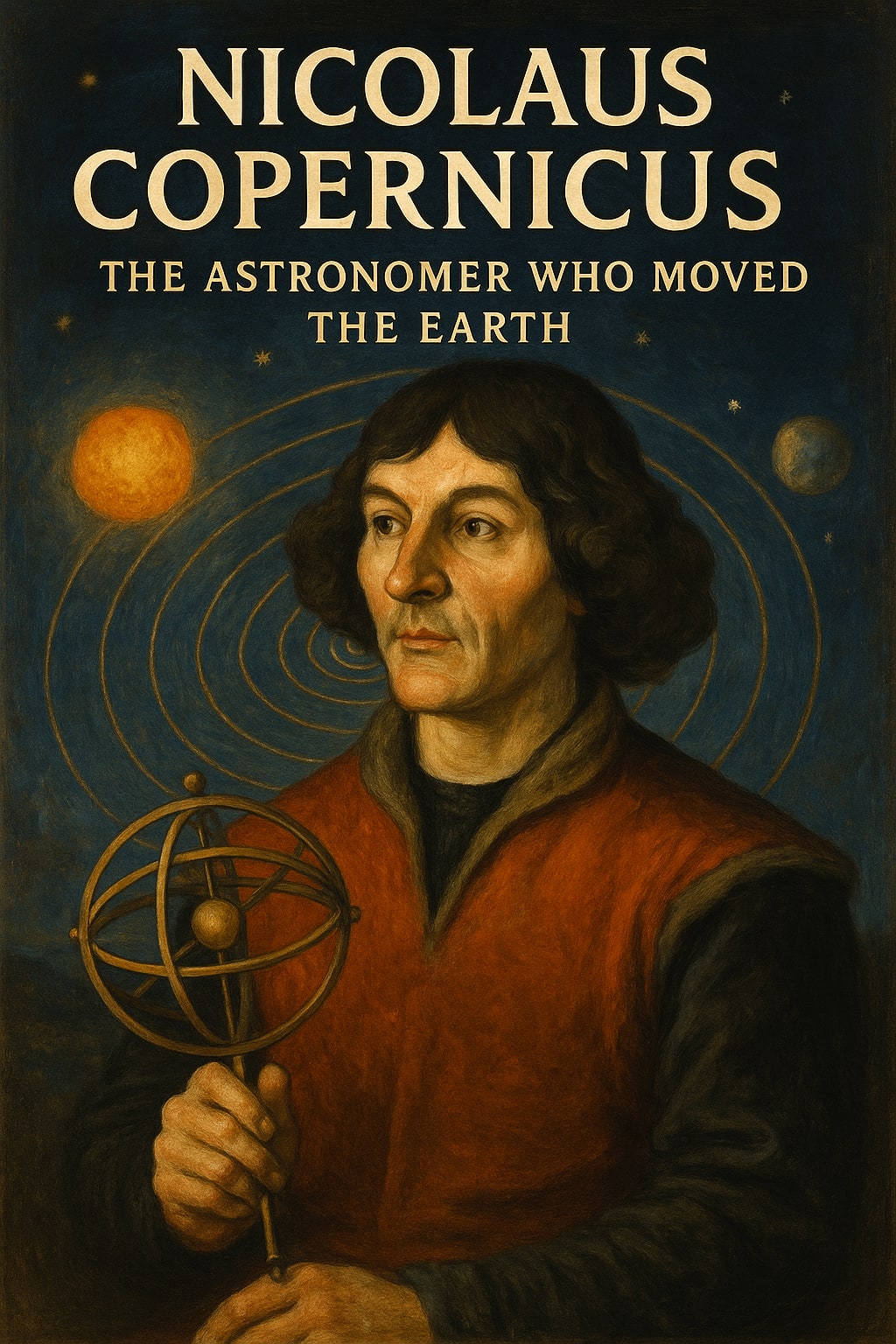
Nicolaus Copernicus, born on February 19, 1473, in the city of Toruń, in the Kingdom of Poland, is celebrated as one of the most influential figures in the history of science. His revolutionary theory—that the Earth and planets revolve around the Sun—completely overturned centuries of astronomical thought and laid the foundation for modern astronomy. The idea that the Earth was not the center of the universe was more than a scientific breakthrough; it was a cultural and philosophical shift that forever changed humanity’s understanding of its place in the cosmos.
Early Life and Education
Copernicus was born into a well-to-do merchant family. Orphaned at a young age, he was raised by his maternal uncle, Lucas Watzenrode, a powerful bishop who ensured Copernicus received an excellent education. His academic journey began at the University of Kraków, where he developed a strong interest in mathematics and astronomy. Later, he studied canon law at the University of Bologna in Italy, but his interests quickly turned back toward astronomy and the natural sciences.
While in Italy, Copernicus also studied medicine and classical literature, and he became fluent in several languages, including Latin, which would later be the language of his scientific work. He observed the skies, read the works of ancient astronomers like Ptolemy, and grew increasingly skeptical of the geocentric model that had dominated scientific thought for over a thousand years.
The World Before Copernicus
Before Copernicus, the dominant model of the universe was the Ptolemaic system, named after the Greco-Roman astronomer Claudius Ptolemy. In this Earth-centered (geocentric) model, the Earth was stationary, and the Sun, Moon, planets, and stars revolved around it in complex patterns involving epicycles and deferents to account for irregular planetary motion.
This model was deeply rooted in both scientific and religious thinking. The Church supported the geocentric view because it aligned with certain interpretations of the Bible, and few dared to question it. However, the Ptolemaic system was becoming increasingly complicated and inaccurate, and Copernicus found this intellectually unsatisfying.
The Heliocentric Theory
After years of observation and mathematical calculations, Copernicus proposed a radically new model: the heliocentric theory. In this Sun-centered system, the Sun is at the center of the universe, and all the planets, including Earth, revolve around it in circular orbits. The Earth also rotates on its axis daily, explaining the apparent movement of the stars and the Sun across the sky.
This idea was not entirely new—some ancient Greek philosophers had speculated about heliocentrism—but Copernicus provided a detailed, mathematically supported model that explained planetary motion more simply and accurately than the Ptolemaic system. It removed the need for complex epicycles and allowed for a more elegant understanding of celestial mechanics.
Publishing De revolutionibus orbium coelestium
Despite developing his heliocentric theory as early as 1514, Copernicus hesitated to publish his work for many years. He was aware of the potential backlash from both the scientific and religious communities. It wasn’t until the urging of a young mathematician named Georg Joachim Rheticus that Copernicus finally agreed to publish his ideas.
In 1543, shortly before his death, Copernicus published his seminal work, De revolutionibus orbium coelestium (On the Revolutions of the Celestial Spheres). The book was dense and mathematical, aimed at professional astronomers rather than the general public. A preface, written without Copernicus’s approval by a Lutheran theologian named Andreas Osiander, framed the heliocentric model as a mere mathematical hypothesis, possibly in an attempt to avoid conflict with religious authorities.
Copernicus died on May 24, 1543, possibly having seen the first printed copy of his book on his deathbed. Though his heliocentric model did not gain immediate acceptance, it had planted the seeds of a scientific revolution.
Legacy and Impact
The heliocentric theory challenged not only scientific conventions but also religious beliefs about the centrality of Earth and humankind in the divine order. Over the next century, Copernicus’s ideas inspired a new generation of astronomers and thinkers, including Johannes Kepler, who refined the model by introducing elliptical orbits, and Galileo Galilei, whose telescopic observations provided further evidence for heliocentrism.
These developments, collectively known as the Copernican Revolution, led to a new scientific worldview based on observation, mathematics, and empirical evidence. Copernicus is now recognized as a central figure in the Scientific Revolution, a period that profoundly reshaped science, philosophy, and society.
His work eventually led to the separation of science from theology and the emergence of modern scientific disciplines. The heliocentric model paved the way for Isaac Newton’s laws of motion and universal gravitation, which further explained the mechanics of planetary motion with astonishing accuracy.
Personal Life and Character
Copernicus lived a modest and private life. He never married and dedicated himself to his studies and church duties. He served as a canon at the cathedral of Frombork, which provided him with the financial stability and freedom to pursue his intellectual interests. His writings show a man of deep curiosity, discipline, and courage—a thinker willing to question long-held beliefs in the pursuit of truth.
Though often portrayed as a solitary genius, Copernicus was deeply connected to the intellectual community of his time. He corresponded with scholars across Europe and drew from the rich traditions of Islamic, Greek, and medieval European astronomy.
Conclusion
Nicolaus Copernicus was more than just an astronomer—he was a revolutionary thinker whose ideas reshaped the way we understand our universe. By daring to challenge the Earth-centered model of the cosmos, he “moved the Earth” not physically, but intellectually and culturally. His heliocentric theory marked the beginning of a shift from faith-based to evidence-based understanding of the natural world. Today, Copernicus stands as a symbol of scientific courage, critical thinking, and the enduring quest for truth.
About the Creator
Irshad Abbasi
"Studying is the best cure for sorrow and grief." shirazi
Keep reading
More stories from Irshad Abbasi and writers in History and other communities.
The Scientist Who Unlocked the Secrets of Cell Death
Guido Kroemer is a name synonymous with innovation in the fields of cell biology, cancer research, and immunology. Best known for his pioneering work on apoptosis (programmed cell death) and autophagy (cellular self-digestion), Kroemer has transformed our understanding of how cells live, die, and contribute to health and disease. His research has not only expanded the scientific boundaries of cell death but has also opened new pathways for therapeutic interventions in cancer, neurodegeneration, and aging.
By Irshad Abbasi 7 months ago in History
Why Early Aircraft Designs Failed Before They Ever Flew
Long before airplanes became symbols of speed and global connection, flight was an idea filled with uncertainty, ambition, and repeated disappointment. Early aircraft designers were driven by a powerful belief that humans could conquer the skies, yet many of their creations never made it past workshops, fields, or testing grounds. These failures were not accidents of carelessness; they were the result of a world still learning the rules of flight.
By Beckett Dowhan3 days ago in History
The Pandyas and Their Foreign Trade Net Worth: A Forgotten Maritime Superpower
At their peak, the Pandyas controlled powerful maritime networks that connected India with Rome, Southeast Asia, China, Arabia, and Africa. Their economic influence, built largely on overseas trade, made them one of the richest dynasties of the ancient world.
By Say the truth 7 days ago in History


Comments
There are no comments for this story
Be the first to respond and start the conversation.