
The Arsenal of Democracy: How American Weapons Are Shaping the UkraineRussia War
Billions in Aid, Cutting Edge Technology, and the Race Against Time

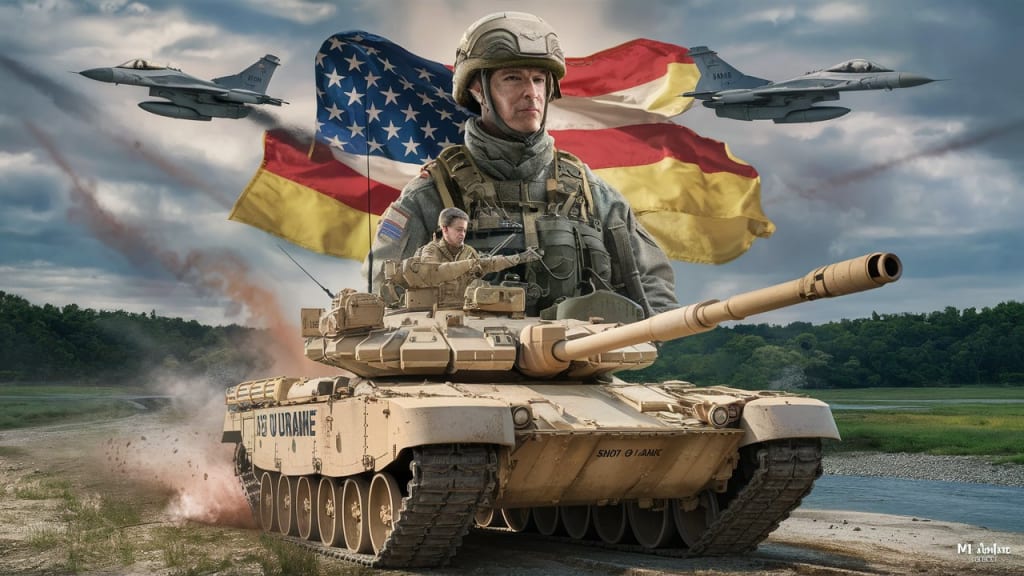
In a conflict that has captured global attention, the United States has emerged as a pivotal player in the Ukraine-Russia war, not through direct military intervention, but by supplying an unprecedented arsenal of weapons and equipment to Ukraine. Since Russia's invasion in 2022, America has poured a staggering $175 billion in aid into Ukraine, surpassing the cost of the first four years of U.S. troop deployment in Afghanistan. This massive investment in Ukraine's defense capabilities has transformed the battlefield and sparked a new era of weapons manufacturing and deployment.
The aid package from the United States encompasses a wide array of military hardware, each playing a crucial role in Ukraine's resistance against Russian aggression. At the forefront of infantry weapons is the Javelin anti-tank missile system. Costing over $200,000 per unit, the U.S. has sent at least 10,000 Javelins to Ukraine. These shoulder-mounted weapons have proven highly effective against Russian armor, allowing Ukrainian soldiers to engage and destroy tanks with minimal exposure to enemy fire.
In addition to offensive weaponry, the U.S. has prioritized the protection of Ukrainian troops. More than 100,000 sets of body armor and helmets have been dispatched, each set valued at around $1,000. This essential gear has undoubtedly saved countless Ukrainian lives as they face the brutal realities of modern warfare.
As the conflict evolved from urban combat to a war of attrition, artillery became a cornerstone of both offensive and defensive operations. The United States responded by ramping up production of 155mm artillery shells, a crucial ammunition type used in howitzers. American factories, some dating back to the War of 1812, have more than doubled their output to meet the demands of the Ukrainian front. These shells, capable of striking targets up to 20 miles away, have become the workhorses of Ukraine's long-range fire capabilities.
Perhaps the most iconic symbol of American military might supplied to Ukraine is the M1 Abrams tank. Nicknamed "The Beast," this main battle tank comes with a hefty price tag of up to $9 million each. The U.S. has committed 31 of these advanced tanks to Ukraine, representing a significant upgrade to their armored forces. With its superior armor, firepower, and mobility, the M1 Abrams offers Ukrainian forces a potent weapon against Russian armor.
The war in Ukraine has also highlighted the growing importance of unmanned aerial vehicles (UAVs) or drones in modern warfare. The United States has supplied Ukraine with various types of drones, including the Switchblade loitering munition. These "kamikaze drones" can loiter over a battlefield for up to 40 minutes before striking a target, providing a cost-effective solution for precision strikes. At around $6,000 per unit for the smaller Switchblade 300, these drones offer an asymmetric advantage against more expensive Russian equipment.
Air superiority remains a contested domain in the conflict, with neither side achieving complete dominance. To bolster Ukraine's air capabilities, the U.S. has committed to supplying 85 F-16 fighter jets. These multirole fighters, each costing between $14 and $18 million, represent a significant upgrade from Ukraine's aging Soviet-era aircraft. However, challenges remain in training enough Ukrainian pilots and maintaining these advanced jets in a war zone.
One of the most game-changing systems provided by the U.S. is the High Mobility Artillery Rocket System (HIMARS). This truck-mounted rocket launcher has proven highly effective in striking Russian supply lines, command centers, and ammunition depots far behind the front lines. With a range of up to 50 miles and pinpoint accuracy, HIMARS has forced Russian forces to adapt their tactics and push critical assets further from the battlefield.
The crown jewel of America's contribution to Ukraine's defense is the Patriot air defense system. Valued at $1 billion per battery, this sophisticated system can intercept aircraft, cruise missiles, and even some ballistic missiles. While only one Patriot system has been delivered so far, its impact has been significant in protecting key Ukrainian infrastructure from Russian air and missile attacks.
As the war enters its third year, the effectiveness of American weapons in Ukraine has not gone unnoticed by the international community. NATO allies have pledged additional support, including more Patriot systems and other advanced weaponry. This influx of Western military technology has not only helped Ukraine defend its territory but has also provided valuable real-world testing for these weapons systems.
However, the conflict remains far from resolution. Russia has adapted to the presence of advanced Western weapons, improving its air defenses and electronic warfare capabilities. The war has become a crucible for military innovation, with both sides constantly seeking new advantages.
The unprecedented level of U.S. military aid to Ukraine has raised questions about the sustainability of such support and its long-term implications for global arms proliferation. It has also sparked a renaissance in American weapons manufacturing, with factories working around the clock to meet demand.
As the arsenal of democracy continues to flow into Ukraine, the world watches closely. The outcome of this conflict may not only determine the fate of Ukraine but also shape the future of warfare and international relations for decades to come. The weapons forged in American factories are writing a new chapter in military history, one shell, drone, and missile at a time.
About the Creator
Reader insights
Nice work
Very well written. Keep up the good work!
Top insight
Expert insights and opinions
Arguments were carefully researched and presented
Keep reading
More stories from Next Koding and writers in History and other communities.
The Phantom Beneath: The Terrifying of China's Sunken Submarine
The confusion and mystery surrounding the supposed submarine disaster have fostered a climate of uncertainty and apprehension. The lack of confirmation from other nations, particularly those with significant naval intelligence such as the U.S., the U.K., and Japan, has only heightened the intrigue. These nations' silence could be interpreted in numerous ways—either they lack the required evidence to confirm the incident, or they are withholding information due to strategic considerations.
By Next Koding2 years ago in History
3 Ordinary Places That Hid Something Truly Disturbing for Years
Most of us take comfort in ordinary places. Schools feel safe. Homes feel familiar. Workplaces feel predictable. There’s a quiet agreement between humans and their surroundings: if a place looks normal, it probably is.
By Enoch Saginia day ago in History




Comments (2)
Two ''strange'' governments play with our minds and lives Things are worse than they look. I believe that they both, can not realize that we are on the edge. Or they don't care because they booked a ticket for an escape to ''Mars''.
Thanks for sharing